
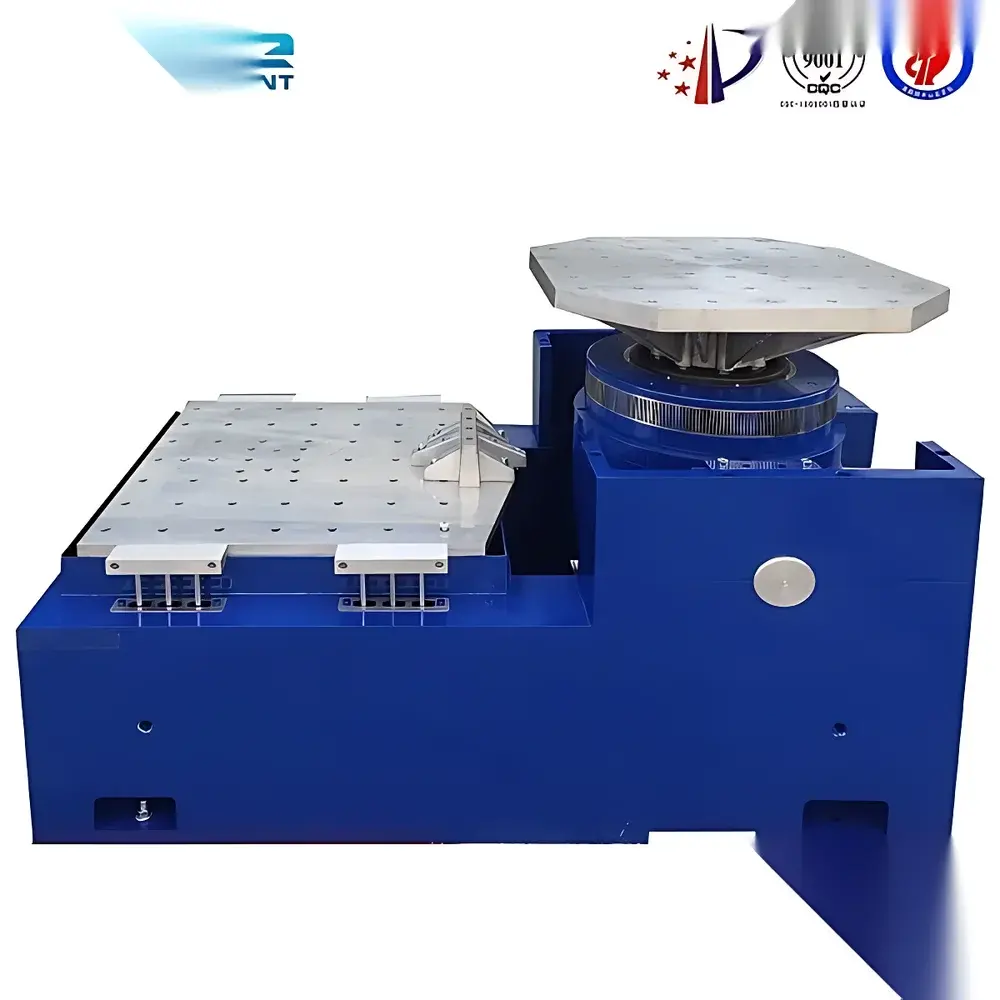
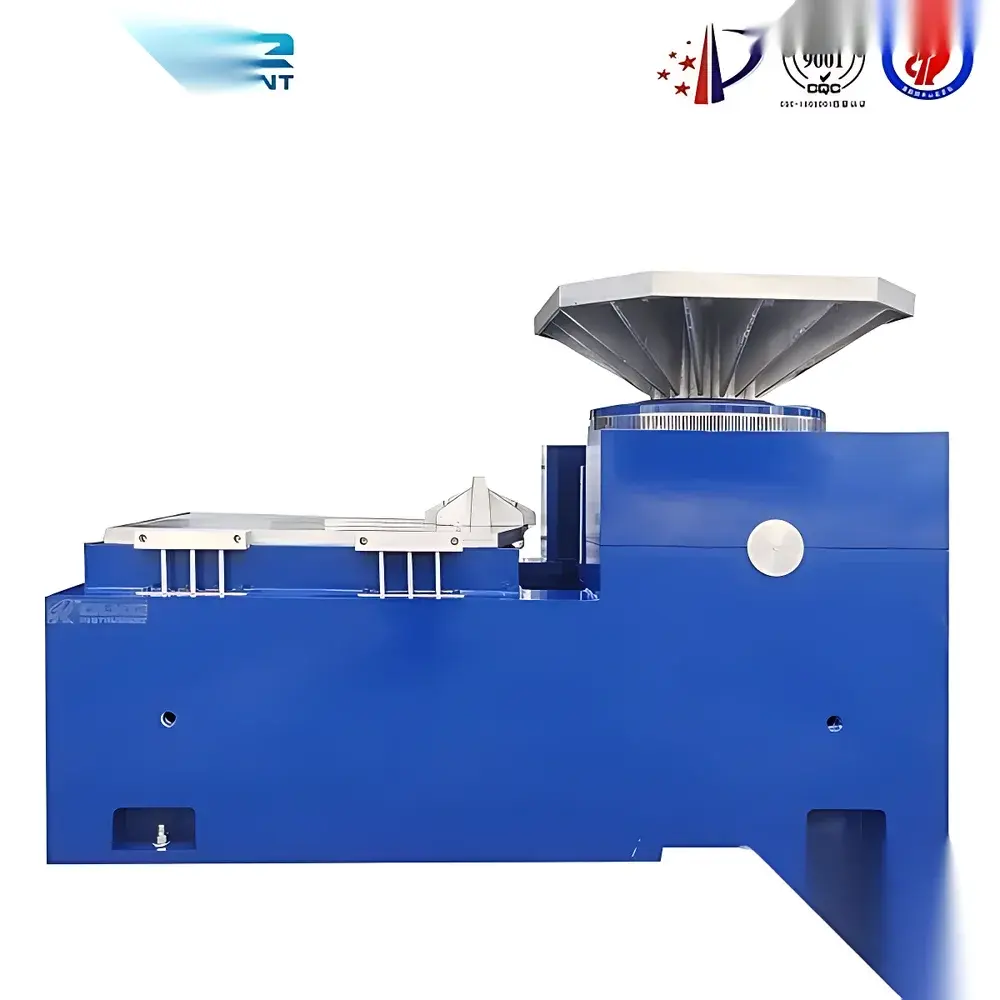
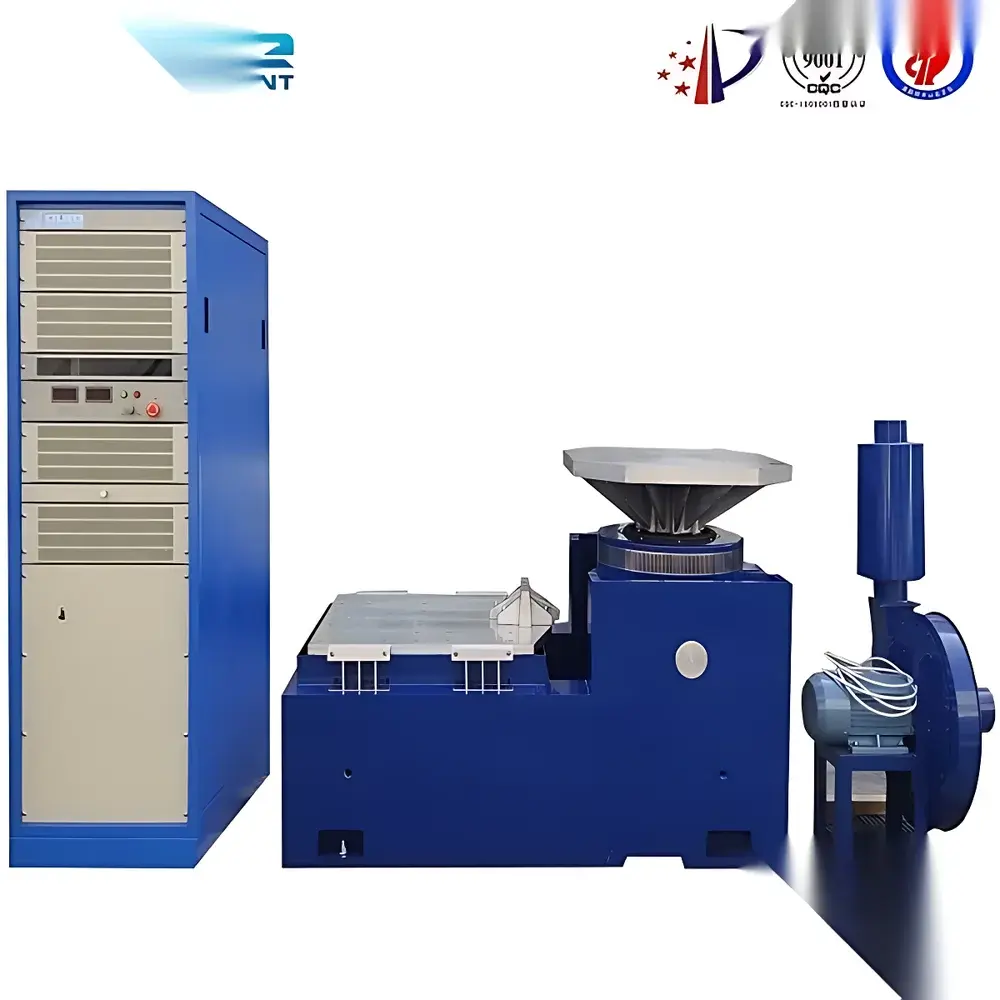
Generic-Brand DVTS-1000 Linear Reciprocating Vibration Shaker Test System
| Brand | Other Brands |
|---|---|
| Origin | Imported |
| Manufacturer Type | Authorized Distributor |
| Speed Range | 150–300 rpm |
| Speed Display Resolution | 0.1 rpm |
| Vibration Mode | Linear Reciprocating |
| Peak-to-Peak Amplitude | 25.4 mm |
| Load Capacity | 45.4 kg (100 lbs) |
| Effective Table Surface | 1.0 m × 1.0 m |
| Timing Range | 1 s to 99 h (or 0.1 s to 300 h) |
| Startup Delay | 0–15 s |
| Motor Power | 1 HP |
| Speed Control | DC or AC Variable-Frequency Drive |
| Supply Voltage | 220 V / 380 V, 50/60 Hz |
| Compliance | ISTA 3A, EN 71-1, ASTM D999 |
Overview
The DVTS-1000 Linear Reciprocating Vibration Shaker Test System is an engineered solution for controlled mechanical stress evaluation of shock-absorbing components—particularly hydraulic and elastomeric dampers—under simulated transportation, handling, and operational service conditions. Based on the principle of linear reciprocating motion driven by a precision-controlled motor coupled with low-backlash mechanical transmission, the system delivers repeatable, sinusoidal-like displacement profiles at selectable frequencies within the 150–300 rpm range. Its design prioritizes metrological stability and operational safety in non-dedicated lab environments: the rigid welded steel base frame, integrated anti-vibration elastomeric mounts, and synchronous toothed-belt drive collectively suppress structural resonance and airborne noise (<58 dB(A) at 1 m), enabling installation in office buildings, shared R&D labs, and QC facilities without requiring reinforced flooring or anchoring. The system operates within ISO 16750-3 (road vehicle vibration environments) and aligns with the mechanical input profiles specified in MIL-STD-810H Method 514.7 for preliminary durability screening.
Key Features
- Linear reciprocating vibration mechanism with fixed 25.4 mm peak-to-peak amplitude—calibrated to meet ISTA 3A and EN 71-1 transport simulation requirements
- Dual-range digital timer with programmable resolution: high-precision mode (0.1 s increments up to 300 h) and standard mode (1 s increments up to 99 h)
- Modular rail-guided sample mounting system enabling rapid, repeatable fixture alignment and secure clamping without tools
- DC motor drive option ensures consistent torque delivery across load variations; AC variable-frequency drive variant offers extended low-speed stability
- Self-contained control panel with LED-based rpm and elapsed time display—no external PC required for basic operation
- Heavy-duty C-channel base structure with pre-compressed rubber isolation pads eliminates need for floor anchoring or concrete foundations
- Low-noise synchronous belt transmission reduces harmonic distortion and bearing wear over extended test cycles
Sample Compatibility & Compliance
The DVTS-1000 accommodates damper assemblies up to 45.4 kg (100 lbs) mounted directly on its 1.0 m × 1.0 m stainless-steel test surface. Fixture adaptability supports vertical, horizontal, and angled mounting configurations via standardized T-slot patterns (M6 spacing). The system’s vibration profile satisfies mechanical stress validation requirements for automotive suspension components per SAE J1211 and aerospace shock absorber qualification per RTCA DO-160 Section 8 (Vibration). It also supports early-life failure detection protocols aligned with IEC 60068-2-6 for electronic subassemblies integrated into damping systems. All electrical components comply with CE marking directives (EMC Directive 2014/30/EU and Low Voltage Directive 2014/35/EU); documentation includes traceable calibration certificates for speed and timing functions.
Software & Data Management
While standalone operation is fully functional via front-panel controls, optional RS-232/USB interface enables integration with third-party data acquisition platforms (e.g., LabVIEW, MATLAB, or custom Python scripts) for automated test sequencing and timestamped parameter logging. The firmware supports configurable pass/fail thresholds based on runtime or cumulative cycle count, generating CSV-formatted audit trails compliant with GLP and internal QA record retention policies. Though not natively 21 CFR Part 11–certified, the system’s deterministic behavior and non-volatile parameter storage facilitate validation under FDA-regulated environments when deployed with validated software layers and procedural controls.
Applications
This shaker system serves as a primary tool for durability benchmarking of passive and semi-active dampers used in passenger vehicles, commercial trucks, railway bogies, and industrial machinery. Typical use cases include: fatigue life assessment of piston rod seals under cyclic compression-tension loading; verification of damping force consistency after 10⁴+ cycles; validation of mounting bracket integrity during multi-axis correlated road-simulation pre-tests; and accelerated aging of polymer bushings under thermal-vibration coupling (when paired with environmental chambers). It is routinely employed by Tier-1 suppliers for PPAP submissions and by university tribology labs for fundamental viscoelastic characterization of novel damping materials.
FAQ
Does the DVTS-1000 support sine, random, or shock vibration profiles?
No—the system is mechanically configured exclusively for fixed-amplitude linear reciprocating motion. It does not generate true sinusoidal, Gaussian random, or transient shock waveforms. For those profiles, a servo-hydraulic or electrodynamic shaker platform is required.
Can the table surface be customized with threaded inserts or vacuum ports?
Yes—custom machining of the stainless-steel top plate (including M6/M8 tapped holes, dowel pin holes, or vacuum grooves) is available upon request with lead-time extension.
Is calibration certification included with shipment?
A factory-issued calibration report covering speed accuracy (±0.3 rpm) and timer drift (<±0.05% over 24 h) is provided. NIST-traceable recalibration services are offered annually.
What maintenance intervals are recommended?
Belt tension verification every 500 operating hours; lubrication of linear guide rails every 1,000 hours; motor brush inspection (DC version) every 2,000 hours.
Is remote monitoring or Ethernet connectivity supported?
Not by default—but the RS-232 port can be bridged to Ethernet using industry-standard protocol converters (e.g., MOXA NPort), enabling integration into plant-wide SCADA networks.



