
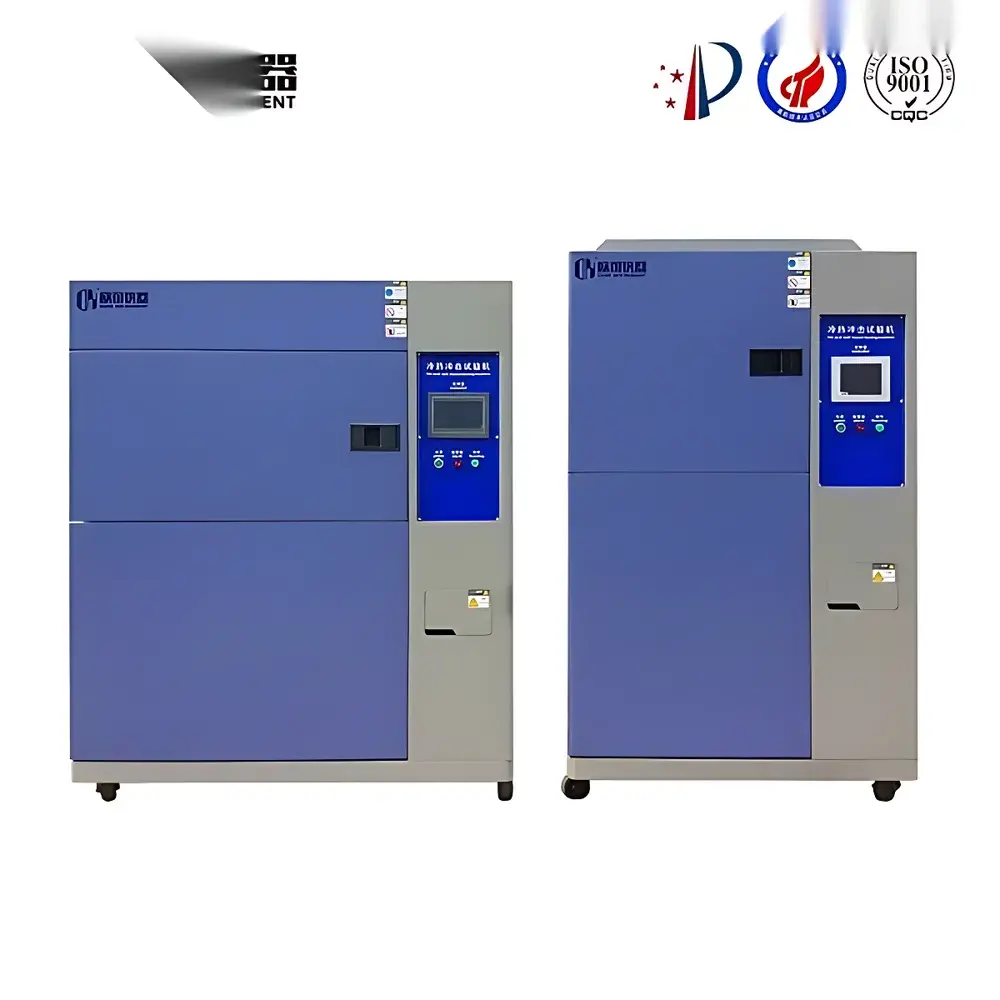
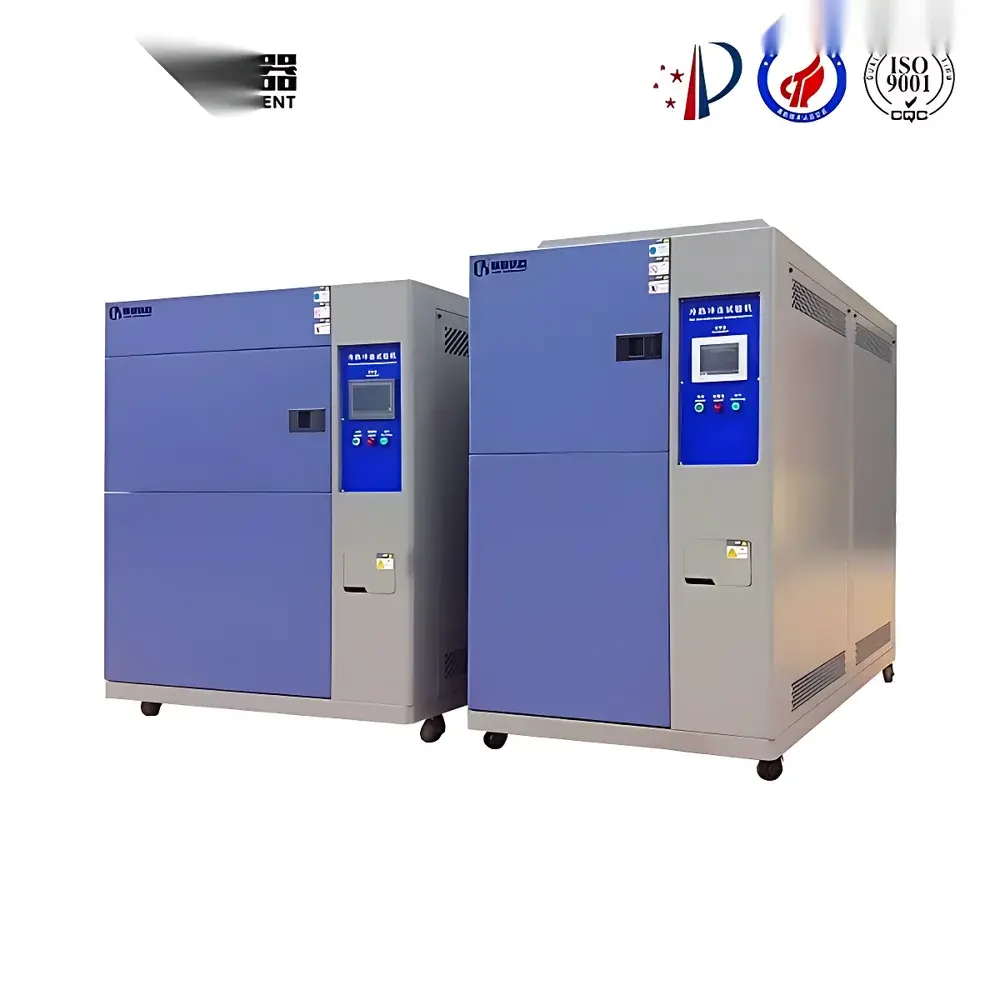
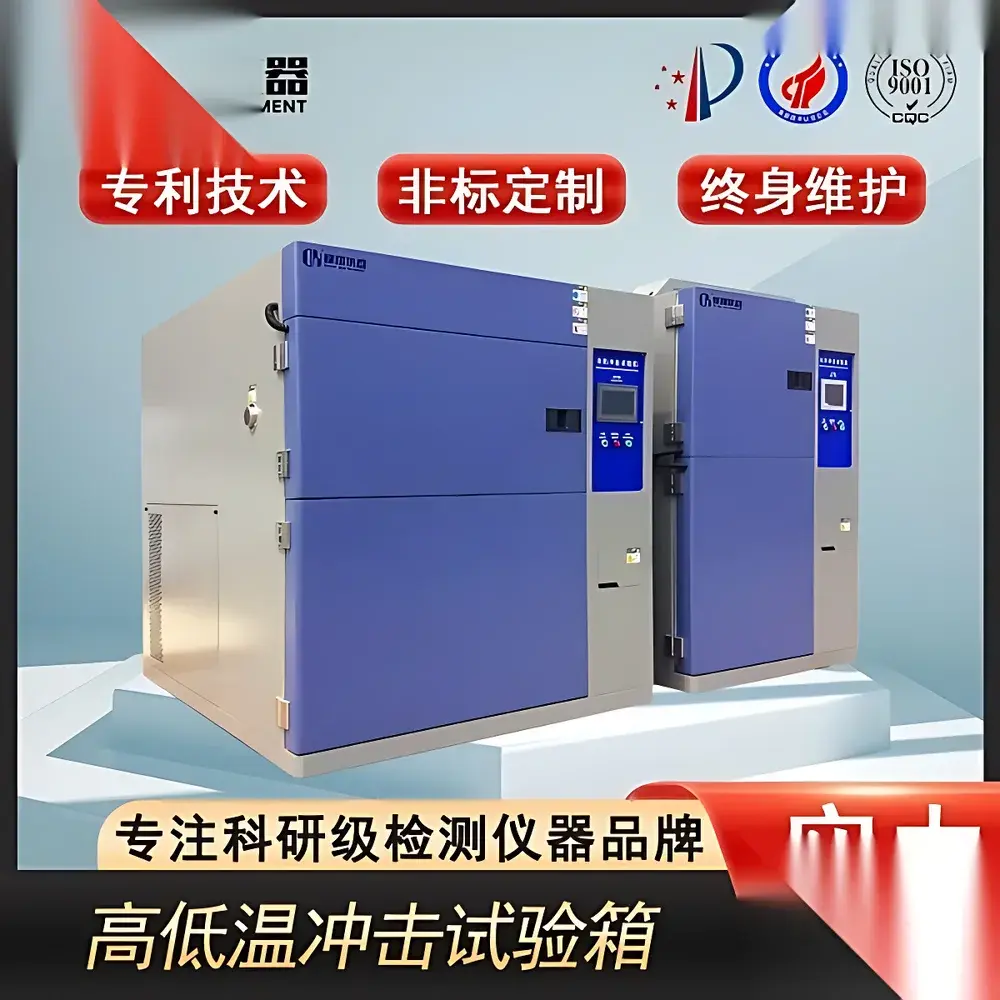
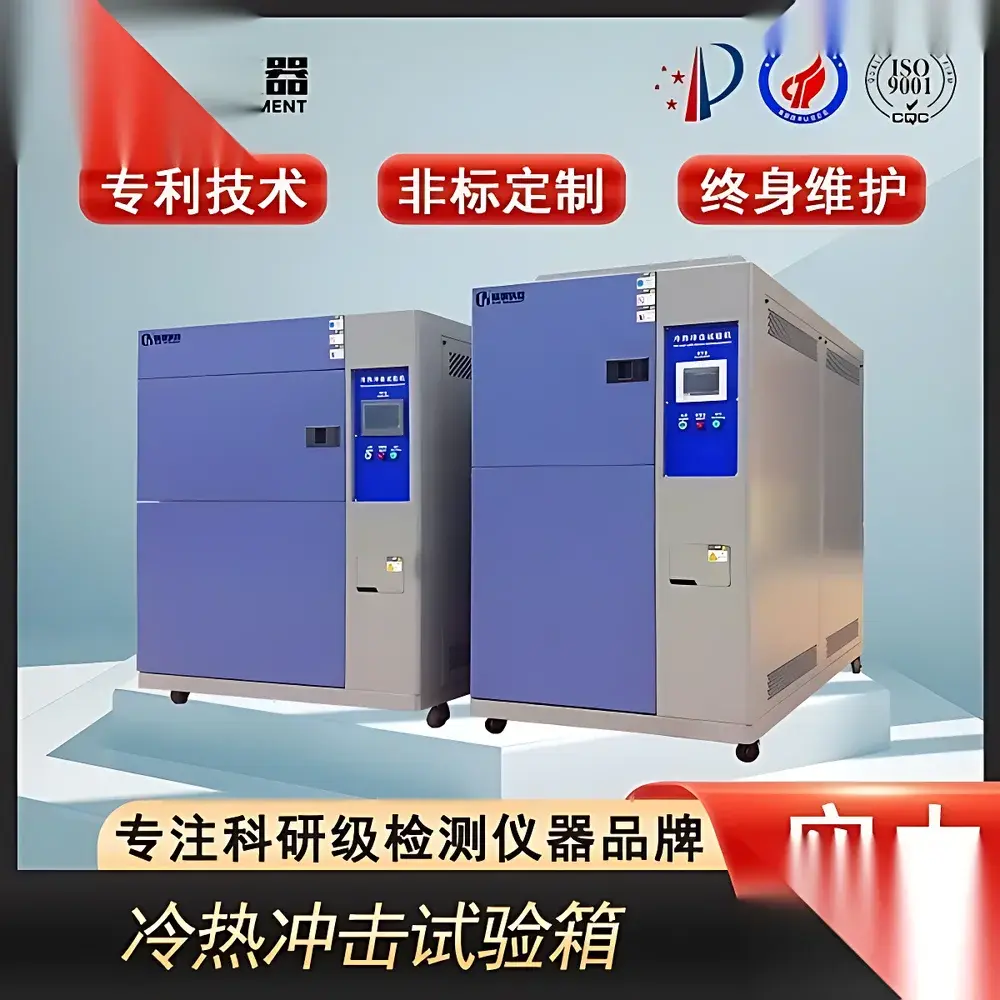
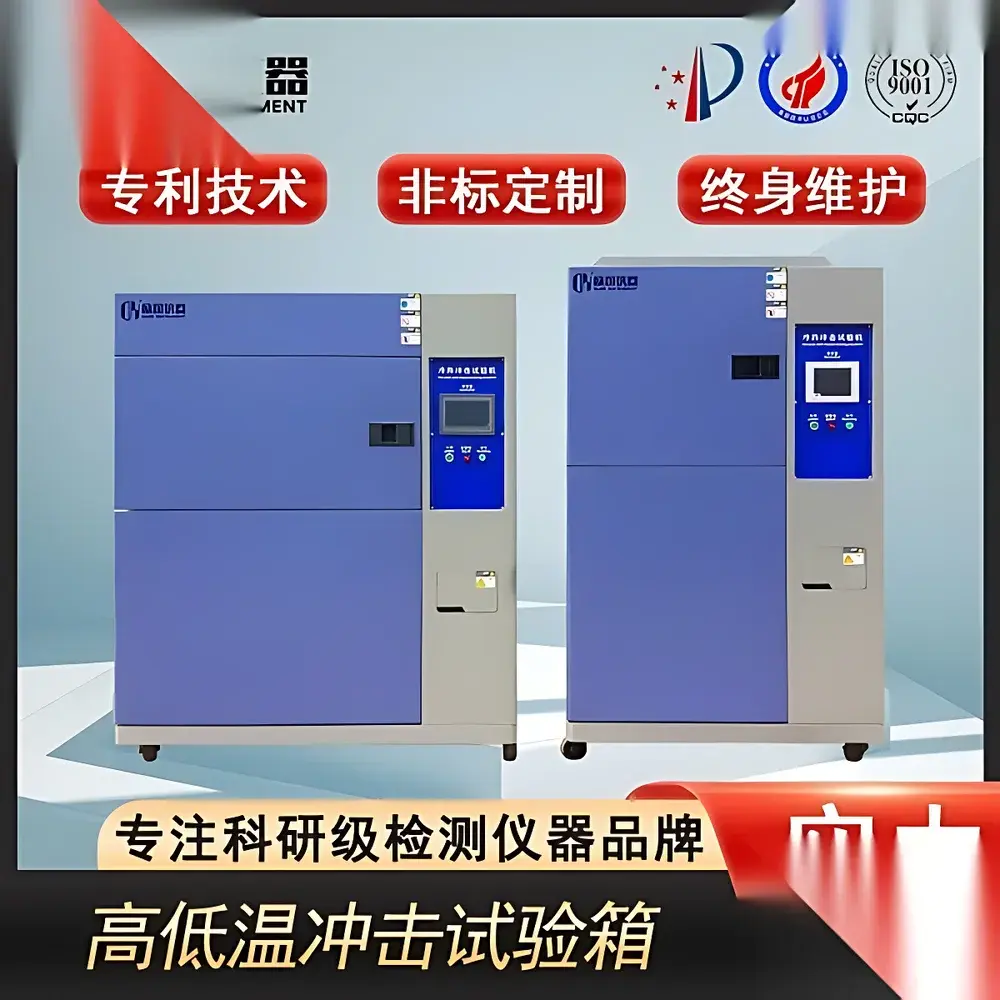
Thermal Shock Test Chamber – Dual- or Tri-Zone Configuration
| Brand | Other Brands |
|---|---|
| Origin | Imported |
| Manufacturer Type | Authorized Distributor |
| Price | USD 11,200 (FOB) |
| Cooling System | Dual-Stage Cascade Refrigeration with German Semi-Hermetic Compressors |
| Cooling Water Requirement | 10 m³/h External Cooling Tower |
| Temperature Range | −65°C to +200°C |
| Transition Time (Typical) | ≤15 s between Chambers |
| Compliance | IEC 60068-2-14 (Test N), MIL-STD-810G Method 503.5, GJB 150.5A-2009, GB/T 2423.22-2012, QC/T 17-1992, EIA-364-32 |
Overview
The Thermal Shock Test Chamber is an engineered environmental stress screening (ESS) system designed to evaluate material and component reliability under rapid, extreme temperature transitions. It operates on the principle of thermal shock—subjecting test specimens to abrupt shifts between high- and low-temperature environments to accelerate failure mechanisms such as interfacial delamination, solder joint fatigue, coating cracking, and coefficient-of-thermal-expansion (CTE) mismatch-induced stress. Available in dual-zone (hot/cold chambers with specimen transfer via motorized basket) and tri-zone (separate hot chamber, cold chamber, and test chamber with static specimen placement) configurations, the system enables precise control over dwell time, transition rate, and cycle count per test profile. Its core architecture supports both qualification-level testing per military and automotive standards and process validation in production environments.
Key Features
- Dual-stage cascade refrigeration system utilizing imported German semi-hermetic compressors for stable operation down to −65°C and up to +200°C;
- Energy-regulated cooling capacity control to maintain consistent thermal ramp rates while minimizing compressor cycling and power consumption;
- Motor-driven insulated transfer basket (dual-zone model) or independent chamber isolation with pneumatic door actuators (tri-zone model);
- Stainless-steel interior construction with non-contaminating insulation and condensate management system;
- Real-time monitoring of chamber temperature uniformity (±0.5°C) and stability (±0.3°C) per IEC 60068-3-5;
- Integrated safety interlocks including over-temperature protection, refrigerant pressure monitoring, and emergency stop circuitry compliant with IEC 61000-6-2/6-4;
- Optional LN₂ assist for sub-zero acceleration (<−70°C) and extended low-temperature hold capability.
Sample Compatibility & Compliance
This chamber accommodates a wide range of physical samples—from printed circuit board assemblies (PCBAs), automotive ECUs, and aerospace avionics modules to polymer housings, optical lenses, and battery packs—without requiring modification to mounting fixtures. Specimen volume constraints are defined by internal chamber dimensions (customizable from 150 L to 1000 L). The system is validated to meet critical international test standards including IEC 60068-2-14 (Test N: Change of Temperature), MIL-STD-810G Method 503.5 (Temperature Shock), GJB 150.5A-2009 (China National Military Standard), GB/T 2423.22-2012 (Chinese national standard for temperature change), QC/T 17-1992 (Automotive component environmental testing), and EIA-364-32 (Connector thermal shock evaluation). All calibration and verification procedures follow ISO/IEC 17025 traceable protocols, with optional GLP-compliant audit trails available upon request.
Software & Data Management
Equipped with a Windows-based controller running proprietary test sequencing software, the chamber supports fully programmable profiles with up to 999 segments, user-defined dwell times, ramp rates (0.5–15°C/min), and automatic cycle repetition. Data logging records temperature at ≥1 Hz resolution across all zones, with timestamped CSV export and configurable alarm thresholds. Optional 21 CFR Part 11 compliance package includes electronic signatures, role-based access control, and immutable audit logs for regulated industries. Remote monitoring and diagnostics are enabled via Ethernet (Modbus TCP/IP) or optional cellular gateway for off-site fleet management.
Applications
- Qualification testing of electronic components per AEC-Q200 and JEDEC JESD22-A106;
- Validation of adhesive bond integrity in multi-material assemblies;
- Accelerated life testing of lithium-ion battery modules under thermal cycling stress;
- Reliability assessment of MEMS devices and optoelectronic packages;
- Process window definition for reflow soldering and conformal coating curing;
- Failure analysis root cause identification in field-return investigations;
- Design verification for harsh-environment sensors used in aviation and oilfield instrumentation.
FAQ
What is the difference between dual-zone and tri-zone thermal shock configurations?
Dual-zone systems use one hot and one cold chamber with mechanical transfer of the specimen; tri-zone systems isolate the test specimen in a neutral chamber and move air or heat exchangers—reducing mechanical stress on samples and enabling higher repeatability.
Is external cooling water mandatory?
Yes. The dual-stage cascade refrigeration system requires a dedicated 10 m³/h closed-loop cooling tower with stable inlet water temperature ≤32°C for sustained operation below −40°C.
Can this chamber be integrated into an automated test line?
Yes. Standard digital I/O and Modbus TCP interfaces support integration with MES, SCADA, or robotic handling systems for unattended batch processing.
Does the system support custom test profiles beyond published standards?
Yes. Users may define arbitrary temperature vs. time sequences—including hold-ramp-hold cycles, step transitions, and conditional branching based on real-time sensor feedback.
What maintenance is required for long-term reliability?
Quarterly refrigerant pressure checks, annual compressor oil analysis, biannual calibration of PT100 sensors, and routine inspection of door gaskets and basket drive belts per manufacturer’s service schedule.



