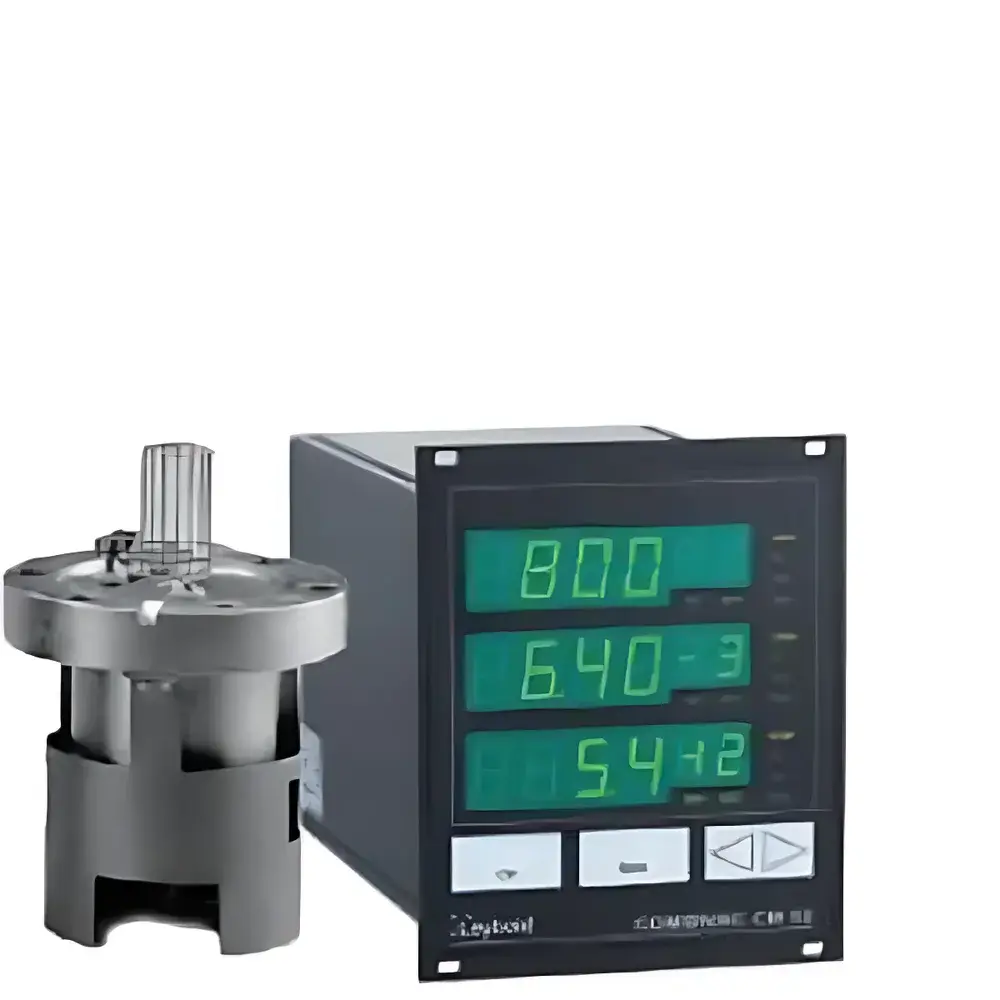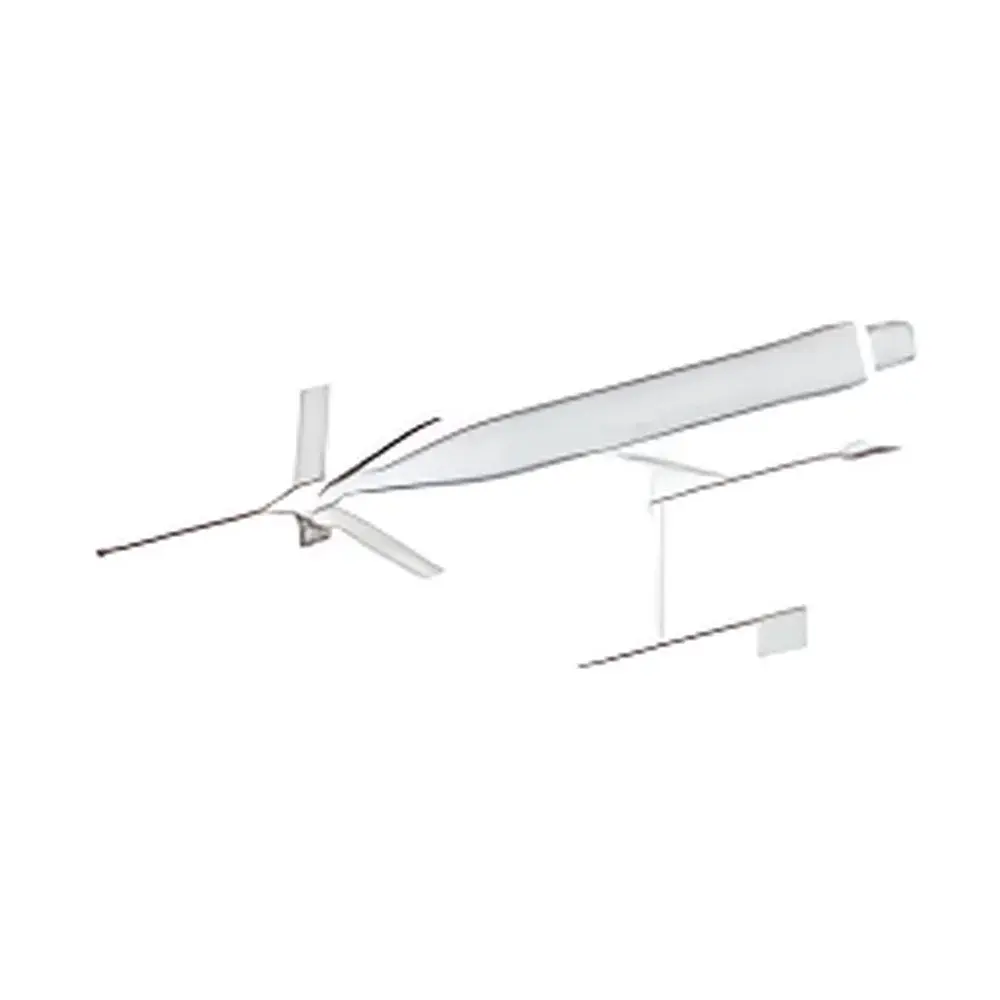
Rotating-Head Atmospheric Airspeed Probe YK100510
| Brand | — |
|---|---|
| Origin | Beijing, China |
| Manufacturer Type | General Distributor |
| Model | YK100510 |
| Pricing | Upon Request |
Overview
The YK100510 Rotating-Head Atmospheric Airspeed Probe is a precision-engineered aerodynamic sensor system designed for real-time measurement of total pressure, static pressure, angle of attack (AOA), and angle of sideslip (AOS) in dynamic flight environments. Based on the proven rotating-head (or “vane-type”) pitot-static architecture, it integrates coaxial pressure ports with angular position sensing to resolve flow directionality while maintaining classical pitot-static airspeed derivation. Unlike fixed-head probes, the rotating head dynamically aligns with the local airflow vector, minimizing stagnation error and improving accuracy under high-angle or unsteady flow conditions—particularly critical during low-speed, high-AOA maneuvers typical of rotary-wing and STOVL (Short Take-Off and Vertical Landing) aircraft operations. The probe is calibrated to a nominal maximum equivalent airspeed of 500 knots (257 m/s) at sea-level ISA conditions, with traceable calibration documentation available upon request.
Key Features
- Integrated rotating-head design with dual-axis angular position sensing for simultaneous AOA and AOS output
- Coaxial total pressure and static pressure ports machined into the rotating assembly for minimal flow disturbance
- Standard analog voltage outputs (±5 V or 0–10 V) for total pressure, static pressure, AOA, and AOS—fully compatible with avionics data acquisition units and flight test recorders
- Compact cylindrical form factor: 28 in (711 mm) length × 8 in (203 mm) outer diameter; mass: 41 oz (1.16 kg)
- Unheated pressure ports—intended for operation within ambient temperature ranges typical of subsonic flight envelopes (−40 °C to +70 °C)
- Robust aluminum alloy housing with anodized surface finish for corrosion resistance and EMI shielding
- Designed for flush or semi-flush mounting on fuselage or wing surfaces; mounting interface compliant with MIL-STD-810G mechanical vibration and shock requirements
Sample Compatibility & Compliance
The YK100510 is optimized for integration into rotorcraft (e.g., utility and attack helicopters) and VTOL/STOVL platforms where rapid changes in attitude, translational velocity, and localized flow separation challenge conventional fixed-head probes. Its rotating mechanism enables stable measurements at AOA up to ±45° and AOS up to ±30°, with hysteresis < ±0.5° under cyclic loading. While not certified to DO-160 or TSO-C145a out-of-the-box, the probe’s mechanical and electrical interfaces support integration into systems meeting RTCA DO-160G Section 21 (lightning-induced transient susceptibility) and Section 22 (induced signal susceptibility) when paired with appropriate conditioning electronics. Calibration certificates follow ISO/IEC 17025 principles, with uncertainty budgets traceable to NIM (National Institute of Metrology, China). For GMP/GLP-aligned flight test programs, full audit trails—including calibration date, environmental conditions, and reference standard IDs—are provided in digital format.
Software & Data Management
The YK100510 operates as a standalone analog transducer and does not include embedded firmware or onboard processing. Output signals are intended for acquisition via external DAQ systems supporting 16-bit resolution and ≥1 kHz sampling rate per channel. Compatible with industry-standard platforms including National Instruments PXI, Dewesoft X, and Siemens DesiLab. ACIS-format CAD models (provided upon order confirmation) enable precise mechanical integration and CFD meshing for installation effect analysis. All delivered documentation includes dimensional drawings (GD&T annotated), pressure port centerline offsets, and electrical pinout schematics—formatted for import into CATIA V5, SolidWorks, and NX. No proprietary drivers or closed-source software dependencies are required.
Applications
- Flight test instrumentation for helicopter performance envelope expansion (hover, transition, autorotation)
- Real-time feedback for fly-by-wire control law validation in STOVL demonstrators
- Wind tunnel testing of VTOL ducted-fan configurations and tiltrotor aerodynamics
- Ground-based aerodynamic characterization of UAV airframes with high-lift devices
- Integration into research-grade flight simulators requiring high-fidelity AOA/AOS dynamics
- Post-flight reconstruction of aerodynamic coefficients (CL, CD, Cm) using synchronized pressure and inertial data
FAQ
Is the YK100510 suitable for supersonic applications?
No. It is rated for subsonic operation only, with calibration validated up to Mach 0.83 at sea level. Shock wave interaction with the rotating head would compromise pressure recovery and angular resolution.
Can the probe be modified for heated pressure ports?
Not as a standard configuration. Heater integration requires redesign of the internal thermal path and validation against ice accretion standards (e.g., FAA AC 20-113). Custom engineering support is available under NDA.
What is the recommended recalibration interval?
Annual recalibration is advised for flight-critical deployments; biennial intervals may be justified for ground-test-only use with documented environmental exposure logs.
Does the probe meet MIL-STD-461E for EMI emissions?
The bare probe itself is passive and emits no RF energy. System-level EMI compliance depends on cabling, shielding, and signal conditioning—full test reports available upon request for integrated configurations.
Are digital output options (e.g., ARINC 429, CAN bus) available?
Not natively. Analog outputs are standard. Digital interface modules can be supplied as ancillary hardware with custom firmware mapping per customer protocol specifications.