
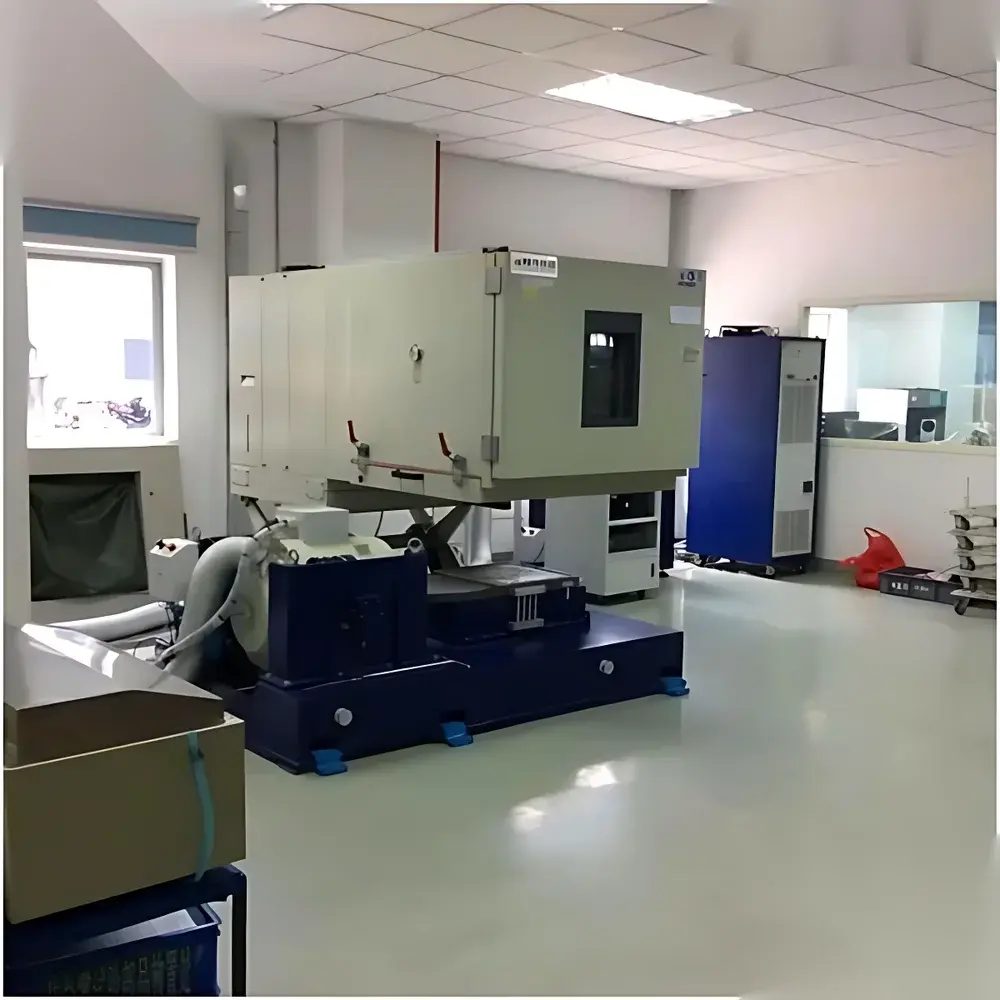
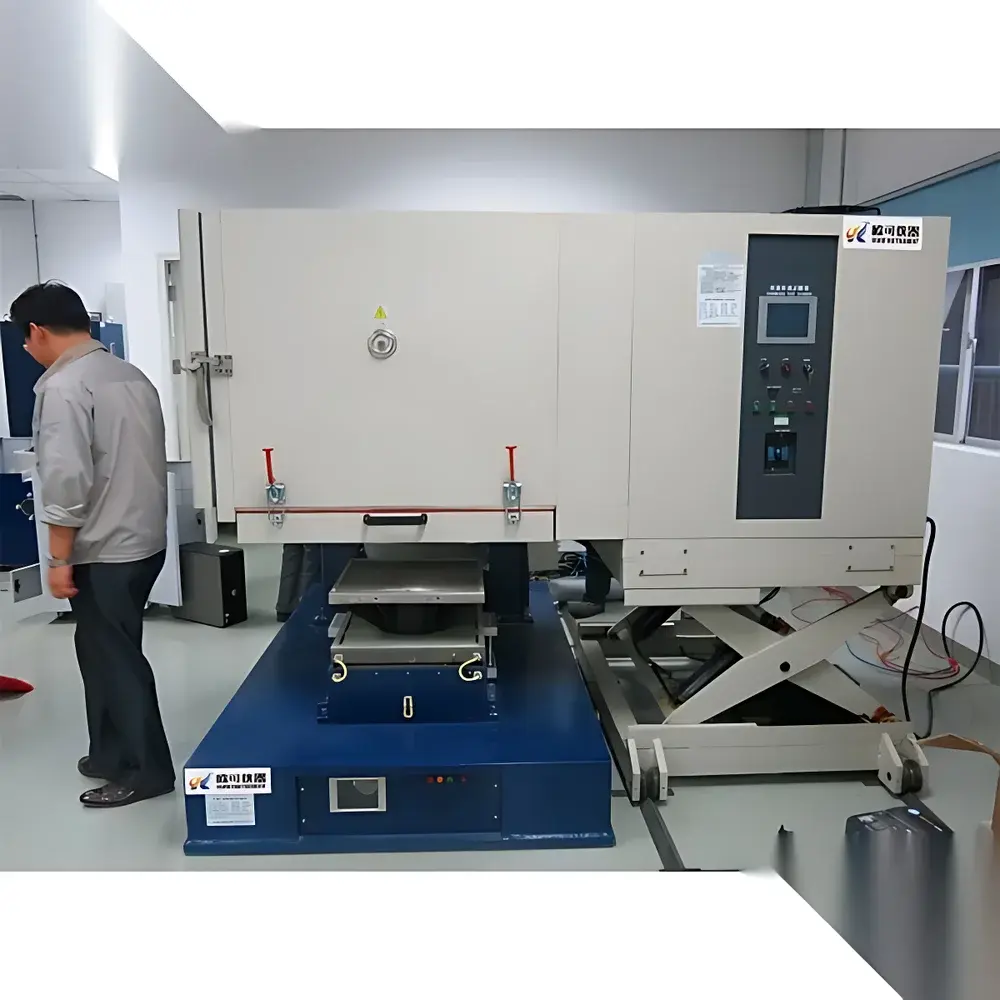
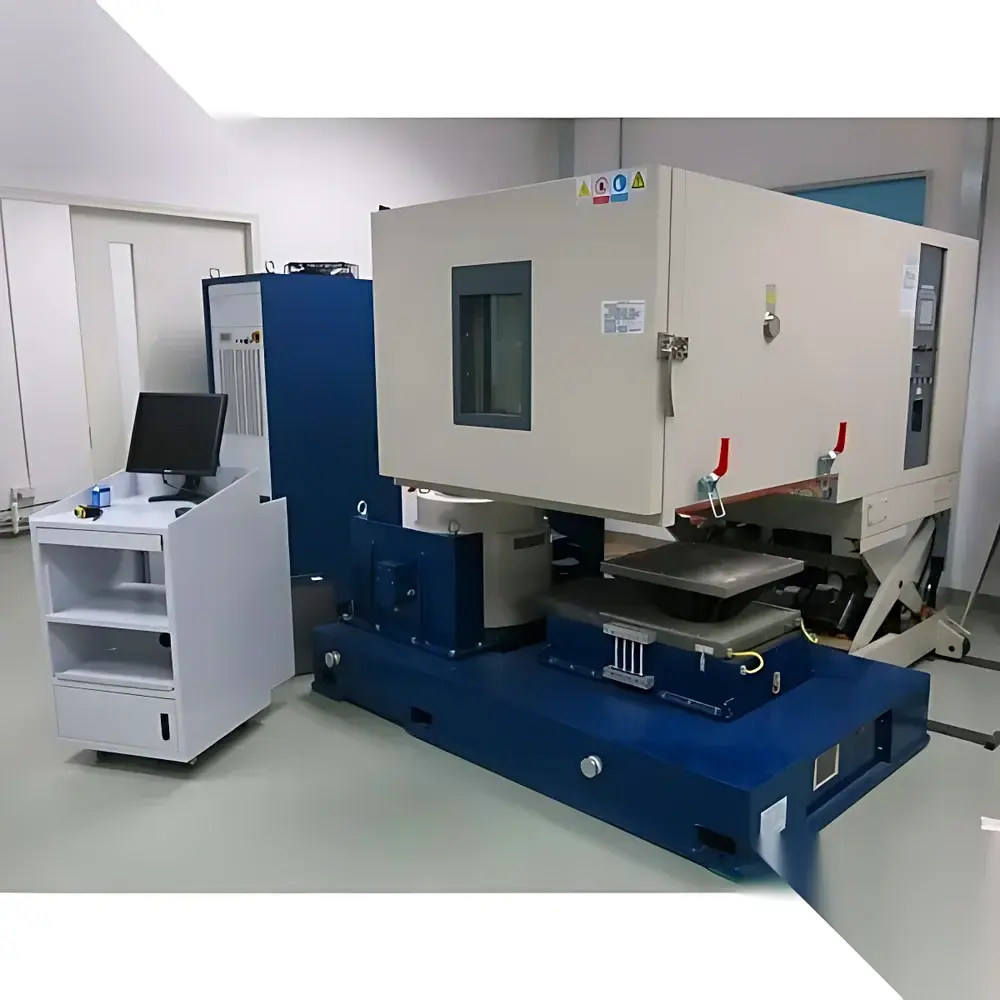
EOKE Combined Temperature, Humidity, and Vibration Test Chamber
| Brand | OEM / Custom Brand |
|---|---|
| Origin | Imported |
| Manufacturer Type | Authorized Distributor |
| Temperature Range | -20°C to 150°C / -40°C to 150°C / -60°C to 150°C |
| Temperature Uniformity | ≤ ±2°C |
| Temperature Fluctuation | ±0.5°C |
| Temperature Deviation | ≤ ±2°C |
| Ramp Rate | 0.7–1.0°C/min |
| Time Setting Range | 0–9999 h |
| Sinusoidal Force Capacity | 2.94 kN (300 kgf) |
| Frequency Range | 5–500 Hz |
| Maximum Acceleration | 980 m/s² (100 g) |
| Maximum Velocity | 1.1 m/s |
| Peak-to-Peak Displacement | 25 mm |
| Moving Mass | 2.7 kg |
| Maximum Payload | 120 kg |
| Table Surface Dimensions | 150 mm × 150 mm |
| Vibration Axis | Vertical (Z-axis only) |
| Power Supply | AC 380 V (±10%), 50 Hz, 3-phase 5-wire |
Overview
The EOKE Combined Temperature, Humidity, and Vibration Test Chamber is an integrated environmental simulation system engineered for concurrent or sequential exposure of test specimens to controlled thermal profiles and mechanical vibration stress. It operates on the principle of coupled environmental stress screening (ESS), enabling accelerated reliability validation under realistic field conditions—particularly critical for aerospace components, automotive electronics, medical devices, and high-reliability PCB assemblies. Unlike single-stress chambers, this triaxial-capable (temperature/humidity/vibration) platform supports synchronized operation of independent climate and shaker subsystems, with full isolation between thermal chamber integrity and dynamic excitation mechanics. The chamber’s structural architecture features a dual-compartment design: a thermally insulated test workspace and a mechanically decoupled electrodynamic shaker assembly mounted on precision linear rails for in-situ insertion and retraction—ensuring zero interference during non-vibration thermal cycling tests.
Key Features
- Modular rail-mounted vibration table enables rapid deployment and physical isolation: the 150 mm × 150 mm stainless steel table slides fully into the chamber base during vibration testing and retracts externally when only thermal/humidity conditioning is required.
- Multi-layer sealing interface between shaker table and chamber floor: alternating layers of high-temperature silicone rubber and epoxy resin ensure hermetic integrity across -60°C to +150°C operational extremes while maintaining low dynamic impedance.
- Thermal chamber construction: A3 carbon steel outer shell with electrostatic powder coating; SUS304 brushed stainless steel interior lining; high-density ultra-fine glass wool insulation (≥100 mm thickness) for thermal stability and low energy consumption.
- Forced-air circulation system: Top-mounted low-noise Xiangming centrifugal blower with multi-wing impeller; bottom return air ducting; unidirectional airflow path optimized for uniform temperature distribution (≤ ±2°C uniformity per IEC 60068-3-5).
- Observation window: Triple-layer tempered safety glass with embedded conductive ITO film for anti-fogging and electromagnetic shielding—enabling real-time optical monitoring without compromising chamber seal or EMI performance.
- Dual-independent control architecture: Separate PID controllers for climate (temperature/humidity) and vibration (acceleration/frequency/displacement) subsystems, each with dedicated safety interlocks and hardware-based emergency stop circuits.
Sample Compatibility & Compliance
This test chamber accommodates specimens up to 120 kg mass and 2.7 kg moving mass, supporting standard MIL-STD-810H, RTCA DO-160G Section 8 (vibration), and IEC 60068-2-6/2-14/2-30 test protocols. Its vertical-only (Z-axis) excitation mode meets ASTM D4728 for random vibration qualification of packaged goods and IPC-9701A for printed circuit board solder joint fatigue assessment. Optional humidity control (not specified in base configuration but available as upgrade) extends compliance to IEC 60068-2-30 damp heat cyclic testing. All electrical interfaces—including the 50 mm diameter feedthrough port on the left chamber wall—are designed to maintain IP54-rated ingress protection during operation. Structural mounting points conform to ISO 5344 and DIN 45673-2 for auxiliary sensor integration.
Software & Data Management
The system integrates with EOKE’s proprietary E-TestSuite™ software suite (Windows-based, 64-bit), supporting real-time synchronized acquisition of temperature, humidity, acceleration, velocity, displacement, and drive voltage signals at up to 20 kHz sampling rate. Data logging complies with FDA 21 CFR Part 11 requirements via electronic signatures, audit trails, and role-based user access control. Test profiles can be imported from CSV or defined graphically using step, ramp, dwell, and random PSD templates. Export formats include CSV, MATLAB .mat, and universal UFF58 binary for post-processing in LMS Test.Lab, Siemens Simcenter, or MATLAB Signal Processing Toolbox. All firmware and controller logs are timestamped with NTP-synchronized UTC clocks and stored redundantly on internal SSD and external NAS.
Applications
- Accelerated life testing of avionics enclosures subjected to launch-phase thermal gradients and acoustic vibration spectra.
- Qualification of automotive ADAS sensors (radar, LiDAR) under combined thermal shock (-40°C ↔ +125°C) and road-simulated vibration (5–200 Hz random PSD).
- Reliability screening of implantable medical device housings per ISO 14971 risk management requirements, including vibration-induced microcrack propagation analysis.
- Validation of battery module thermal runaway containment systems under simultaneous thermal abuse and mechanical shock loading.
- Materials science research on polymer composite creep behavior under sustained vibration and elevated temperature (up to 150°C).
FAQ
Can the vibration table be operated independently of the thermal chamber?
Yes—the shaker assembly is fully decoupled and may be used standalone with external signal generators and power amplifiers.
Is humidity control included in this base configuration?
No; humidity capability requires optional humidification/dehumidification module (EOKE-HUM-1500 series) and associated dew point sensor calibration.
What safety certifications does the system hold?
The chamber conforms to CE (EMC Directive 2014/30/EU and Low Voltage Directive 2014/35/EU), UL 61010-1, and IEC 61000-6-2/6-3 for industrial environment immunity and emissions.
How is traceability maintained for calibration records?
All transducers (PT100 temperature probes, IEPE accelerometers, capacitive humidity sensors) are supplied with NIST-traceable calibration certificates; recalibration intervals follow ISO/IEC 17025 guidelines.
Is remote monitoring supported over Ethernet or industrial protocols?
Yes—Modbus TCP and OPC UA server interfaces are standard; optional MQTT gateway enables integration into cloud-based IIoT platforms such as Azure IoT Hub or AWS IoT Core.
Related Products



