
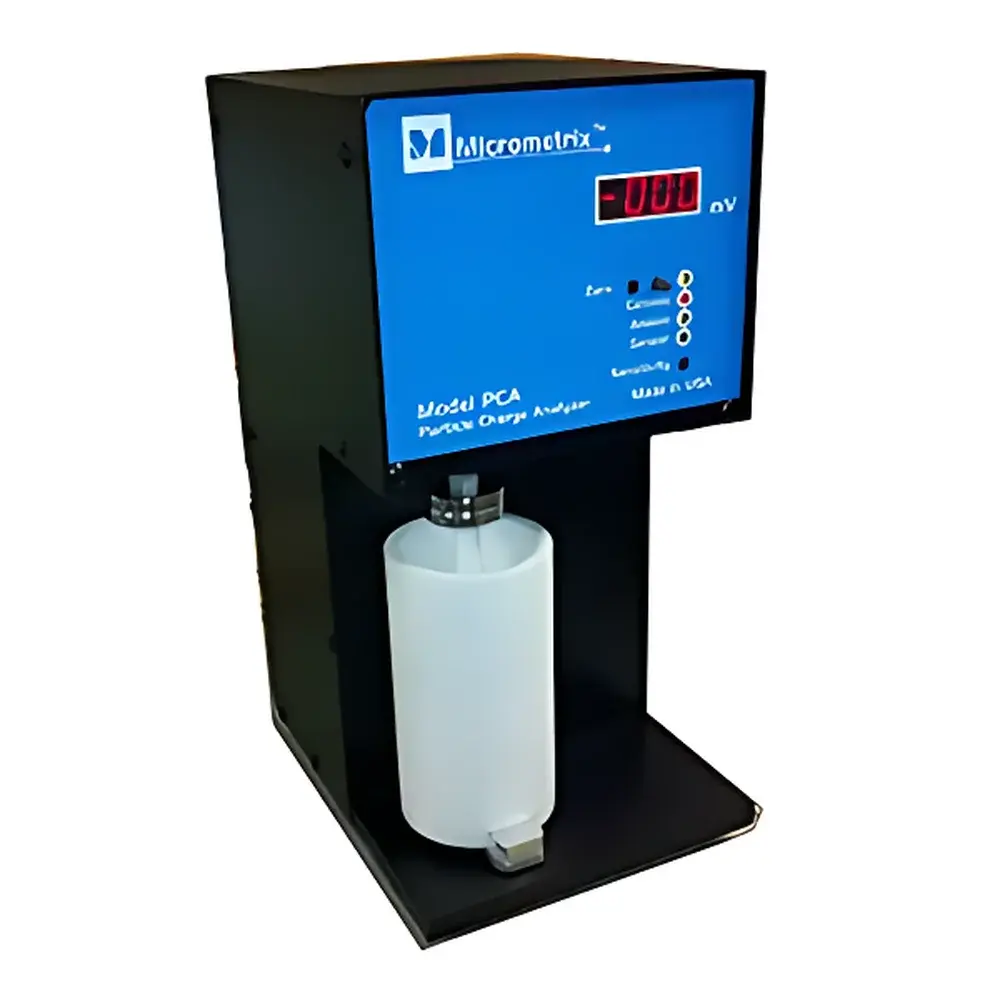
PCA Particle Charge Analyzer
| Origin | USA |
|---|---|
| Manufacturer Type | Authorized Distributor |
| Origin Category | Imported |
| Model | PCA |
| Price Range | USD 700 – 10,000 |
| Instrument Type | Universal Potentiometric Titrator |
| Application Scope | General-Purpose |
| Measurement Range | −1000 to +1000 mV |
| Meter Accuracy | ±0.1% of full scale |
| Meter Resolution | 1 mV |
| Titration Precision | ±1 mV |
Overview
The PCA Particle Charge Analyzer is a dedicated electrokinetic measurement instrument engineered for rapid, quantitative assessment of net surface charge in colloidal suspensions and aqueous solutions. It operates on the principle of streaming current (SC) detection—a well-established electrohydrodynamic technique defined in ASTM D6975 and ISO 13099-2—where controlled oscillatory fluid motion across a charged solid–liquid interface generates a measurable transient current proportional to the zeta potential-related surface charge density. Unlike conventional electrophoretic light scattering or microelectrophoresis systems, the PCA employs a robust, non-invasive flow cell design that eliminates sample dilution, electrode polarization artifacts, and high-voltage hazards. Its core function is not direct zeta potential calculation but real-time, absolute streaming current quantification (in mV), serving as a highly reproducible process proxy for coagulant/flocculant demand, colloid stability, and charge neutralization endpoints in industrial water matrices.
Key Features
- Streaming current measurement cell fabricated from chemically inert PTFE with integrated dual-electrode configuration (top and bottom Ag/AgCl reference electrodes)
- Digital LED display with real-time mV readout and polarity indication (±)
- Motor-driven precision piston operating at 4 Hz oscillation frequency, ensuring consistent shear-induced ion displacement
- Auto-gain sensitivity control for optimal signal-to-noise ratio across wide conductivity ranges (10–5000 µS/cm)
- BNC analog output port compatible with external data loggers, PLCs, or optional automated titrators
- Compact benchtop footprint (380 × 178 × 178 mm) and lightweight construction (4.5 kg) for integration into QC labs and process skids
- Self-diagnostic LED indicators for sensor integrity, power status, and flow cell engagement
Sample Compatibility & Compliance
The PCA accepts undiluted liquid samples ranging from 10 to 100 mL, including raw surface water, clarified effluent, pulp suspensions, pigment dispersions, pharmaceutical colloids, and fermentation broths. It is compatible with both anionic and cationic polyelectrolytes (e.g., poly-DADMAC, polyacrylamide, sodium polyphosphate) used as titrants. The system complies with GLP documentation requirements when paired with audit-trail-capable software; its analog output supports integration into FDA 21 CFR Part 11–compliant control environments via third-party SCADA or LIMS interfaces. Cell geometry and electrode placement conform to standardized streaming current cell specifications referenced in USP Annex for particulate matter evaluation in injectables.
Software & Data Management
While the base PCA unit operates as a stand-alone analog meter, it is fully compatible with optional PC-based acquisition software (sold separately) enabling time-stamped mV logging, endpoint detection algorithms, titration curve generation (mV vs. titrant volume), and batch report export in CSV/PDF formats. The software includes configurable alarm thresholds, statistical process control (SPC) charts, and calibration history tracking—essential for ISO/IEC 17025-accredited laboratories. All digital records maintain immutable timestamps and user authentication logs, satisfying traceability mandates under GMP Annex 11 and EU GMP Chapter 4.
Applications
- Optimization of coagulant dosing in municipal and industrial wastewater treatment plants
- Charge demand profiling of kaolin, bentonite, or TiO₂ slurries in ceramic and coating manufacturing
- In-process monitoring of cationic starch adsorption in papermaking wet-end chemistry
- Stability assessment of protein formulations and lipid nanoparticles in biopharmaceutical development
- Quality verification of flocculant efficacy in beverage clarification (juice, beer, wine)
- Real-time feedback control of polymer addition in mineral processing flotation circuits
FAQ
What is the difference between streaming current and zeta potential?
Streaming current reflects the net mobile charge density at the solid–liquid interface under hydrodynamic shear; zeta potential is a derived electrophoretic parameter requiring additional assumptions about double-layer thickness and medium conductivity. The PCA measures the former directly without modeling dependencies.
Can the PCA be used for non-aqueous samples?
No—the streaming current mechanism requires ion mobility in conductive media; the instrument is validated only for aqueous systems with conductivity ≥10 µS/cm.
Is calibration required before each analysis?
A single-point zero calibration using deionized water is recommended prior to each session; no multi-point standardization is needed due to the ratiometric nature of the SC signal.
How does the PCA interface with automated titration systems?
Via its BNC analog output and TTL-compatible trigger input, enabling synchronized titrant delivery and endpoint recognition by external burettes or peristaltic pumps.
What maintenance is required for the SC cell?
Rinsing with DI water after each use and periodic ultrasonic cleaning of the PTFE cell body; electrodes are factory-sealed and non-replaceable, with typical service life exceeding 5 years under normal operation.




