
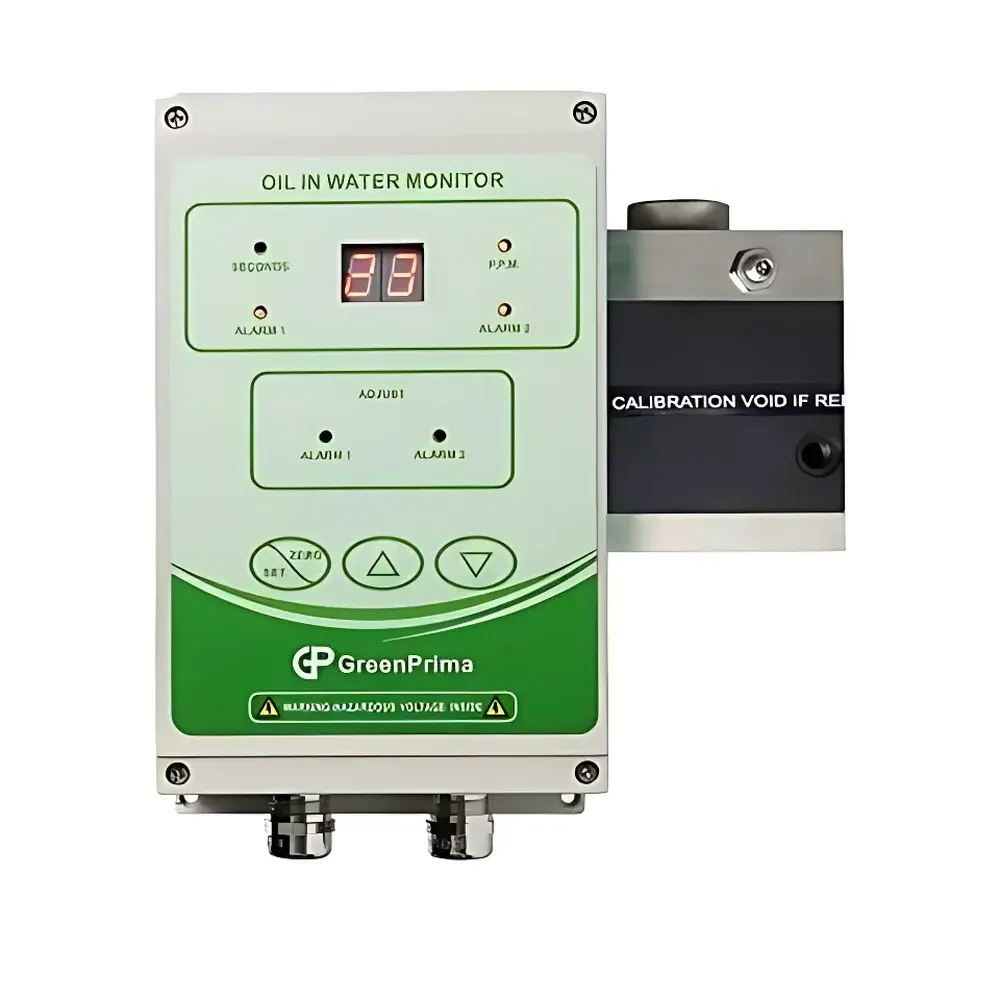
GreenPrima PROCON 7000 Online Oil-in-Water Analyzer
| Brand | GreenPrima |
|---|---|
| Origin | United Kingdom |
| Manufacturer Type | Manufacturer |
| Origin Category | Imported |
| Model | PROCON 7000 |
| Instrument Type | Online |
| Measurement Principle | Fluorescence-based optical detection (non-extractive, in-situ) |
| Measurement Range | 0–99 ppm |
| Accuracy | ±2 ppm |
| Alarm Setpoint Range | 1–98 ppm (adjustable) |
| Alarm Delay 1 | 0–60 s (adjustable) |
| Alarm Delay 2 | 10–240 s (adjustable) |
| Display | 240 × 128 pixel touchscreen |
| Analog Outputs | 0/4–20 mA (min. load 820 Ω), 0–5 V / 1–5 V DC (min. load 50 kΩ) |
| Sample Flow Rate | 0.1–2 L/min |
| Sample Temperature | 1–40 °C |
| Sample Pressure | 0.1–10 bar |
| Ambient Temperature | 1–60 °C |
| Humidity | ≤90% RH at 55 °C |
| Enclosure Rating | IP55 |
| Electrical Safety | EN 61010-1, IEC 664 Category II |
| Weight | 2.25 kg |
| Dimensions (H×W×D) | 215 × 242 × 73 mm |
| Power Supply | 230 V / 115 V AC or 24 V AC |
| Max. Power Consumption | 10 VA |
Overview
The GreenPrima PROCON 7000 Online Oil-in-Water Analyzer is an industrial-grade, fluorescence-based optical sensor system engineered for continuous, real-time monitoring of hydrocarbon contamination in aqueous streams. Unlike extractive methods requiring solvent handling or complex sample preparation, the PROCON 7000 employs a non-contact, in-situ measurement principle: excitation of aromatic hydrocarbons at specific UV wavelengths (typically 254–280 nm) followed by detection of characteristic fluorescence emission in the visible range (320–420 nm). This approach delivers high selectivity for mineral oils, diesel, lubricants, and other petroleum-derived compounds while minimizing interference from turbidity, suspended solids (<50 ppm), or naturally occurring organic matter. Designed for integration into closed-loop cooling water circuits—particularly engine jacket water, boiler condensate return lines, and freshwater make-up systems—the analyzer operates without reagents, consumables, or routine calibration drift correction, making it suitable for unattended operation in remote or safety-critical environments such as power generation facilities, oil refineries, and marine propulsion plants.
Key Features
- Automatic self-diagnostic routines including LED intensity verification, optical path integrity check, and zero-point drift compensation
- Configurable measurement intervals (1–60 minutes) to balance data resolution with maintenance cycle requirements
- Intuitive 240 × 128 pixel resistive touchscreen interface with multilingual support (English, German, French, Spanish)
- Two independent programmable alarm outputs with adjustable delay timers (Alarm 1: 0–60 s; Alarm 2: 10–240 s) for staged response protocols
- Isolated 0/4–20 mA analog output (820 Ω min. load) and dual DC voltage outputs (0–5 V / 1–5 V, 50 kΩ min. load) compliant with standard DCS/PLC signal conditioning
- External start/stop trigger capability via dry-contact input for synchronization with pump cycles or process valves
- IP55-rated enclosure with M20 cable glands and reinforced polycarbonate front panel for indoor industrial deployment
- USB port (optional) for local firmware updates and batch export of time-stamped measurement logs (CSV format)
- No field calibration required—factory-traceable NIST-certified reference standards used during production validation
Sample Compatibility & Compliance
The PROCON 7000 is validated for use with clean-to-moderately-turbid water matrices, including treated freshwater, demineralized boiler feedwater, and low-salinity cooling water (TDS 50 ppm suspended solids without upstream filtration. The instrument meets EN 61010-1:2010 for electrical safety and conforms to IEC 664 insulation coordination requirements for Pollution Degree 2 environments. Its analog outputs comply with IEC 60079-28 for optical radiation safety in potentially explosive atmospheres (Zone 2/22 when installed per manufacturer’s mounting instructions). While not certified to ISO 8573 or ASTM D6647, its performance aligns with operational benchmarks defined in ISO 9377-2 (water quality — determination of hydrocarbon oil — part 2: infrared spectrometry) for screening-level surveillance where regulatory compliance relies on trend analysis rather than absolute quantification.
Software & Data Management
Data logging is managed internally via non-volatile flash memory supporting ≥12 months of 1-minute interval records (timestamped to ±1 s accuracy). Configuration parameters—including alarm thresholds, output scaling, and communication settings—are stored in EEPROM with write-cycle protection. Optional USB connectivity enables direct retrieval of .csv files compatible with Excel, LabVIEW, or SCADA historian systems. The embedded firmware supports Modbus RTU over RS-485 (isolated, optional module) for integration into legacy control architectures. Audit trails are maintained for all configuration changes, including user ID (if network-enabled), timestamp, and parameter name—supporting GLP-aligned documentation practices. No cloud dependency or proprietary software installation is required for basic operation or data extraction.
Applications
- Continuous monitoring of engine jacket cooling water in thermal power stations and marine diesel engines to detect early-stage heat exchanger tube failure
- Boiler condensate return line surveillance to prevent oil ingress-induced corrosion and carryover in high-pressure steam systems
- Industrial wastewater pre-discharge verification prior to municipal sewer entry or on-site treatment units
- Groundwater remediation site effluent monitoring under EPA Region 4 or EU WFD (Water Framework Directive) reporting frameworks
- Lubricating oil cooler leak detection in turbine and compressor packages operating under API RP 500 guidelines
FAQ
What measurement principle does the PROCON 7000 use?
It utilizes ultraviolet-induced fluorescence spectroscopy optimized for aliphatic and aromatic hydrocarbons in aqueous solution.
Is the analyzer suitable for seawater applications?
No—high ionic strength and chlorophyll interference limit accuracy; it is validated only for freshwater and low-conductivity industrial water streams.
Does the instrument require periodic recalibration?
No—factory calibration is stable over the rated service life (≥5 years) under specified environmental conditions; no user recalibration is supported or required.
Can the PROCON 7000 be integrated into a DCS with redundant analog inputs?
Yes—its isolated 4–20 mA output meets ISA-50.00.01 signal integrity requirements and can drive dual-input DCS cards with appropriate loop-powered isolation.
What is the minimum detectable oil concentration?
The lower limit of quantitation (LLOQ) is 1 ppm under optimal flow and temperature conditions, consistent with its ±2 ppm accuracy specification across the 0–99 ppm range.
Related Products







