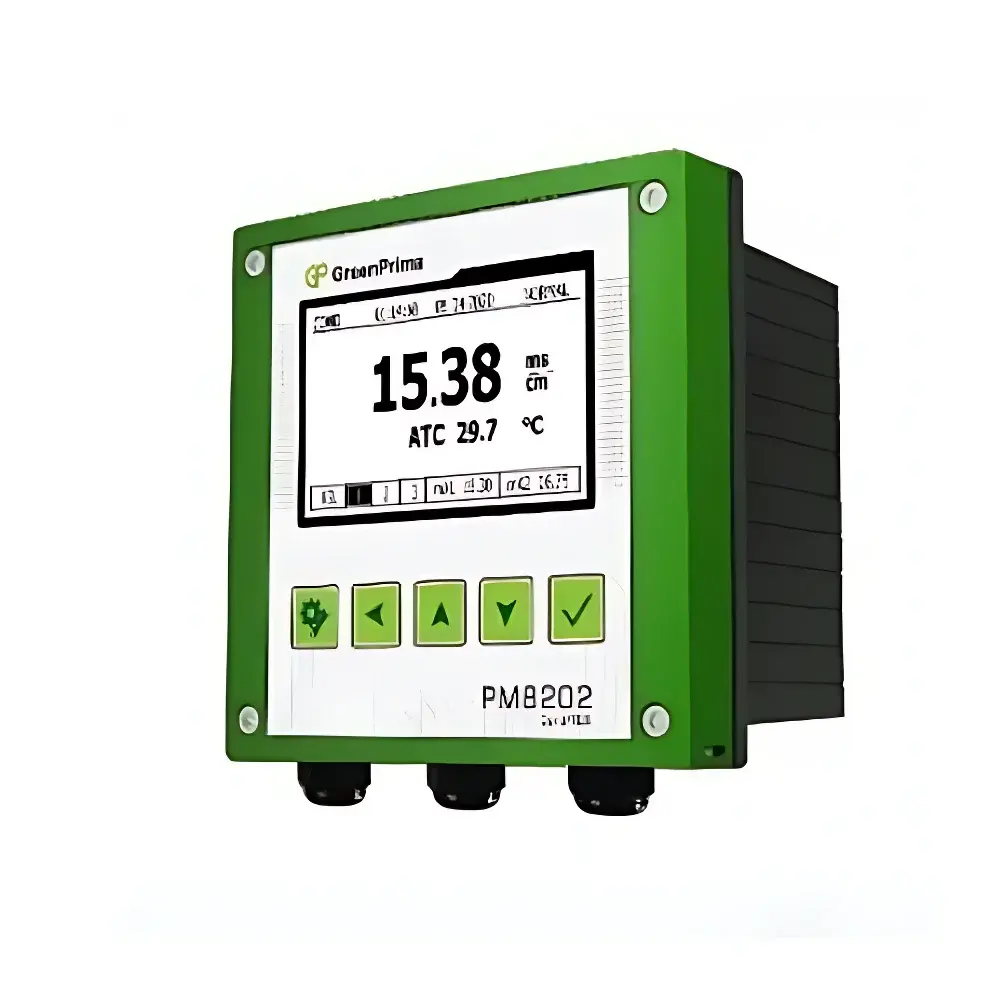
GreenPrima PM8202C Online Conductivity Analyzer
| Brand | GreenPrima |
|---|---|
| Origin | United Kingdom |
| Manufacturer Type | Manufacturer |
| Origin Category | Imported |
| Model | PM8202C |
| Price | Upon Request |
| Measurement Range (Conductivity) | 0.00–2000 mS/cm |
| Measurement Range (Salinity) | 0.00–78.00 ppt |
| Measurement Range (TDS) | 0–120,000 ppm |
| Resolution (Conductivity) | 0.01 mS/cm (varies by electrode) |
| Accuracy | ±1% of Full Scale |
| Temperature Compensation | –10 to 130 °C, manual or automatic (NTC10K / PT1000) |
| Operating Temperature | 0 to 70.0 °C |
| Storage Temperature | –20 to 70.0 °C |
| Power Supply | 90–260 VAC, 50/60 Hz |
| Analog Outputs | Two isolated 4–20 mA outputs, max loop resistance 500 Ω, accuracy 0.1% F.S. |
| Cleaning Output | Adjustable interval (0.1–1000 h), adjustable duration (1–1000 s) |
| Enclosure Dimensions | 144 × 144 × 108 mm |
| Panel Cutout | 138 × 138 mm |
| Weight | 0.87 kg |
| IP Rating | IP68 (electrodes) |
| Electrode Options | Bsens310 (0–20.00 µS/cm, K=0.01), Bsens320 (0–200.0 µS/cm, K=0.1), Bsens330 (0–2000 µS/cm, K=1), Bsens340 (0–500 mS/cm, K=0.5), Bsens350 (0.1–2000.0 mS/cm, K=10) |
| Electrode Materials | 316L stainless steel (Bsens310–330), titanium alloy (Bsens340), graphite (Bsens350) |
| Process Connection | 3/4" NPT |
| Max Pressure Rating | 5 bar |
Overview
The GreenPrima PM8202C Online Conductivity Analyzer is a robust, microprocessor-based industrial process instrument engineered for continuous, high-stability measurement and control of electrical conductivity, total dissolved solids (TDS), and salinity in liquid streams. It operates on the principle of two- or four-electrode conductometric sensing—applying an alternating current across a known cell geometry and measuring the resulting conductance to determine solution conductivity in accordance with ASTM D1125 and ISO 7888 standards. The analyzer integrates seamlessly into plant-wide automation architectures via Modbus RTU over RS485, while dual isolated 4–20 mA analog outputs support direct interfacing with DCS, PLC, or SCADA systems. Designed for demanding environments—including chemical dosing loops, reverse osmosis permeate monitoring, boiler feedwater control, and wastewater effluent compliance—the PM8202C delivers repeatable performance across temperature ranges from –10 °C to 130 °C using either NTC10K or PT1000 temperature compensation sensors.
Key Features
- Large backlit LCD display with intuitive bilingual (English/Chinese) menu navigation—optimized for rapid configuration without external software
- Factory-default reset function accessible via single-button press—minimizing downtime during commissioning or troubleshooting
- User-configurable password protection (4-digit code) restricting access to calibration, output scaling, and system settings—supporting GLP/GMP operational integrity
- Dual independent 4–20 mA outputs with 0.1% full-scale accuracy—enabling simultaneous transmission of primary conductivity and compensated temperature signals
- Programmable relay output supporting alarm, control, or cleaning actuation—with fully adjustable timing (interval: 0.1–1000 h; duration: 1–1000 s)
- Universal power input (90–260 VAC, 50/60 Hz) with optional 24 VDC variant—suitable for both panel-mounted and hazardous-area installations
- IP68-rated sensor variants compatible with submersion, high-pressure (up to 5 bar), and chemically aggressive media—including caustic, acidic, and saline solutions
Sample Compatibility & Compliance
The PM8202C supports five interchangeable electrode models (Bsens310–Bsens350), each optimized for distinct conductivity spans and process conditions. Electrode selection follows IEC 60746-3 guidance on cell constant (K) matching: low-K (0.01–0.1) electrodes for ultrapure water (e.g., semiconductor rinse water, pharmaceutical WFI); unit-K (K=1) for municipal drinking water and cooling tower applications; and high-K (K=0.5–10) configurations for concentrated brines, seawater desalination reject streams, and electroplating baths. All electrodes feature chemically inert materials—316L stainless steel for general-purpose use, titanium alloy for chloride-rich environments, and graphite for highly oxidizing or abrasive slurries. Each sensor meets EN 61326-1 for electromagnetic compatibility and complies with ATEX/IECEx requirements when paired with approved barriers (not included). Calibration traceability aligns with ISO/IEC 17025-accredited reference standards.
Software & Data Management
While the PM8202C operates autonomously via front-panel interface, its embedded Modbus RTU protocol enables bidirectional communication with supervisory systems for remote parameter read/write, real-time data logging, and event-triggered diagnostics. The device supports standard Modbus function codes (03h, 06h, 10h) for register access—including conductivity value (40001), temperature (40002), relay status (40003), and calibration coefficients (40101–40104). No proprietary software is required; integration is validated with common industrial platforms including Siemens SIMATIC, Rockwell Automation Logix, and Schneider EcoStruxure. Audit trail functionality—while not native—is achievable through external historian systems that log Modbus transaction timestamps, satisfying FDA 21 CFR Part 11 requirements when deployed with appropriate validation protocols.
Applications
- Pharmaceutical water systems: Continuous monitoring of Purified Water (PW) and Water for Injection (WFI) per USP and EU Annex 1
- Power generation: Condensate polishing and steam cycle purity assurance in thermal and nuclear plants
- Food & beverage: CIP rinse validation, syrup concentration control, and wastewater BOD/COD correlation
- Environmental monitoring: Effluent discharge compliance per EPA Method 120.1 and local regulatory limits
- Chemical manufacturing: Reaction endpoint detection in neutralization processes and electrolyte concentration feedback control
- Desalination plants: Feed, permeate, and concentrate stream characterization across multi-stage flash and RO trains
FAQ
What electrode model should I select for ultrapure water applications?
For conductivity below 1 µS/cm (e.g., WFI or semiconductor process water), the Bsens310 (K=0.01, range 0–20.00 µS/cm) is recommended to maximize resolution and minimize polarization error.
Does the PM8202C support automatic temperature compensation with external Pt1000 sensors?
Yes—the controller accepts both NTC10K and Pt1000 inputs, and auto-compensation follows the nonlinear CaCl₂-based algorithm per ISO 7888, configurable via setup menu.
Can the relay output be used to trigger an automatic electrode cleaning cycle?
Yes—relay activation timing and duration are fully programmable, allowing synchronization with pneumatic wipers, ultrasonic transducers, or chemical injection valves.
Is firmware upgrade capability available in-field?
Firmware updates require connection to a PC via RS232-to-RS485 converter and GreenPrima’s configuration utility (available under NDA upon request); no over-the-air update functionality is implemented.
How is calibration traceability documented for audit purposes?
Each calibration event (date, operator ID, standard used, before/after deviation) is stored in non-volatile memory and exportable via Modbus register dump—supporting internal QA review and external regulatory inspection.
Related Products