
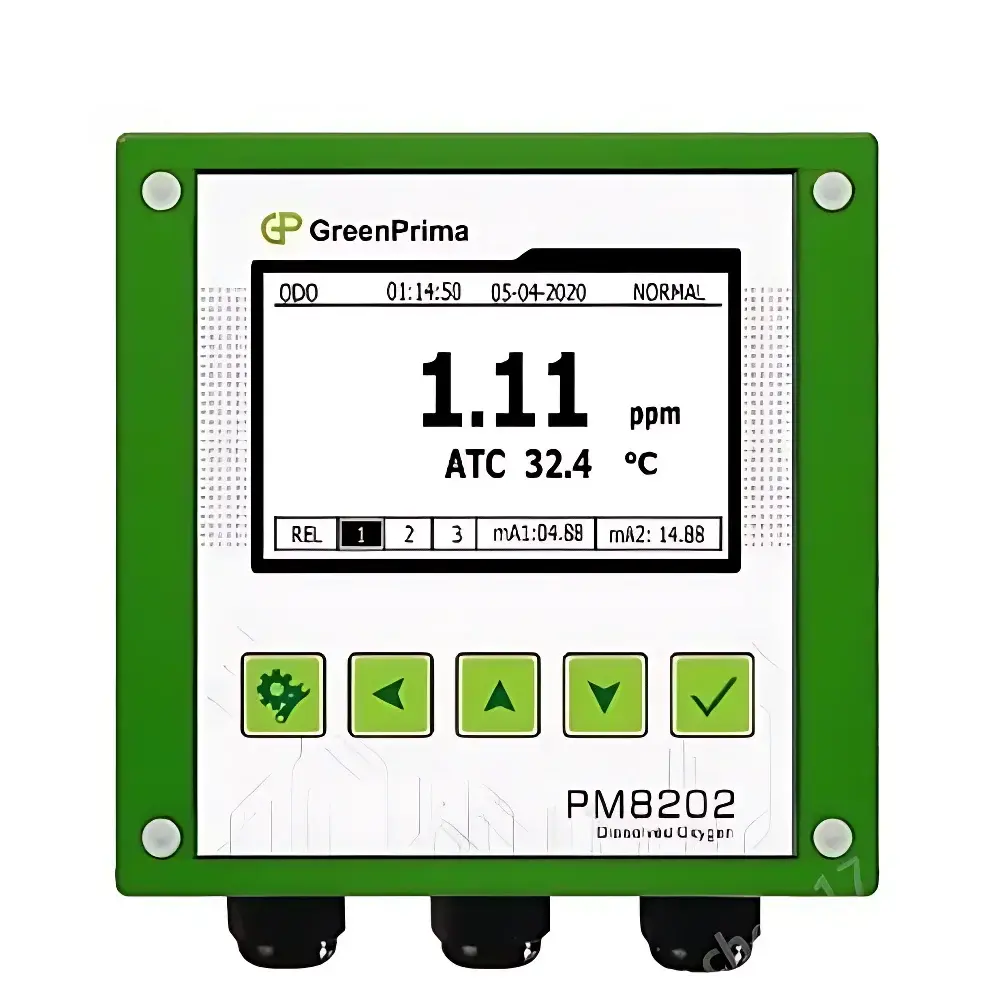
GreenPrima PM8202O Fluorescence-Based Online Dissolved Oxygen Analyzer
| Brand | GreenPrima |
|---|---|
| Origin | United Kingdom |
| Manufacturer Type | Original Equipment Manufacturer (OEM) |
| Product Category | Imported Instrument |
| Model | PM8202O |
| Instrument Type | Online Analyzer |
| Measurement Principle | Fluorescence Quenching |
| Measurement Range | 0.00–20.00 ppm |
| Accuracy | ±0.01 ppm |
| Resolution | 0.01 ppm |
| Temperature Compensation Range | −10 to +130 °C (NTC30k or PT1000 selectable) |
| Operating Temperature | −10 to +70.0 °C |
| Storage Temperature | −20 to +70.0 °C |
| Display | Backlit Graphic LCD |
| Language Interface | English & Chinese |
| Data Storage Capacity | 600,000 records |
| Power Supply | 90–260 VAC, 50/60 Hz or 24 VDC optional |
| Output | Dual isolated 4–20 mA (max. loop resistance 500 Ω, accuracy 0.1% FS), RS485 Modbus RTU |
| Cleaning Function | Optional air-pulse self-cleaning (interval: 0.1–1000 h |
| duration | 1–1000 s) |
| Alarm Outputs | Two independent Hi/Lo relay outputs (5 A / 250 VAC / 30 VDC) |
| Enclosure Rating | IP65 |
| Mounting Options | Wall-mount, pipe-mount, panel-mount |
| Dimensions (H×W×D) | 144 × 144 × 108 mm |
| Panel Cutout | 138 × 138 mm |
| Weight | 0.87 kg |
| Electrode Material | 316L stainless steel |
Overview
The GreenPrima PM8202O is a robust, maintenance-optimized online dissolved oxygen (DO) analyzer engineered specifically for continuous monitoring in aquaculture systems, wastewater treatment plants, surface water networks, and industrial process streams. It employs the optical fluorescence quenching principle—where molecular oxygen modulates the intensity and lifetime of fluorescent emission from a proprietary ruthenium-based sensing layer—to deliver stable, drift-free measurements without electrochemical consumption of oxygen. Unlike Clark-type amperometric sensors, the PM8202O requires no oxygen-permeable membrane, liquid electrolyte, or polarization time. This eliminates calibration drift associated with membrane fouling, electrolyte depletion, or cathode passivation, making it especially suitable for low-flow or stagnant environments common in recirculating aquaculture systems (RAS), pond monitoring, and effluent discharge points.
Key Features
- Fluorescence-based measurement ensures zero oxygen consumption—critical for accurate DO assessment in low-turnover aquatic habitats.
- True maintenance-free operation: no membrane replacement, no electrolyte refills, no anode/cathode cleaning cycles.
- Digital sensor architecture with embedded temperature compensation (NTC30k or PT1000 configurable) enables high reproducibility across wide thermal ranges (−10 to +130 °C).
- Stable signal output with no baseline drift—eliminates routine zero/span calibration under normal operating conditions.
- Industrial-grade 316L stainless steel sensing electrode designed for corrosion resistance in saline, brackish, and organic-rich media.
- Backlit graphic LCD with intuitive bilingual (English/Chinese) menu navigation and real-time display of DO concentration, temperature, and system status.
- Dual isolated 4–20 mA analog outputs assignable to DO value and/or temperature—fully programmable with 0.1% full-scale accuracy and 500 Ω max loop resistance.
- RS485 Modbus RTU interface supports integration into SCADA, DCS, or PLC-based supervisory systems for centralized data acquisition and alarm management.
- Optional air-pulse self-cleaning module mitigates biofilm accumulation on the sensing surface—configurable cleaning interval (0.1–1000 h) and duration (1–1000 s).
- Two independent relay outputs with user-defined high/low thresholds, adjustable hysteresis, and dry-contact ratings up to 5 A / 250 VAC.
Sample Compatibility & Compliance
The PM8202O is validated for use in diverse aqueous matrices including freshwater aquaculture ponds, marine RAS units, municipal and industrial wastewater effluents, and natural surface waters. Its optical design renders it insensitive to hydrogen sulfide, chlorine, heavy metals, and suspended solids that commonly interfere with electrochemical DO sensors. The instrument complies with IEC 61326-1 (EMC for industrial environments), IEC 60529 (IP65 ingress protection), and meets functional safety requirements aligned with ISO 14001 environmental management system frameworks. While not certified for pharmaceutical-grade compliance (e.g., USP or FDA 21 CFR Part 11), its data logging integrity—including timestamped storage of 600,000 records with audit-trail-capable firmware—supports GLP-aligned field deployment and regulatory reporting in environmental monitoring applications.
Software & Data Management
Data acquisition and configuration are managed via the front-panel interface or remotely through Modbus-enabled host software. All measurements are automatically time-stamped and stored in non-volatile memory with cyclic overwrite capability. Export options include manual USB dump (via optional adapter) or scheduled transmission via Modbus TCP gateway. The device supports password-protected configuration access (three-tier privilege levels) to prevent unauthorized parameter changes—a requirement in multi-operator facilities. Firmware updates are performed via secure UART interface using signed binaries, ensuring traceability and version control in operational deployments.
Applications
- Real-time DO monitoring in recirculating aquaculture systems (RAS) for feed optimization and hypoxia prevention.
- Effluent compliance tracking at wastewater treatment plant outfalls per local discharge permits (e.g., EU Urban Wastewater Treatment Directive, US EPA NPDES).
- Surface water quality surveillance in rivers, lakes, and reservoirs—integrated with meteorological and nutrient sensor networks.
- Process control in activated sludge basins, aerated lagoons, and oxidation ditches where DO setpoint stability directly impacts nitrification efficiency.
- Long-term ecological studies requiring unattended, low-maintenance field instrumentation with high data continuity.
FAQ
Does the PM8202O require regular calibration?
No—fluorescence quenching is inherently stable over time. Field verification against a certified Winkler titration or NIST-traceable standard is recommended annually or after sensor replacement.
Can it operate in seawater or brackish conditions?
Yes—the 316L stainless steel housing and optical sensor coating resist chloride-induced corrosion; salinity compensation is applied automatically via integrated temperature and conductivity inputs (when paired with optional conductivity module).
Is temperature compensation automatic?
Yes—built-in NTC30k or PT1000 probe support enables real-time, algorithmic compensation across −10 to +130 °C, with manual offset adjustment available if required.
What power options are supported?
Standard operation uses 90–260 VAC, 50/60 Hz; 24 VDC is available as an optional configuration for hazardous or remote locations.
How is sensor fouling addressed?
The optional air-pulse cleaning system delivers controlled bursts of compressed air to the sensing window at user-defined intervals—proven effective against algal biofilms and particulate buildup without mechanical wipers or consumables.







