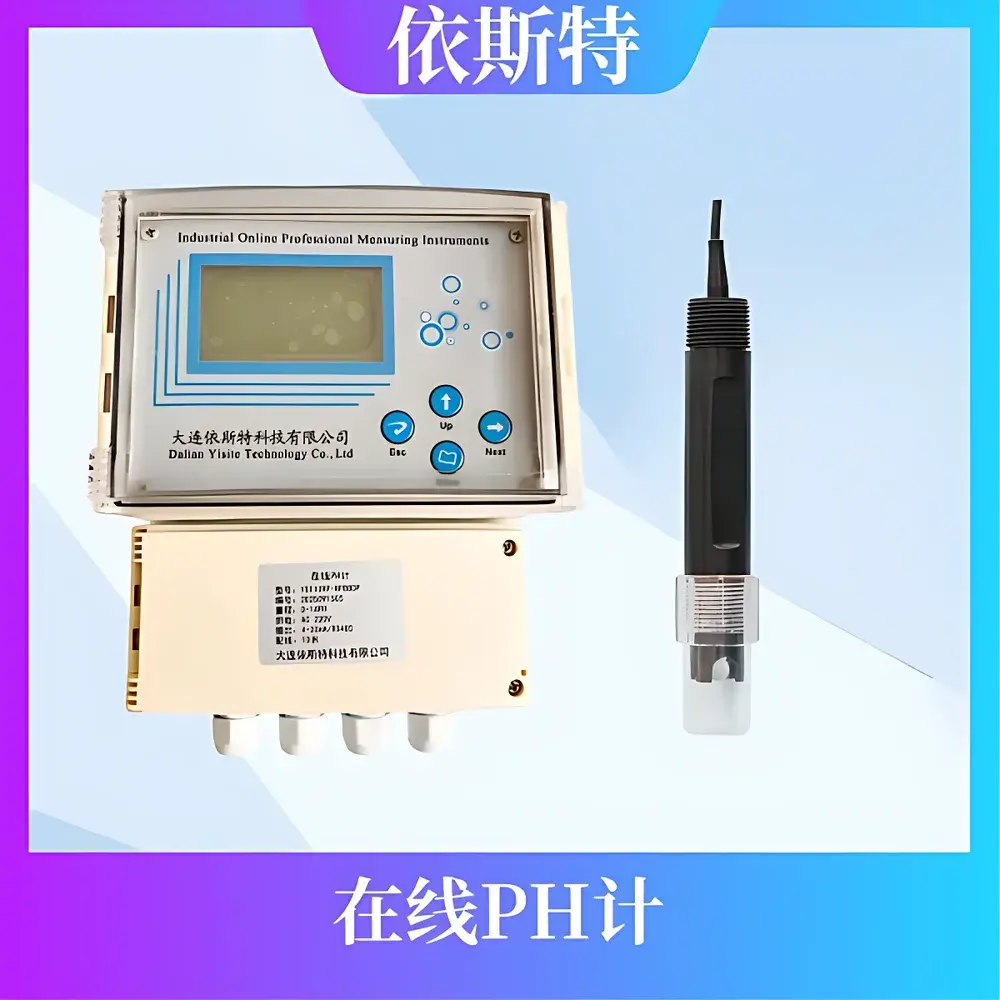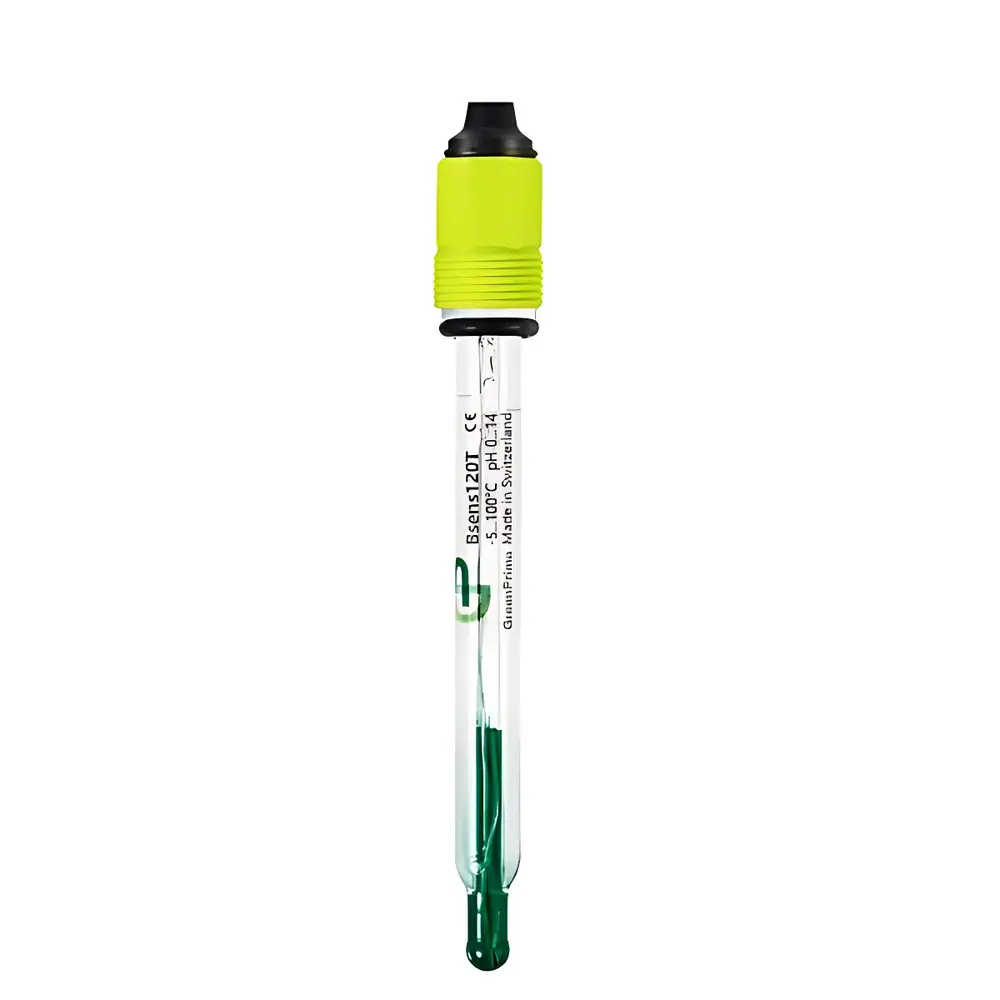
GreenPrima Bsens120T Desulfurization-Grade Online pH Electrode
| Brand | GreenPrima |
|---|---|
| Origin | Switzerland |
| Manufacturer Type | OEM Manufacturer |
| Product Origin | Imported |
| Model | Bsens120T |
| Measurement Range | pH 0–14 |
| Temperature Range | −5 to 100 °C |
| Max. Operating Pressure | 6 bar |
| Electrode Body Material | S-Glass |
| Reference System | Ag/AgCl Cartridge |
| Electrolyte | Polymer Gel |
| Electrical Impedance | ≤300 Ω at 25 °C |
| Electrode Length | 120 mm |
| Electrode Diameter | 12 mm |
| Connection Thread | PG13.5 |
| Membrane Type | S-Glass |
| Minimum Immersion Depth | 20 mm |
| Zero Point | 0 ±20 mV |
| Sensitivity | 57–59 mV/pH at 25 °C |
| Minimum Sample Conductivity | 150 μS/cm |
| Response Time (pH 4–7) | <30 s |
| Cable Length | 5 m |
Overview
The GreenPrima Bsens120T is a rugged, desulfurization-optimized online pH electrode engineered for continuous, high-stability measurement in aggressive industrial process streams—particularly flue gas desulfurization (FGD) scrubber liquors, coal-fired power plant wastewater, and other highly contaminated, high-turbidity aqueous environments. Unlike standard laboratory or general-purpose pH sensors, the Bsens120T employs a robust S-glass pH-sensitive membrane combined with a polymer gel electrolyte and replaceable Ag/AgCl reference cartridge architecture. This design eliminates liquid junction clogging, minimizes drift under variable ionic strength, and ensures long-term electrochemical stability in slurries containing suspended solids, heavy metals, sulfides, and scaling ions (e.g., Ca²⁺, Mg²⁺, SO₄²⁻). Its measurement principle relies on the Nernstian potential difference generated across the hydrated glass membrane in response to hydrogen ion activity, referenced against a stable, low-resistance Ag/AgCl internal element. The electrode operates within pH 0–14 and withstands temperatures up to 100 °C and pressures up to 6 bar—making it suitable for direct insertion into recirculation loops, absorber sumps, and oxidation tanks without external housings or flow cells.
Key Features
- Desulfurization-specific S-glass membrane with enhanced chemical resistance to sulfite, sulfate, and chloride-rich matrices
- Polymer gel electrolyte eliminates leakage, drying, and crystallization—critical for unattended operation in FGD systems
- Modular Ag/AgCl reference cartridge enables field-replacement without sensor disassembly or recalibration downtime
- Low-impedance design (≤300 Ω at 25 °C) ensures signal integrity over 5 m cable length and compatibility with standard industrial pH transmitters
- PG13.5 threaded process connection enables secure, leak-tight mounting in ANSI, DIN, or custom flanged piping systems
- Optimized response time (<30 s from pH 4 to 7) supports real-time feedback control of limestone slurry dosing and oxidation efficiency
- Minimal immersion depth (20 mm) allows installation in shallow sumps or compact bypass lines
Sample Compatibility & Compliance
The Bsens120T is validated for use in conductive aqueous media with minimum conductivity ≥150 μS/cm—covering typical FGD scrubber liquors (conductivity range: 20–50 mS/cm), lime/limestone slurry suspensions, and biologically treated effluents. It complies with IEC 60746-1 (Electrochemical pH measurement—Part 1: General requirements) and meets functional safety prerequisites for SIL-2 capable systems when integrated with certified transmitter platforms. While not intrinsically safe, its construction supports ATEX Zone 2 / IECEx Zone 2 certification when installed with appropriate barrier systems. The electrode’s materials of construction—S-glass, PTFE-insulated stainless steel body, and polymer gel—conform to FDA 21 CFR §177.2420 for incidental food contact and are compatible with ISO 9001-certified manufacturing traceability.
Software & Data Management
The Bsens120T is analog-output compatible (mV signal) and integrates seamlessly with industry-standard pH transmitters (e.g., Endress+Hauser Liquiline CM44P, Emerson Rosemount 5081-P, or Siemens Desigo CC) supporting HART, Modbus RTU/TCP, or PROFIBUS PA protocols. When paired with compliant transmitters, it supports full audit trail functionality per FDA 21 CFR Part 11—including electronic signatures, calibration history logging, sensor diagnostics (impedance monitoring, asymmetry potential tracking), and automatic out-of-spec alerts. Data export formats include CSV and OPC UA, enabling integration into MES (Manufacturing Execution Systems) and DCS historian archives for trend analysis, predictive maintenance scheduling, and regulatory reporting (e.g., EPA Clean Air Act compliance documentation).
Applications
- Continuous pH monitoring in wet limestone FGD absorber slurry recirculation lines
- Control of neutralization reactors in metallurgical acid mine drainage treatment
- pH supervision in municipal wastewater biological nutrient removal (BNR) basins with high particulate load
- Process analytics in pulp & paper bleach plant effluent streams
- Quality assurance in chemical manufacturing rinse water recovery loops
FAQ
What distinguishes the Bsens120T from general-purpose pH electrodes?
It features an S-glass membrane formulation optimized for sulfite/sulfate stability, polymer gel electrolyte to prevent junction fouling, and mechanical robustness for direct insertion into abrasive slurries—unlike standard electrodes designed for clean, low-conductivity lab samples.
Can the Bsens120T be used in high-temperature flue gas condensate applications?
Yes—it is rated for continuous operation up to 100 °C and 6 bar pressure; however, thermal shock must be avoided during installation, and steam sterilization is not recommended.
Is calibration required before each use?
No—factory-calibrated with documented NIST-traceable certificates; field calibration is performed per ISO 8655-4 using two-point buffer verification (e.g., pH 4.01 and 7.00 at process temperature) at intervals defined by QA/QC protocols (typically weekly or per batch cycle).
How often should the Ag/AgCl reference cartridge be replaced?
Under typical FGD conditions, replacement is recommended every 6–12 months based on impedance rise (>500 Ω) or asymmetry voltage drift exceeding ±30 mV—monitored via transmitter diagnostics.
Does the 5-meter cable support extension beyond 5 m?
No—signal degradation occurs beyond 5 m without active signal conditioning; for longer runs, install a local transmitter or use a shielded twisted-pair cable with proper grounding and noise suppression per IEC 61000-6-2 EMC standards.
Related Products