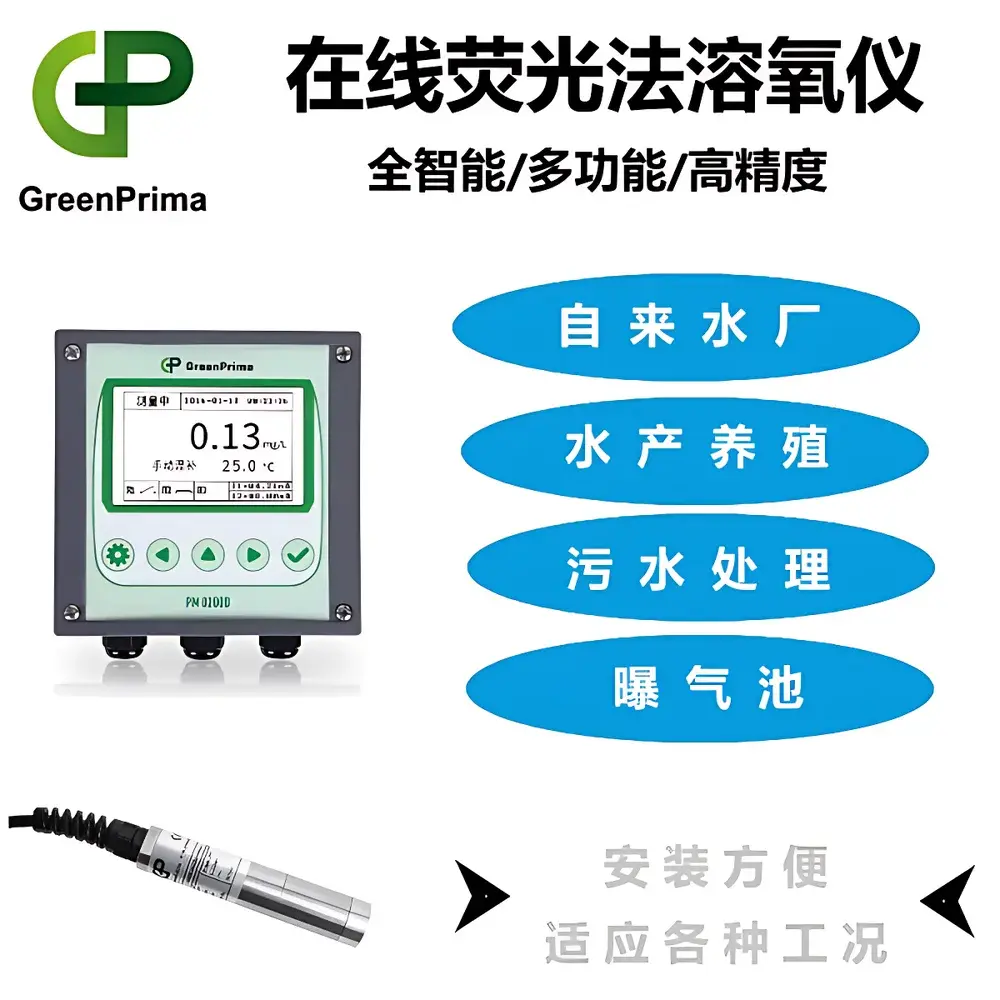
GreenPrima PM8202O Fluorescence-Based Online Dissolved Oxygen Analyzer
| Brand | GreenPrima |
|---|---|
| Origin | Switzerland |
| Manufacturer | GreenPrima AG |
| Type | PM8202O |
| Resolution | 0.01 ppm |
| Measurement Range | 0.00–20.00 ppm |
| Repeatability | ±0.01 ppm |
| Stability | ±0.5% FS |
| Temperature Compensation | −10 to +130 °C (NTC10K/PT1000) |
| Output | Dual isolated 4–20 mA (max. 500 Ω, 0.1% FS), RS485 Modbus RTU (HART optional) |
| Cleaning Output | Adjustable interval (0.1–1000 h), duration (1–1000 s) |
| Alarm Outputs | Two independent Hi/Lo relays (5 A / 250 VAC / 30 VDC) |
| Enclosure Rating | IP65 |
| Dimensions | 144 × 144 × 108 mm |
| Weight | 0.87 kg |
| Sensor Model | Bsens410 |
| Sensor Material | 316L stainless steel |
| Max. Pressure | 5 bar |
| Cable Length | 7 m |
| Sensor Protection Rating | IP68 |
| Ambient Operating Temperature | 0–70 °C |
| Storage Temperature | −20–70 °C |
Overview
The GreenPrima PM8202O is a fluorescence-based online dissolved oxygen (DO) analyzer engineered for continuous, high-reliability monitoring in demanding industrial and environmental water applications. Unlike traditional electrochemical (Clark-type) sensors that rely on oxygen diffusion through a membrane and consumption during measurement, the PM8202O employs phase-fluorometry—a non-consumptive optical principle where molecular oxygen quenches the fluorescence lifetime of a proprietary ruthenium-based luminophore immobilized on the sensor tip. This physical interaction yields a stable, temperature-dependent decay time signal directly proportional to dissolved oxygen concentration. Because no oxygen is consumed and no electrolyte or gas-permeable membrane is required, the sensor exhibits zero drift over time, eliminates flow dependency, and delivers consistent performance even under low-flow or stagnant conditions—critical for wastewater treatment basins, aquaculture recirculation systems, and surface water monitoring stations.
Key Features
- Non-consumptive fluorescence sensing: No oxygen depletion, enabling accurate measurement in low-circulation or static water bodies.
- Zero-maintenance sensor architecture: No membrane replacement, electrolyte refilling, or polarization time—typical service intervals exceed 12–24 months with only periodic fluorescent cap replacement.
- Dual analog and digital outputs: Two fully isolated 4–20 mA current loops configurable for DO value and temperature; RS485 interface compliant with Modbus RTU protocol (HART optional for legacy integration).
- Intelligent air-purge cleaning system: Programmable cleaning cycles (interval: 0.1–1000 hours; duration: 1–1000 seconds) mitigate biofouling without chemical agents or manual intervention.
- Rugged industrial design: IP65-rated controller housing; 316L stainless steel sensor body (IP68, 5 bar pressure rating); operating ambient temperature range: 0–70 °C.
- Configurable user interface: Backlit dot-matrix LCD display with dual-language (English/Chinese) menu navigation; password-protected calibration (code: 1010) and setup (code: 2020) modes ensure operational integrity.
Sample Compatibility & Compliance
The PM8202O is validated for use across heterogeneous aqueous matrices including municipal and industrial wastewater effluents, activated sludge tanks, oxidation ditches, drinking water distribution networks, aquaculture ponds, and natural surface waters. Its optical sensing principle renders it insensitive to hydrogen sulfide, chlorine residuals, heavy metals, and suspended solids—common interferents in electrochemical DO measurement. The analyzer complies with key international standards governing process instrumentation: IEC 61000-6-2 (EMC immunity), IEC 61000-6-4 (EMC emissions), and EN 61326-1 (industrial measurement equipment). When deployed in regulated environments (e.g., wastewater discharge compliance monitoring per EU Urban Wastewater Treatment Directive or US EPA Method 4500-O G), the device supports audit-ready operation via timestamped calibration logs and configurable data retention—aligning with GLP-aligned data governance expectations.
Software & Data Management
The embedded firmware provides real-time diagnostics including sensor health status, signal-to-noise ratio, temperature stability index, and cleaning cycle execution history. All configuration parameters—including measurement units (ppm or % saturation), temperature compensation algorithm (NTC10K or PT1000), alarm thresholds with hysteresis, and output scaling—are stored in non-volatile memory. Modbus RTU communication enables seamless integration into SCADA, DCS, or cloud-based IIoT platforms (e.g., Siemens Desigo, Honeywell Experion, or Azure IoT Edge). Optional HART support allows backward compatibility with legacy control systems. Data logging capability (via external PLC or gateway) facilitates trend analysis, regulatory reporting, and predictive maintenance planning—fully traceable under FDA 21 CFR Part 11 when paired with compliant software infrastructure.
Applications
- Biological nutrient removal (BNR) process control in municipal wastewater treatment plants—optimizing aeration energy use via real-time DO feedback in anoxic/oxic zones.
- Recirculating aquaculture systems (RAS)—maintaining precise DO setpoints (≥5 ppm) for high-density fish farming while minimizing stress-induced mortality.
- Industrial cooling tower and boiler feedwater monitoring—detecting early-stage corrosion risk from oxygen ingress or inadequate deaeration.
- Environmental monitoring networks—long-term deployment in rivers, lakes, and estuaries where low-power, low-maintenance operation is essential.
- Pharmaceutical clean-in-place (CIP) validation—verifying residual oxygen levels post-sterilization in bioreactor vessels and piping.
FAQ
How does fluorescence-based DO measurement differ from electrochemical methods?
Fluorescence sensing measures oxygen concentration by detecting changes in the luminescence decay time of an immobilized dye—no oxygen is consumed, no membrane is required, and response is unaffected by flow rate or redox-active contaminants.
Is temperature compensation automatic or manual?
Both options are supported: automatic compensation using integrated NTC10K or PT1000 probes, or manual offset entry within the configuration menu.
What is the expected service life of the fluorescent sensor cap?
Under typical municipal wastewater conditions, the cap maintains metrological integrity for 12–24 months; replacement is field-serviceable and requires no recalibration.
Can the PM8202O be installed in pressurized pipelines?
Yes—the Bsens410 sensor is rated IP68 and withstands up to 5 bar static pressure; appropriate threaded or flanged process connections must be selected per ANSI/ISO standards.
Does the analyzer support regulatory audit trails?
While the device itself does not store full audit logs internally, its Modbus register map includes timestamps for all calibration events and parameter changes—enabling external systems to reconstruct full operational history in compliance with ISO/IEC 17025 or GMP documentation requirements.