
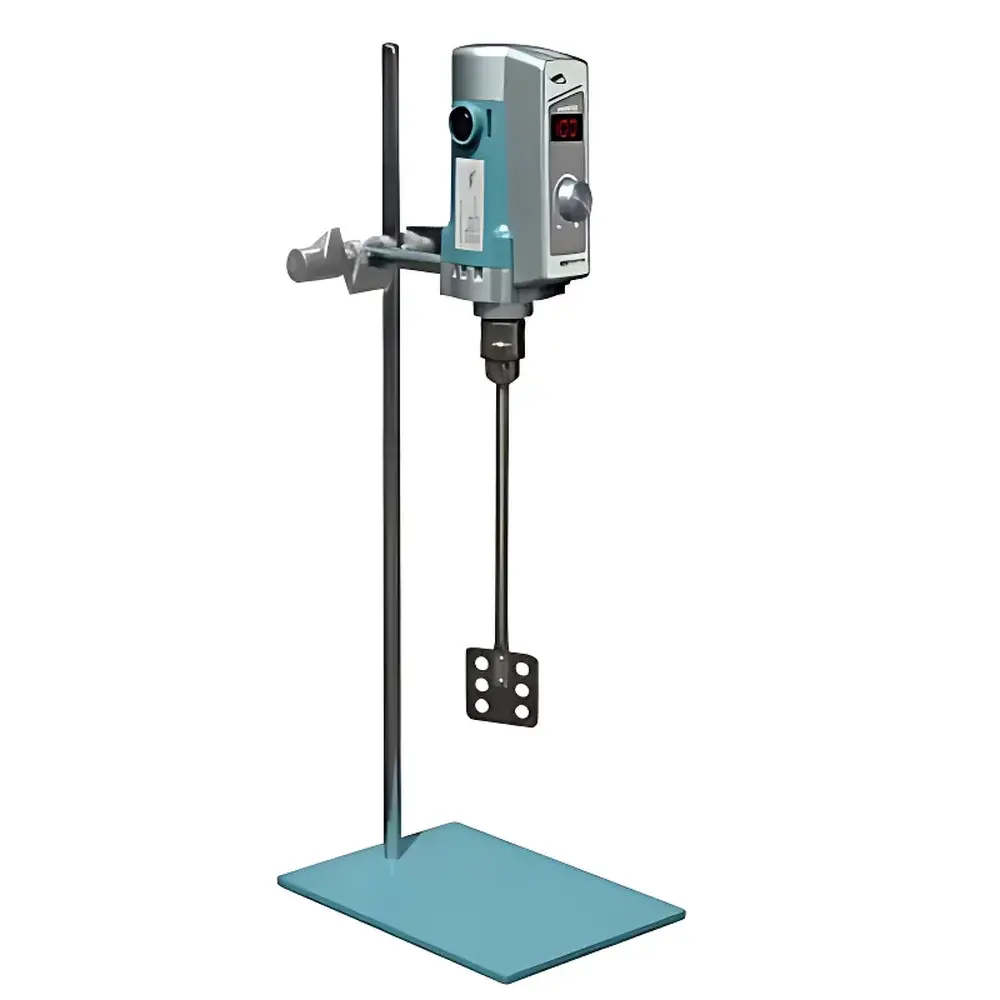
PRIMA PM-1800 PLUS Digital Overhead Stirrer
| Brand | PRIMA (UK) |
|---|---|
| Model | PM-1800 PLUS |
| Max. Speed | 0–2000 rpm |
| Max. Volume | 120 L |
| Max. Viscosity | 26,000 cP |
| Speed Resolution | 10 rpm (LCD display) |
| Power Input | 220 V, 510 W |
| Output Power | 300 W |
| Motor Type | Low-maintenance high-torque DC motor |
| Stirring Mode | Continuous or programmable timer operation |
| Protection | Electronic overload protection with auto-shutdown |
| Stirrer Shaft Clamping | Quick-release chuck |
| Compatible Shaft Diameter | 2–13 mm |
| Standard Impeller | Flat-blade paddle |
| Dimensions (W×D×H) | 360 × 250 × 750 mm |
| Weight | 5.0 kg |
| Noise Level | <65 dB(A) |
| Continuous Operation Duration | Up to 168 hours (7 days) |
Overview
The PRIMA PM-1800 PLUS Digital Overhead Stirrer is an engineered solution for precise, reproducible mixing and dispersion tasks in analytical, quality control, and R&D laboratories. Designed around a high-efficiency brushless DC motor architecture, it delivers consistent torque across the full speed range (0–2000 rpm) without mechanical gear reduction—minimizing thermal drift and ensuring long-term rotational stability. Its core operating principle relies on controlled angular momentum transfer via interchangeable impellers, enabling effective homogenization of low-to-high-viscosity fluids (up to 26,000 cP), suspension of particulates, gas dispersion into liquids, and circulation of viscous reaction media. Unlike benchtop magnetic stirrers, the overhead configuration eliminates limitations imposed by vessel geometry, bottom surface contact, or heat-sensitive sample placement—making it suitable for jacketed reactors, tall cylindrical vessels, and sealed systems requiring inert atmosphere compatibility.
Key Features
- High-resolution LCD display showing real-time speed (in 10-rpm increments) and operational status—no external interface required for basic control.
- Dual-mode operation: continuous stirring or programmable timed runs with memory retention for last-used speed and duration settings.
- Integrated electronic overload protection circuitry that monitors current draw and initiates immediate shutdown upon sustained torque exceedance—preserving motor integrity and preventing sample contamination from thermal degradation.
- Quick-release chuck mechanism accommodating shaft diameters from 2 mm to 13 mm; compatible with standardized ISO 22411-compliant impeller mounts.
- Low-noise (<65 dB[A]) operation enabled by precision-balanced rotor assembly and vibration-damped housing—critical for shared lab environments and noise-sensitive applications.
- Robust aluminum alloy chassis with reinforced vertical column; designed for stable mounting on reactor frames, fume hoods, or custom rigging systems.
- Rated for uninterrupted operation up to 168 hours under nominal load conditions—validated per IEC 61000-4-30 for electromagnetic compatibility and thermal endurance.
Sample Compatibility & Compliance
The PM-1800 PLUS supports a broad spectrum of liquid-phase systems, including aqueous suspensions, polymer melts, emulsions, colloidal dispersions, and non-Newtonian gels. Its torque profile enables reliable handling of shear-thinning and thixotropic media without stalling. Optional impellers—including MP-1 flat-blade paddles (for low-shear blending), MP-2 helical ribbons (for high-viscosity layer turnover), MP-3 propellers (for axial flow in tall vessels), MA-1 anchor types (for wall-scraping in viscous boundary layers), and MC-1 centrifugal turbines (for turbulent dispersion)—allow method-specific optimization aligned with ASTM D2196 (viscosity measurement) and ISO 3219 (rheological behavior classification). The unit complies with CE marking requirements (2014/30/EU EMC Directive and 2014/35/EU LVD), and its electrical design meets IEC 61010-1 safety standards for laboratory equipment.
Software & Data Management
While the PM-1800 PLUS operates as a standalone instrument, its digital control board includes RS-232 serial output (optional adapter available) for integration into centralized lab data acquisition networks. When connected to validated third-party SCADA or LIMS platforms, speed logs and runtime events can be timestamped and archived with audit-trail capability—supporting GLP/GMP documentation requirements. All parameter changes are internally logged with power-cycle persistence, satisfying basic FDA 21 CFR Part 11 traceability expectations for non-critical process steps. No proprietary software installation is required; raw ASCII data streams conform to Modbus RTU protocol conventions for interoperability.
Applications
- Preparation of homogeneous calibration standards and reference materials in metrology labs.
- Controlled dissolution testing of pharmaceutical dosage forms per USP <711>.
- Emulsion stabilization trials during formulation development of cosmetics and agrochemicals.
- Gas-liquid mass transfer studies (e.g., O2 or CO2 sparging) in bioreactor mock-ups.
- Mixing of high-solids-content battery electrode slurries prior to coating validation.
- Suspension of catalyst particles in heterogeneous hydrogenation reactions under inert atmosphere.
- Long-duration aging studies involving temperature-controlled viscous polymer solutions.
FAQ
What impeller types are included as standard with the PM-1800 PLUS?
The base configuration includes one flat-blade paddle impeller (MP-1 type), mounted via a standard quick-release chuck.
Is the unit suitable for use in explosion-proof environments?
No—this model lacks ATEX or IECEx certification; for hazardous area deployment, consult PRIMA’s certified Ex-d or Ex-e variants.
Can the stirrer be mounted horizontally or at an angle?
Mounting is strictly vertical per mechanical design specifications; off-axis orientation voids torque calibration and risks premature bearing wear.
Does the device support external analog speed control (e.g., 0–10 V or 4–20 mA signals)?
Not natively; optional analog interface modules are available separately and require factory calibration.
How often does the motor require maintenance?
The brushless DC motor is sealed and maintenance-free for ≥10,000 operating hours under normal laboratory conditions (per manufacturer MTBF assessment).



