
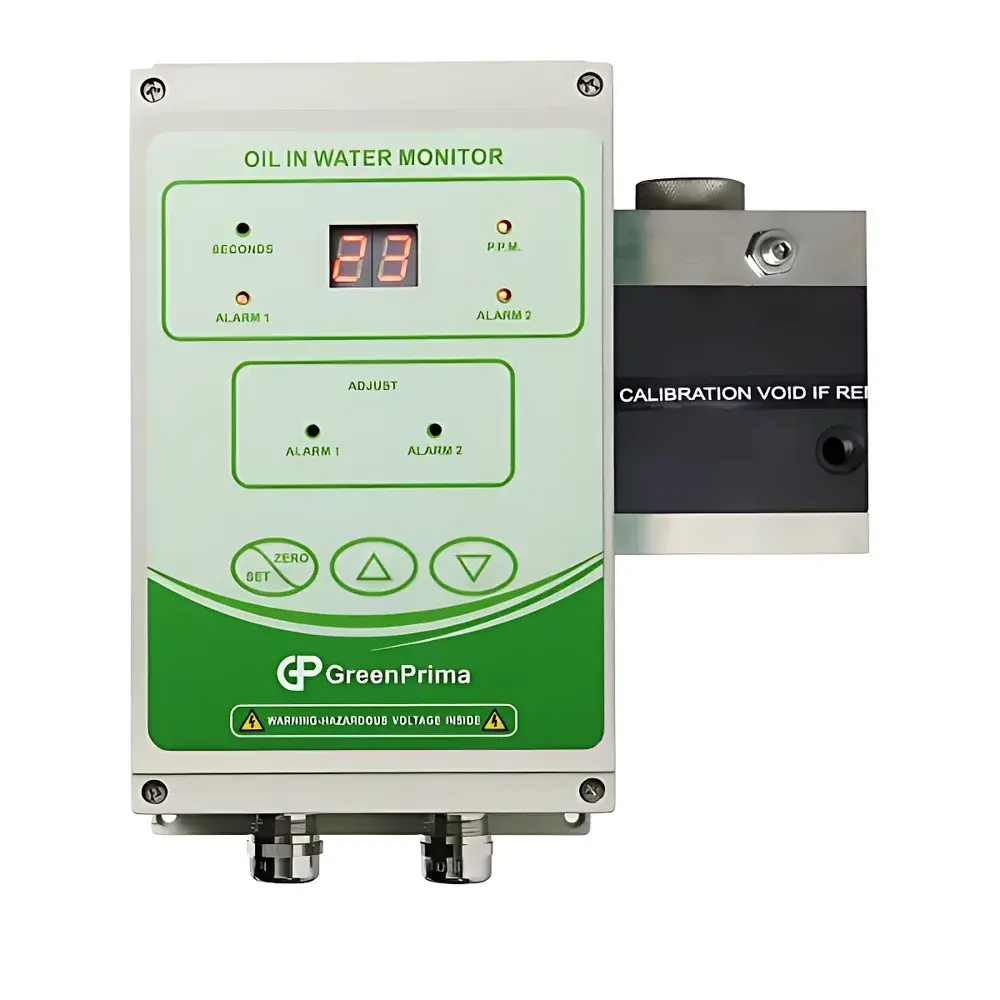
GreenPrima PROCON7000 Online Oil-in-Water Analyzer
| Brand | GreenPrima |
|---|---|
| Origin | United Kingdom |
| Manufacturer Type | Manufacturer |
| Origin Category | Imported |
| Model | PROCON7000 |
| Instrument Type | Online |
| Measurement Principle | Fluorescence-based Optical Detection (Non-Extractive, Solvent-Free) |
| Measurement Range | 0–99 ppm |
| Accuracy | ±2 ppm |
| Alarm Setpoint Range | 1–98 ppm (Adjustable) |
| Alarm Delay 1 | 0–60 s (Adjustable) |
| Alarm Delay 2 | 10–240 s (Adjustable) |
| Display | 240×128 Pixel Touchscreen |
| Output Signals | 0/4–20 mA (min. load 820 Ω), 0–5 V / 1–5 V DC (min. load 50 kΩ) |
| Sample Flow Rate | 0.1–2 L/min |
| Sample Temperature | 1–40 °C |
| Sample Pressure | 0.1–10 bar |
| Ambient Operating Temperature | 1–60 °C |
| Relative Humidity | ≤90% RH at 55 °C |
| Enclosure Rating | IP55 |
| Electrical Safety | EN 61010-1 / IEC 61010-1, Overvoltage Category II |
| Power Supply | 230 V / 115 V AC or 24 V AC |
| Max. Power Consumption | 10 VA |
| Weight | 2.25 kg |
| Dimensions (H×W×D) | 215 × 242 × 73 mm |
Overview
The GreenPrima PROCON7000 Online Oil-in-Water Analyzer is an industrial-grade, fluorescence-based optical instrument engineered for continuous, real-time monitoring of hydrocarbon contamination in aqueous streams. Unlike solvent-extraction or gravimetric methods, the PROCON7000 employs a non-contact, extractive-free excitation/emission detection scheme optimized for aliphatic and aromatic hydrocarbons—including mineral oils, diesel, lubricants, and light crude fractions—without chemical reagents or consumables. Its measurement principle relies on selective UV-induced fluorescence, calibrated against traceable NIST-traceable oil standards (e.g., ISO 9377-2 reference oils), delivering stable baseline performance across varying water matrices. Designed specifically for cooling water circuits in power generation, refinery utility systems, and marine engine plants, the analyzer operates reliably under dynamic flow, temperature, and pressure conditions typical of closed-loop freshwater and condensate return lines. Optional inline cooling modules enable direct analysis of boiler condensate at elevated temperatures, extending applicability to steam cycle integrity monitoring.
Key Features
- Automated self-diagnostic routine with real-time drift compensation and zero-point validation
- Configurable measurement intervals (1–60 min) and external trigger capability via dry-contact input
- Intuitive 240×128 pixel resistive touchscreen interface with multilingual menu support (English, German, Spanish, French)
- Two independent programmable alarm outputs with adjustable delay timers (Alarm 1: 0–60 s; Alarm 2: 10–240 s) and relay contact rating of 8 A @ 240 V AC
- Flexible analog output configuration: isolated 0/4–20 mA (min. 820 Ω load) and voltage outputs (0–5 V / 1–5 V DC, min. 50 kΩ load)
- IP55-rated enclosure with IP65-compliant external terminal block for field wiring of alarms, relays, and control signals
- No routine calibration required—factory-calibrated with documented uncertainty budget per ISO/IEC 17025-accredited procedures
- USB port (optional) for local data logging (CSV export) and firmware updates compliant with IEC 62443-3-3 cybersecurity guidelines
Sample Compatibility & Compliance
The PROCON7000 is validated for use with clarified, low-turbidity water streams containing suspended solids ≤50 ppm—consistent with ASTM D7066-17 and ISO 9377-2 test water specifications. It maintains measurement integrity in presence of common interferents including chlorinated disinfectants (<5 ppm Cl₂), low-concentration surfactants, and dissolved iron up to 2 mg/L. The analyzer complies with electromagnetic compatibility (EMC) requirements per EN 61326-1 and meets safety standards EN 61010-1 (Category II, Pollution Degree 2). Its design supports integration into GMP-regulated environments through optional audit-trail-enabled firmware (21 CFR Part 11 ready), and all calibration records and maintenance logs are timestamped and user-identifiable for GLP/GMP traceability.
Software & Data Management
Embedded firmware supports Modbus RTU (RS-485) and optional Modbus TCP/IP communication protocols for seamless SCADA and DCS integration. Configuration, alarm thresholds, and output scaling are managed locally via touchscreen or remotely via ASCII command set. Data history is retained onboard for ≥30 days (1-min resolution); USB export enables post-processing in Excel or LIMS-compatible formats. Firmware versioning, event logging (e.g., alarm activation, sensor fault, power cycle), and password-protected administrator access ensure operational accountability. All software updates undergo functional safety verification per IEC 61508 SIL1.
Applications
- Continuous monitoring of lube oil cooler leakage in gas turbine and steam turbine cooling circuits
- Early detection of fuel oil ingress in marine engine jacket water systems
- Boiler feedwater and condensate return line surveillance (with optional inline cooler)
- Effluent compliance tracking for industrial wastewater discharge permits (e.g., EPA 40 CFR Part 420, EU WFD Annex X)
- Groundwater remediation site monitoring where hydrocarbon plume migration must be quantified at sub-5 ppm levels
- Pre-treatment screening for membrane filtration or activated carbon polishing units
FAQ
Does the PROCON7000 require periodic recalibration?
No. The analyzer is factory-calibrated using certified mineral oil standards and features automatic baseline correction. Recalibration is only necessary after sensor replacement or major mechanical impact, per ISO/IEC 17025 clause 7.7.
Can it measure emulsified oil?
Yes—within limits. It detects free and mechanically dispersed oil droplets >1 µm diameter. Emulsions stabilized by surfactants may yield reduced response; application-specific validation is recommended per ISO 9377-2 Annex B.
Is hazardous area certification available?
Standard units are rated for Zone 2 / Class I Div 2 environments. ATEX/IECEx-certified variants (II 2G Ex db IIB T4 Gb) are available upon request with modified housing and barrier-protected electronics.
What maintenance is required?
Quarterly visual inspection of flow cell window cleanliness and annual verification of flow rate accuracy using a calibrated rotameter. No consumables or reagents are used.
How is sample integrity preserved during transport to the analyzer?
A dedicated stainless-steel sample conditioning panel (optional) provides pressure regulation, particulate filtration (5 µm), and temperature stabilization—critical for maintaining representative oil phase distribution upstream of the optical cell.







