
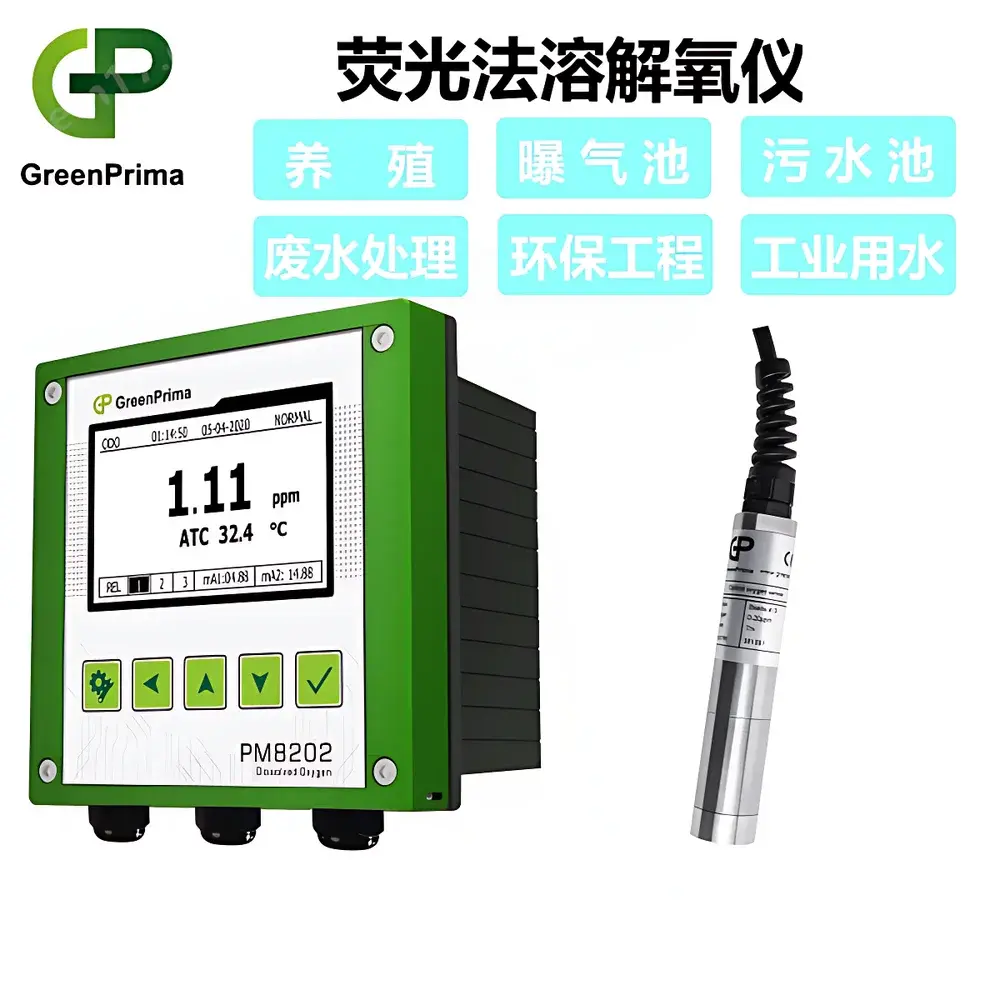
GreenPrima PM8202O Fluorescence-Based Dissolved Oxygen Analyzer
| Brand | GreenPrima |
|---|---|
| Origin | United Kingdom |
| Manufacturer Type | Original Equipment Manufacturer (OEM) |
| Product Category | Imported Instrument |
| Model | PM8202O |
| Instrument Type | Online Dissolved Oxygen Analyzer |
| Measurement Principle | Fluorescence Quenching |
| Measurement Range | 0.00–20.00 ppm |
| Accuracy | ±0.01 ppm |
| Resolution | 0.01 ppm |
| Temperature Compensation Range | –10 to +130 °C (NTC30k or PT1000 selectable) |
| Operating Temperature | –10 to +70.0 °C |
| Storage Temperature | –20 to +70.0 °C |
| Display | Backlit Graphic LCD |
| Language Interface | English & Chinese |
| Data Storage Capacity | 600,000 records |
| Power Supply | 90–260 VAC, 50/60 Hz or 24 VDC (optional) |
| Output | Two isolated 4–20 mA outputs (max. loop resistance 500 Ω, accuracy 0.1% FS) |
| Cleaning Control | Optional air-pulse self-cleaning (interval: 0.1–1000 h |
| duration | 1–1000 s) |
| Alarm Outputs | Two independent Hi/Lo relay outputs (5 A / 250 VAC / 30 VDC) |
| Enclosure Rating | IP65 |
| Mounting Options | Wall-mount, pipe-mount, panel-mount |
| Dimensions (H×W×D) | 144 × 144 × 108 mm |
| Panel Cutout | 138 × 138 mm |
| Weight | 0.87 kg |
Overview
The GreenPrima PM8202O is an online dissolved oxygen (DO) analyzer engineered for continuous, high-stability monitoring in demanding water quality applications. It employs optical fluorescence quenching technology—based on the Stern–Volmer principle—to quantify dissolved molecular oxygen concentration without electrochemical consumption or membrane-dependent diffusion. Unlike traditional Clark-type amperometric sensors, the PM8202O utilizes a solid-state luminescent sensor spot (integrated into the Bsens410 probe) that emits light upon excitation and exhibits intensity- and lifetime-based quenching proportional to local O2 partial pressure. This non-consumptive measurement eliminates flow dependency, avoids zero drift from electrolyte depletion or membrane fouling, and ensures stable baseline performance across low-circulation environments—including wastewater effluent channels, aquaculture ponds, and reservoir intakes.
Key Features
- Fluorescence-based sensing with no oxygen consumption—ideal for stagnant or laminar flow conditions
- Zero-maintenance optical transducer: no membranes, no electrolytes, no refilling or replacement cycles
- Stable signal output with negligible long-term drift; calibration intervals extended to ≥6 months under routine operation
- Digital Bsens410 sensor with embedded temperature compensation (NTC30k or PT1000 configurable) and built-in diagnostics
- Backlit high-contrast graphic LCD supporting dual-language (English/Chinese) interface and intuitive navigation
- Two fully isolated 4–20 mA analog outputs assignable to DO concentration and/or temperature; compliant with industrial current-loop standards (IEC 61000-4-4, IEC 61000-4-5)
- RS485 Modbus RTU protocol support for integration into SCADA, DCS, or PLC-based monitoring networks
- 316L stainless steel sensor body rated for aggressive aqueous media including saline, chlorinated, and sulfide-rich waters
- Optional compressed-air pulse cleaning system programmable for interval (0.1–1000 h) and duration (1–1000 s), mitigating biofouling in untreated surface water or wastewater
- Configurable dual relay alarm outputs with adjustable hysteresis, suitable for process interlock or maintenance alerting per ISO 14001 or ISO 55000 asset management frameworks
Sample Compatibility & Compliance
The PM8202O is validated for use across diverse aqueous matrices: municipal and industrial wastewater streams, raw and treated drinking water, natural surface waters (rivers, lakes, estuaries), recirculating aquaculture systems (RAS), and cooling tower circuits. Its optical design inherently rejects interference from hydrogen sulfide, chlorine residuals, heavy metals, and suspended solids—common sources of error in electrochemical DO sensors. The instrument meets electromagnetic compatibility requirements per EN 61326-1 (industrial environment) and carries CE marking under the EU Measuring Instruments Directive (MID) Annex MI-004 for continuous emission monitoring. While not certified to US EPA Method 360.1 or ASTM D888, its performance characteristics align with the precision and stability benchmarks specified therein for field-deployable optical DO analyzers. Data integrity complies with GLP principles through time-stamped storage (600,000 records) and password-protected configuration access.
Software & Data Management
No proprietary software is required for basic operation; all configuration, calibration, and diagnostic functions are accessible via the front-panel interface. For centralized deployment, the Modbus RTU protocol enables seamless integration with third-party historian platforms (e.g., Ignition, Siemens Desigo, Honeywell Experion). Stored data include timestamped DO values, temperature readings, sensor status flags (e.g., “cleaning active”, “signal weak”), and system events—all exportable via USB or serial dump. Audit trails are maintained for parameter changes, including user ID (if network-authenticated), timestamp, and previous/updated values—supporting FDA 21 CFR Part 11 readiness when deployed within validated GMP water systems.
Applications
- Real-time DO control in activated sludge bioreactors and denitrification zones
- Early-warning monitoring of hypoxia events in riverine and coastal ecosystems
- Process optimization in fish hatcheries and shrimp farming operations where DO < 4 ppm threatens survival
- Compliance tracking for discharge permits requiring continuous DO reporting (e.g., UK Environment Agency General Binding Rules, EU Urban Wastewater Treatment Directive Annex I)
- Performance verification of aerators, diffusers, and mixing systems in treatment plants
- Long-term environmental monitoring at remote stations powered by solar/battery hybrid systems (24 VDC option supports off-grid operation)
FAQ
Does the PM8202O require periodic calibration?
Yes—though significantly less frequently than electrochemical sensors. A two-point calibration (zero-oxygen and air-saturated water) is recommended every 3–6 months depending on exposure conditions. Factory calibration certificates are traceable to NPL (UK National Physical Laboratory) standards.
Can it operate in seawater or brackish water?
Yes. The 316L stainless steel housing and fluoropolymer-coated optical window provide corrosion resistance up to 3.5% salinity. Salinity compensation is applied automatically when temperature and conductivity inputs are available (external probe required).
Is the air-pulse cleaning system mandatory?
No—it is optional and application-dependent. It is strongly advised for untreated surface water, wastewater influent, or any site with measurable biofilm formation potential. In clean, filtered process water, manual cleaning every 3–12 months suffices.
What is the maximum cable length between controller and Bsens410 sensor?
Standard configuration supports up to 100 m using shielded twisted-pair (STP) cable. For longer runs, signal repeaters or fiber-optic media converters may be integrated via the RS485 interface.
How is temperature compensated during measurement?
The Bsens410 probe integrates a precision NTC30k or PT1000 thermistor. Compensation follows the ISO 5814:2012 algorithm for oxygen solubility in water, dynamically adjusting for local temperature and—when configured—barometric pressure and salinity.







