
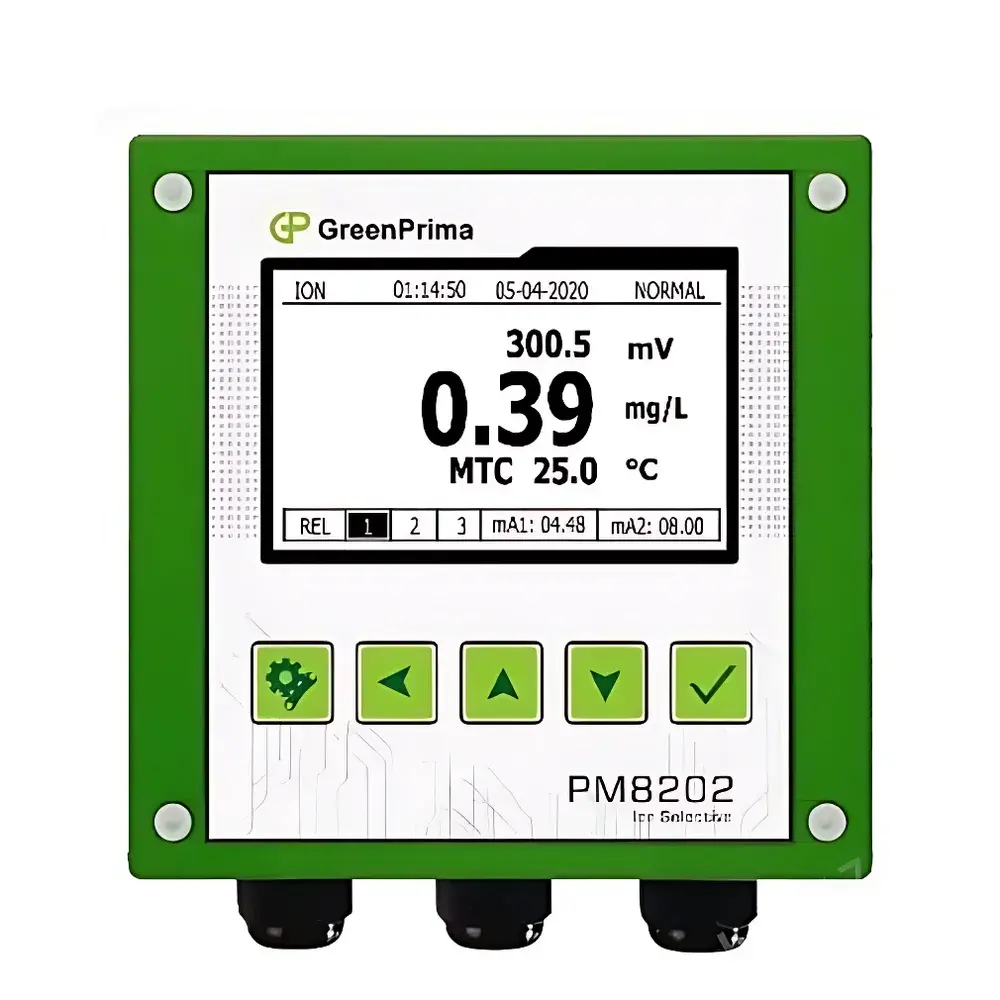
GreenPrima PM8202I Online Ammonia Nitrogen Analyzer
| Brand | GreenPrima |
|---|---|
| Origin | United Kingdom |
| Manufacturer Type | Original Equipment Manufacturer (OEM) |
| Product Category | Imported Instrument |
| Model | PM8202I |
| Instrument Type | Online Analyzer |
| Measurement Principle | Ion-Selective Electrode (ISE) Method |
| Measurement Range | 0.00–20,000 ppm NH₃–N |
| Accuracy | ±0.01 ppm / ±0.1 ppm / ±1 ppm (depending on range selection) |
| Resolution | 0.01 / 0.1 / 1 ppm |
| Temperature Compensation | –10 to 130 °C (manual or automatic |
| Operating Temperature | –10 to 70.0 °C |
| Storage Temperature | –20 to 70.0 °C |
| Display | Backlit dot-matrix LCD |
| Language Interface | English & Chinese |
| Data Storage Capacity | 600,000 records |
| Power Supply | 90–260 VAC, 50/60 Hz or optional 24 VDC |
| Output Signals | Two isolated 4–20 mA outputs (max. loop resistance 500 Ω, accuracy ±0.1% FS) |
| Cleaning Control | Adjustable cleaning interval (0.1–1000 h) and duration (1–1000 s) |
| Alarm Outputs | Two independent Hi/Lo relay outputs (5 A / 250 VAC / 30 VDC), with hysteresis setting |
| Enclosure Rating | IP65 |
| Mounting Options | Wall-mount, pipe-mount, panel-mount |
| Dimensions (H×W×D) | 144 × 144 × 108 mm |
| Cut-out Size | 138 × 138 mm |
| Weight | 0.87 kg |
Overview
The GreenPrima PM8202I Online Ammonia Nitrogen Analyzer is a dedicated, multi-parameter ion-selective electrode (ISE)-based monitoring system engineered for continuous, real-time quantification of ammonia nitrogen (NH3–N) in aqueous environments. Unlike colorimetric or spectrophotometric methods, the PM8202I employs a potentiometric ISE measurement principle—specifically utilizing the Bsens730 ammonia-selective electrode—which delivers rapid response, minimal reagent dependency, and stable long-term operation under variable flow and matrix conditions. The analyzer integrates seamlessly into distributed control systems (DCS) or SCADA networks via standard industrial protocols, supporting uninterrupted compliance monitoring across municipal water treatment, wastewater effluent discharge points, and process-critical industrial cooling or boiler feedwater loops.
Key Features
- Triple-electrode modular architecture: Supports simultaneous or sequential deployment of Bsens710 (fluoride), Bsens720 (chloride), and Bsens730 (ammonia nitrogen) electrodes—enabling flexible configuration without hardware replacement.
- Robust IP65-rated enclosure with full-seal design ensures operational reliability in humid, dusty, or splash-prone environments typical of pump stations, lift stations, and outdoor metering kiosks.
- High-resolution backlit dot-matrix LCD provides simultaneous visualization of NH3–N concentration, measured temperature, system time, relay status, and diagnostic flags—reducing operator interpretation latency.
- Dual isolated 4–20 mA analog outputs assignable to either NH3–N concentration or temperature, each calibrated to ±0.1% full scale, compliant with ISA-50.00.01 signal integrity requirements.
- Configurable cleaning cycle management: Programmable cleaning interval (0.1–1000 hours) and duration (1–1000 seconds) mitigates electrode fouling in high-suspended-solid or organic-rich streams.
- Modbus RTU over RS485 enables bidirectional communication for remote parameter adjustment, data polling, and firmware updates—fully compatible with industry-standard PLCs and HMI platforms.
- Password-protected configuration interface prevents unauthorized calibration or setpoint modification, supporting audit-ready operational discipline per ISO/IEC 17025 and EPA Method 350.1 documentation practices.
Sample Compatibility & Compliance
The PM8202I is validated for use in potable water, secondary-treated wastewater, industrial process water, and recirculating cooling systems. Its ISE-based detection exhibits low interference from common anions (e.g., Cl−, NO3−) and cations (e.g., Ca2+, Mg2+) when operated within specified pH (6.0–9.0) and ionic strength ranges. The system meets CE marking requirements for electromagnetic compatibility (EN 61326-1) and safety (EN 61010-1). While not certified to US EPA Method 350.1 or ISO 7150-1 as a standalone unit, its measurement performance aligns with the precision and repeatability thresholds defined therein when deployed with appropriate sample conditioning (e.g., pH adjustment, filtration) and routine electrode maintenance.
Software & Data Management
Data logging is performed autonomously onboard the controller, storing up to 600,000 timestamped records—including NH3–N value, temperature, electrode mV output, and system diagnostics—at user-defined intervals (1 second to 24 hours). Logged data can be exported via USB or retrieved remotely via Modbus register reads for integration into LIMS or cloud-based asset monitoring platforms. All configuration changes, calibration events, and alarm triggers are time-stamped and retained in non-volatile memory, satisfying GLP traceability requirements. Optional software tools support calibration curve generation, drift analysis, and trend reporting aligned with ISO 5725 reproducibility guidelines.
Applications
- Real-time monitoring of ammonia breakthrough in granular activated carbon (GAC) or ion exchange polishing units.
- Effluent compliance verification at municipal wastewater treatment plant (WWTP) discharge outfalls per national limits (e.g., EU Urban Wastewater Directive, US Clean Water Act NPDES permits).
- Process control of nitrification/denitrification basins through feedback-driven aeration optimization.
- Early detection of ammonia spikes in drinking water distribution systems following chloramine decay or source contamination events.
- Monitoring of ammonia accumulation in closed-loop industrial cooling towers to prevent microbiologically influenced corrosion (MIC) and scale formation.
FAQ
What calibration standards are required for the Bsens730 ammonia electrode?
Standard ammonium chloride (NH4Cl) solutions at two or three concentrations spanning the intended measurement range—e.g., 1 ppm, 100 ppm, and 5,000 ppm NH3–N—are recommended. Calibration frequency depends on application severity but typically ranges from daily (high-fouling influent) to weekly (polished effluent).
Can the PM8202I operate without temperature compensation?
No. Accurate ISE measurements require active temperature compensation due to the inherent thermodynamic dependence of electrode potential. The system supports both NTC30K and PT1000 sensors and allows manual or automatic compensation mode selection.
Is the analyzer suitable for seawater or brackish water applications?
Not without pretreatment. High ionic strength (>35,000 µS/cm) and competing ions (e.g., Na+) significantly affect ISE selectivity and slope stability. Dilution or desalination pretreatment is advised, and validation against reference methods (e.g., ASTM D1426) is required prior to deployment.
How is electrode lifetime defined and monitored?
Electrode lifespan is assessed via slope evaluation during calibration (target: 54–59 mV/decade at 25 °C) and zero-point stability. The controller logs mV readings and calculates slope deviation; alerts trigger when slope falls below 90% of initial value or zero drift exceeds ±15 mV.
Related Products







