
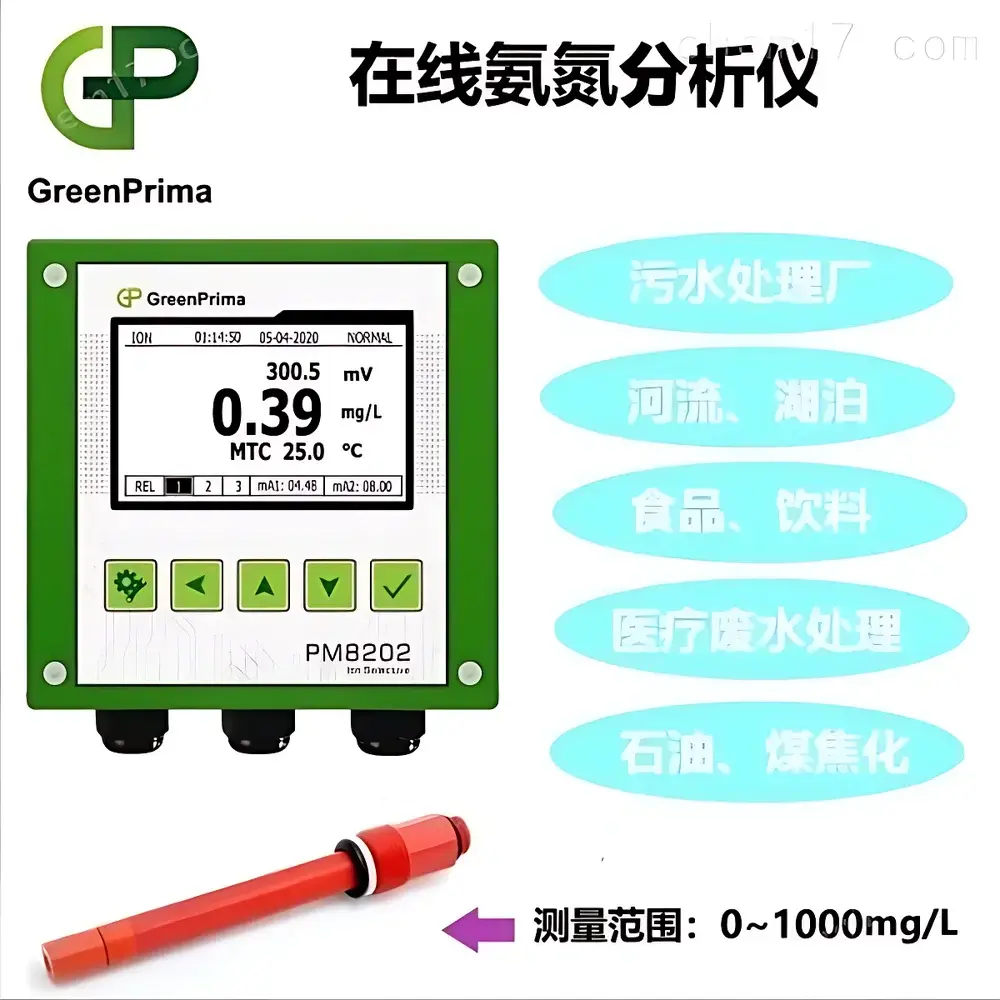
GreenPrima PM8202I Online Ammonia Nitrogen Analyzer
| Brand | GreenPrima |
|---|---|
| Origin | UK |
| Manufacturer Type | Manufacturer |
| Origin Category | Imported |
| Model | PM8202I |
| Instrument Type | Online |
| Measurement Principle | Ion-Selective Electrode (ISE) Method |
| Measurement Range | 0.00–20,000 ppm |
| Accuracy | ±0.01 ppm / ±0.1 ppm / ±1 ppm (range-dependent) |
| Resolution | 0.01 / 0.1 / 1 ppm |
| Temperature Compensation | -10–130 °C (manual/automatic, NTC30K or PT1000) |
| Operating Temperature | -10–70.0 °C |
| Storage Temperature | -20–70.0 °C |
| Display | Backlit large-dot-matrix LCD |
| Language | English & Chinese |
| Data Storage | 600,000 records |
| Power Supply | 90–260 VAC, 50/60 Hz or optional 24 VDC |
| Output | Two isolated 4–20 mA outputs (max. loop resistance 500 Ω, accuracy 0.1% FS) |
| Communication | RS485 Modbus RTU |
| Cleaning Control | Adjustable interval (0.1–1000 h) and duration (1–1000 s) |
| Alarm Outputs | Two independent Hi/Lo relay outputs (5 A / 250 VAC / 30 VDC) |
| Mounting | Wall-mounted, pipe-mounted, or panel-mounted |
| Enclosure Rating | IP65 |
| Dimensions | 144 × 144 × 108 mm |
| Cutout | 138 × 138 mm |
| Weight | 0.87 kg |
Overview
The GreenPrima PM8202I Online Ammonia Nitrogen Analyzer is an industrial-grade, continuous monitoring system engineered for reliable quantification of ammonia nitrogen (NH₃-N) in aqueous matrices using potentiometric ion-selective electrode (ISE) technology. Based on the Nernst equation response of a proprietary solid-state ammonium-selective membrane, the analyzer delivers stable, real-time measurement across a wide dynamic range—0.00 to 20,000 ppm—without requiring reagent addition or optical path alignment. Its architecture integrates the PM8202I controller with the Bsens730 ammonia-specific ISE sensor, enabling simultaneous multi-parameter capability (e.g., fluoride, chloride, and ammonium) when configured with compatible electrodes. Designed for deployment in demanding water infrastructure environments—including drinking water treatment plants, municipal wastewater influent/effluent streams, and industrial process water loops—the system operates under variable pH, turbidity, and conductivity conditions while maintaining electrochemical stability through integrated temperature compensation (NTC30K or PT1000 probe support).
Key Features
- Robust IP65-rated enclosure with full-seal design, suitable for outdoor or wet-location installation without additional housing
- Intuitive dual-language (English/Chinese) graphical interface on backlit dot-matrix LCD, supporting parameter navigation, calibration logging, and real-time trend visualization
- Dual isolated 4–20 mA analog outputs configurable for NH₃-N concentration and/or temperature, compliant with standard PLC/SCADA integration requirements
- RS485 Modbus RTU communication protocol for seamless data exchange with central monitoring systems and DCS platforms
- Programmable automatic electrode cleaning cycle—adjustable interval (0.1–1000 hours) and duration (1–1000 seconds)—to mitigate fouling in high-suspended-solid applications
- Two independent relay alarm outputs with user-defined high/low thresholds and adjustable hysteresis, rated at 5 A / 250 VAC / 30 VDC
- Onboard data logger storing up to 600,000 timestamped records (concentration, temperature, calibration events, system status)
- Flexible power options: universal 90–260 VAC, 50/60 Hz input or optional 24 VDC for hazardous-area or battery-backed deployments
Sample Compatibility & Compliance
The PM8202I is validated for use in potable water, secondary-treated wastewater, cooling tower makeup, and industrial process streams with total suspended solids (TSS) ≤ 100 mg/L and pH 4.0–9.0. It meets functional requirements aligned with ISO 7888 (water quality — determination of ammonium — ion-selective electrode method) and supports audit-ready operation per GLP and GMP principles. While not a certified reference method per EPA Method 350.1 or ISO 14911, its performance characteristics—including range linearity (R² ≥ 0.999), repeatability (<1.5% RSD over 24 h), and low drift (<0.5% FS/week)—enable routine compliance monitoring where regulatory frameworks permit ISE-based online instrumentation. The system’s password-protected configuration interface and immutable event logging satisfy foundational data integrity expectations under FDA 21 CFR Part 11 for non-GxP-critical applications.
Software & Data Management
No external software is required for basic operation; all configuration, calibration, and diagnostics are performed locally via the front-panel interface. For centralized data aggregation, the built-in Modbus RTU server allows polling of real-time values (NH₃-N concentration, temperature, electrode mV, slope, offset, cleaning status) and historical logs via standard Modbus function codes (03h, 04h, 16h). Logged data include UTC timestamps, measurement units, operator ID (if entered), and calibration verification flags. Export is supported via USB memory stick (optional accessory) in CSV format for traceability and third-party analysis. Firmware updates are delivered via secure encrypted HEX files loaded from removable media—no internet connectivity required.
Applications
- Real-time ammonia breakthrough detection in granular activated carbon (GAC) or ion exchange beds
- Process control of nitrification/denitrification basins in biological nutrient removal (BNR) systems
- Monitoring of ammonia slip in chloramination processes to prevent disinfection byproduct formation
- Effluent compliance tracking against local discharge limits (e.g., EU Urban Wastewater Directive Annex I, US NPDES permits)
- Industrial cooling water management to prevent microbiologically influenced corrosion (MIC) linked to elevated NH₃-N
- Recirculating aquaculture systems (RAS) where sub-ppm-level ammonia toxicity thresholds must be enforced
FAQ
What calibration standards are required for the Bsens730 ammonia electrode?
Standard solutions of ammonium chloride (NH₄Cl) at two or three concentrations spanning the operational range (e.g., 1 ppm, 100 ppm, 5000 ppm) are recommended. Calibration frequency depends on application severity—typically every 24–168 hours in wastewater; weekly in potable water.
Can the PM8202I measure free ammonia (NH₃) separately from total ammonia nitrogen (TAN)?
No. The Bsens730 electrode responds to the ammonium ion (NH₄⁺) activity, which—under equilibrium—is directly related to TAN. Free ammonia concentration must be calculated post-measurement using simultaneous pH and temperature readings and established equilibrium equations.
Is the system compatible with hazardous area classifications (e.g., ATEX, IECEx)?
The base unit is not intrinsically safe certified. For Zone 1/2 installations, it must be housed in an approved explosion-proof enclosure or used with an I.S. barrier kit (sold separately) in conjunction with the 24 VDC power option.
How often does the ammonium ISE require replacement?
Typical service life is 12–18 months under continuous operation in clean water; 6–12 months in wastewater with high sulfide or organic loading. Performance degradation is indicated by reduced slope (±15 mV).







