
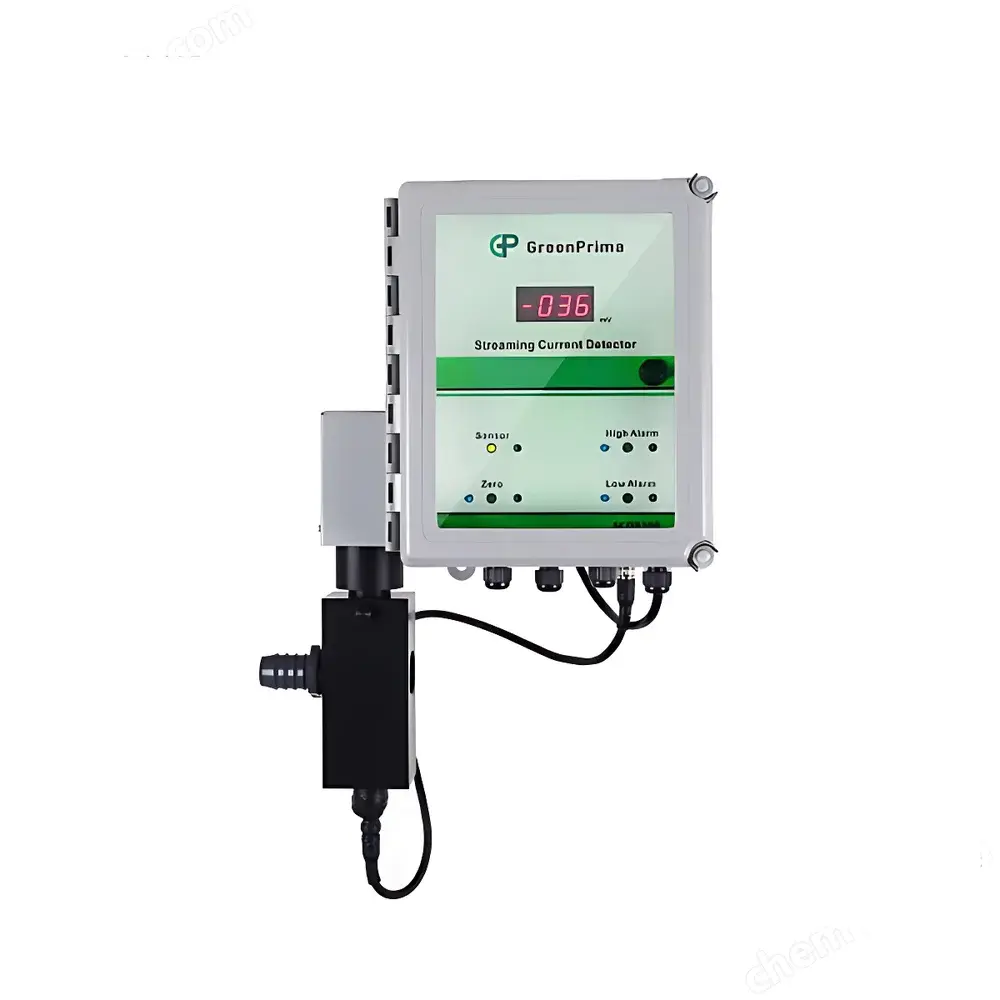
GreenPrima SCD 8200 Streaming Current Detector
| Brand | GreenPrima |
|---|---|
| Origin | Germany |
| Manufacturer Type | Manufacturer |
| Origin Category | Imported |
| Model | SCD 8200 |
| Price | Upon Request |
| Power Supply | 100–240 VAC |
| Measurement Range | −1000 to +1000 mV |
| Accuracy | ±0.1% of full scale |
| Display | LED |
| Flow Rate | 1 L/min |
| Inlet Connection | 1/2" |
| Outlet Connection | 3/4" |
| Response Time | 1 s |
| Sensor Material | Delrin / 316 Stainless Steel / PTFE |
| Output Signals | 4–20 mA, −10 to +10 V, 0–10 V |
| Communication | Optional MODBUS RTU (RS-485) |
| Alarm Outputs | High/Low Relay |
| Enclosure Rating | IP65 |
| Dimensions | 279 × 152 mm (11.0" × 6.00") |
| Weight | 9 kg |
Overview
The GreenPrima SCD 8200 Streaming Current Detector is an industrial-grade, online electrokinetic analyzer engineered for real-time monitoring and control of coagulation efficiency in water and wastewater treatment processes. It operates on the principle of streaming current measurement—a well-established electrokinetic technique wherein a controlled pressure-driven flow of sample liquid through a narrow, insulated capillary or sensor chamber generates a measurable electrical potential across two parallel electrodes. This potential arises from the displacement of the diffuse layer of counter-ions adjacent to charged colloidal particles (e.g., clay, organic matter, or metal hydroxides) under shear stress. The resulting streaming current is directly proportional to the net surface charge density of suspended colloids and serves as a robust surrogate for zeta potential—without requiring dilution, particle size assumptions, or optical access.
Key Features
- Real-time streaming current measurement with 1-second response time, enabling dynamic feedback control of coagulant dosing
- Zero-point auto-calibration function eliminates manual drift correction and ensures long-term measurement stability
- Robust sensor architecture featuring chemically inert wetted materials: Delrin housing, 316 stainless steel fluid path components, and PTFE-sealed electrodes for resistance to aggressive oxidants, acids, and chlorine residuals
- Triple-output analog interface (4–20 mA, ±10 V, 0–10 V) compatible with DCS, PLC, and SCADA systems for seamless integration into existing process automation infrastructure
- Optional MODBUS RTU (RS-485) communication protocol supporting remote configuration, diagnostics, and data logging in compliance with IEC 61158 and ISA-88 standards
- IP65-rated enclosure suitable for wall-mount or panel-mount installation in humid, non-hazardous environments common in pump stations, clarifiers, and filtration skids
Sample Compatibility & Compliance
The SCD 8200 is validated for continuous operation with raw surface water, clarified effluent, pre-filtered RO feedwater, and thickened sludge supernatant—provided suspended solids remain below 100 mg/L and particulate size does not exceed 100 µm to prevent sensor clogging. It complies with EN 61326-1 (EMC for industrial environments) and meets the mechanical safety requirements of EN 61000-6-2/-4. While not certified to ISO/IEC 17025 as a standalone metrological instrument, its measurement traceability aligns with ASTM D2022 (Standard Test Method for Streaming Current of Aqueous Suspensions) and supports GLP/GMP process validation when integrated into documented control strategies per USP and EPA Guidance for Coagulation Control in Drinking Water Treatment.
Software & Data Management
The device operates autonomously without embedded software; however, its analog and MODBUS outputs are fully compatible with industry-standard supervisory platforms including Siemens Desigo CC, Honeywell Experion PKS, and Schneider EcoStruxure Process Expert. When connected to a historian or MES system, streaming current trends can be correlated with turbidity, pH, conductivity, and coagulant dosage rate to generate multivariate process signatures. Audit trails—including calibration timestamps, alarm events, and output signal deviations—are retained within the host system in accordance with FDA 21 CFR Part 11 requirements when paired with compliant data acquisition modules.
Applications
- Optimization of polyaluminum chloride (PACl), ferric chloride, or cationic polymer dosing in potable water treatment plants
- Adaptive control of coagulant feed in membrane bioreactor (MBR) and tertiary filtration systems to minimize fouling
- Monitoring charge neutralization efficacy during dissolved air flotation (DAF) and lamella clarifier operations
- Process support for zero-liquid discharge (ZLD) pretreatment where residual colloidal charge impacts evaporator scaling potential
- Sludge conditioning assessment prior to centrifuge dewatering or belt press operations
FAQ
What physical parameter does the SCD 8200 actually measure?
It measures the streaming current (in millivolts) generated by the movement of counter-ions in the electrical double layer under controlled laminar flow—directly reflecting the net surface charge of colloidal suspensions.
Can it replace offline zeta potential analyzers?
No—it provides a process-robust, continuous proxy for colloidal charge state but lacks the particle-size resolution and statistical sampling depth of laboratory-based electrophoretic light scattering instruments.
Is regular maintenance required beyond zero calibration?
Yes: quarterly inspection of electrode surfaces for biofilm or precipitate buildup is recommended; sensor cleaning with 0.1 M HCl followed by deionized water rinse restores baseline performance.
Does the unit require a dedicated sample loop or bypass line?
Yes—an external recirculation pump and pressure-regulated side-stream (1 L/min at ≤3 bar) must be provided; the SCD 8200 itself contains no internal pumping mechanism.
How is sensor fouling mitigated in high-turbidity applications?
By integrating a 50-µm inline filter upstream and scheduling automated backflush cycles synchronized with plant SCADA logic—typically every 4–8 hours depending on influent quality.




