
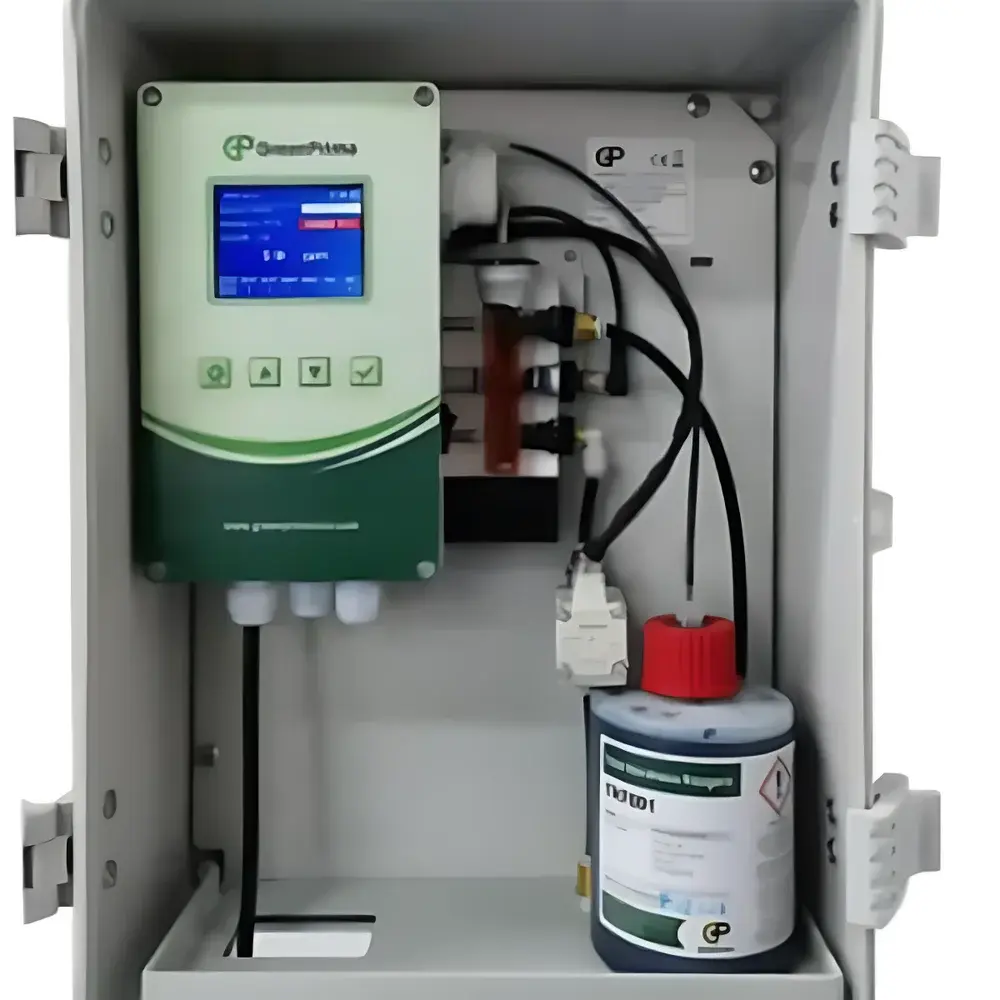
GreenPrima DPD-Aqualysis800 Industrial Water Hardness Analyzer
| Brand | GreenPrima |
|---|---|
| Origin | UK |
| Manufacturer Type | Manufacturer |
| Origin Category | Imported |
| Model | DPD-Aqualysis800 |
| Price | Upon Request |
| Measurement Principle | Titrimetric Colorimetry |
| Measurement Time | 2–8 min (hardness-dependent) |
| Accuracy | ±2% of selected reagent’s upper range |
| Repeatability | ±2% of selected reagent’s upper range |
| Power Supply | 85–265 VAC, 47–63 Hz |
| Power Consumption | 25 VA (operational), 3.5 VA (standby) |
| Enclosure Rating | IP65 |
| Dimensions (H×W×D) | 400 × 300 × 180 mm |
| Weight | 4 kg |
| Display | Color LCD with bilingual (English/Chinese) interface |
| Measurement Modes | Continuous or interval (1–360 min) |
| Sample Temperature Range | 5–40 °C |
| Ambient Operating Temperature | 10–40 °C |
| Sample Pressure Range | 0.2–5 bar (recommended: 1–2 bar) |
| Sample pH Range | 4–10 |
| Interference Limits | Fe < 3 ppm, Cu < 0.2 ppm, Al < 0.1 ppm, Mn < 0.2 ppm |
| Output Options | 4 programmable relay outputs (max. 250 V, 4 A), 1 isolated 4–20 mA output (max. 750 Ω), 1 RS485 Modbus RTU port |
| Input Options | 2 programmable digital inputs (IN1: start analysis |
| IN2 | stop analysis) |
| Flush Duration | Configurable (15–1800 s) |
| Reagent Kits | TH7000 to TH7100 (7 ranges, covering 0.177–625.8 ppm CaCO₃ equivalent) |
Overview
The GreenPrima DPD-Aqualysis800 Industrial Water Hardness Analyzer is an automated, on-line titrimetric colorimetric instrument engineered for continuous or scheduled monitoring of total hardness—expressed as calcium carbonate (CaCO₃) equivalence—in industrial process water streams. It operates on the standardized DPD (N,N-diethyl-p-phenylenediamine)–EDTA titration principle, where a precisely metered volume of sample reacts with a buffered chromogenic reagent and titrant under controlled pH conditions; the endpoint is detected photometrically via dual-wavelength absorbance measurement. This method delivers high specificity for divalent cations (primarily Ca²⁺ and Mg²⁺), minimizing interference from monovalent ions and offering superior selectivity compared to conductometric or ion-selective electrode approaches. Designed for unattended operation in demanding environments—including boiler feedwater systems, cooling towers, reverse osmosis pre-treatment loops, and steam generation units—the Aqualysis800 integrates robust fluidics, temperature-compensated optics, and embedded calibration logic to ensure long-term stability and traceable accuracy without manual intervention.
Key Features
- Modular reagent architecture supporting seven interchangeable test kits (TH7000–TH7100), enabling dynamic range selection from 0.177 to 625.8 ppm CaCO₃—optimized for low-hardness boiler make-up water or high-hardness cooling tower blowdown.
- Self-diagnostic system with real-time fault logging, automatic blank verification, and reagent depletion alerts—reducing operator dependency and ensuring analytical integrity across extended deployment cycles.
- Compact wall-mount enclosure (IP65-rated) with integrated color LCD display, supporting both English and Chinese language modes for multilingual operational environments.
- Flexible measurement scheduling: configurable interval analysis (1–360 minutes), external trigger control via dry-contact inputs, or flow-synchronized sampling—enabling alignment with plant maintenance windows or process batch cycles.
- Low reagent consumption (<1.2 mL per analysis) and minimal waste generation—aligned with ISO 14001 environmental management objectives and reducing total cost of ownership over 5+ year service life.
- Comprehensive I/O suite: four programmable relay outputs for alarm staging or softener regeneration control, one isolated 4–20 mA analog output for SCADA integration, and RS485 Modbus RTU for centralized data aggregation in distributed control systems (DCS).
Sample Compatibility & Compliance
The Aqualysis800 is validated for use with clarified, non-turbid industrial water matrices meeting defined physicochemical constraints: pH 4.0–10.0, dissolved iron < 3 ppm, copper < 0.2 ppm, aluminum < 0.1 ppm, and manganese < 0.2 ppm. These specifications align with ASTM D1126–22 (Standard Test Method for Hardness in Water) and support compliance with ASME B31.1 power piping code requirements for boiler feedwater quality. The analyzer’s design adheres to IEC 61000-6-2 (EMC immunity) and IEC 61000-6-4 (EMC emissions) standards. When deployed in regulated pharmaceutical or food-grade water systems, its audit-ready event log (including calibration timestamps, reagent lot tracking, and error codes) supports adherence to FDA 21 CFR Part 11 electronic record requirements when paired with validated LIMS or MES platforms.
Software & Data Management
The embedded firmware provides local data retention for up to 30 days of hourly hardness values, diagnostic events, and calibration history—all timestamped and stored with millisecond precision. No proprietary software is required for basic configuration; all setup is performed via intuitive on-device menu navigation or Modbus register mapping. For enterprise-level integration, GreenPrima provides a documented Modbus RTU register map and optional OPC UA gateway compatibility (via third-party middleware). All stored data are exportable via RS485 using standard ASCII or CSV protocols. Firmware updates are delivered via secure USB flash drive, with version-controlled release notes and rollback capability—ensuring continuity during GxP validation lifecycle management.
Applications
- Real-time hardness surveillance in high-pressure boiler feedwater circuits to prevent scale formation in economizers and superheaters.
- Automated control of ion exchange softeners and antiscalant dosing pumps in HVAC cooling tower networks.
- Pre-treatment monitoring upstream of reverse osmosis (RO) membranes to extend membrane service life and reduce cleaning frequency.
- Quality gate checks in pharmaceutical purified water (PW) and water-for-injection (WFI) distribution loops per USP and EU Annex 1 guidance.
- Process water certification in semiconductor wet benches and electroplating rinse stages where residual Ca²⁺/Mg²⁺ induces surface defects.
- Regulatory reporting for municipal-industrial effluent discharge permits requiring hardness-based compliance thresholds.
FAQ
What hardness ranges does the Aqualysis800 support, and how is range selection performed?
The analyzer supports seven calibrated ranges (TH7000–TH7100), spanning 0.177–625.8 ppm CaCO₃. Range selection is configured via the device menu or Modbus register and must match the installed reagent kit—no hardware modification is required.
Can the Aqualysis800 be integrated into an existing PLC-based control system?
Yes. Its native RS485 Modbus RTU interface enables seamless read/write communication with Allen-Bradley, Siemens, and Schneider PLCs. Relay outputs can directly initiate softener backwash cycles or alarm annunciation without intermediary controllers.
Is periodic manual calibration required?
No. The system performs automatic zero and span verification using factory-certified reference solutions at user-defined intervals. Full calibration verification is recommended annually per ISO/IEC 17025 laboratory practice.
What maintenance tasks are required for uninterrupted operation?
Routine tasks include quarterly optical path cleaning, biannual peristaltic pump tube replacement, and reagent cartridge replacement every 3–6 months depending on analysis frequency—documented in the included maintenance log template.
Does the analyzer comply with GLP or GMP documentation requirements?
It provides full electronic audit trail functionality (user actions, parameter changes, error events) and supports 21 CFR Part 11-compliant electronic signatures when deployed with validated third-party data management software.




