
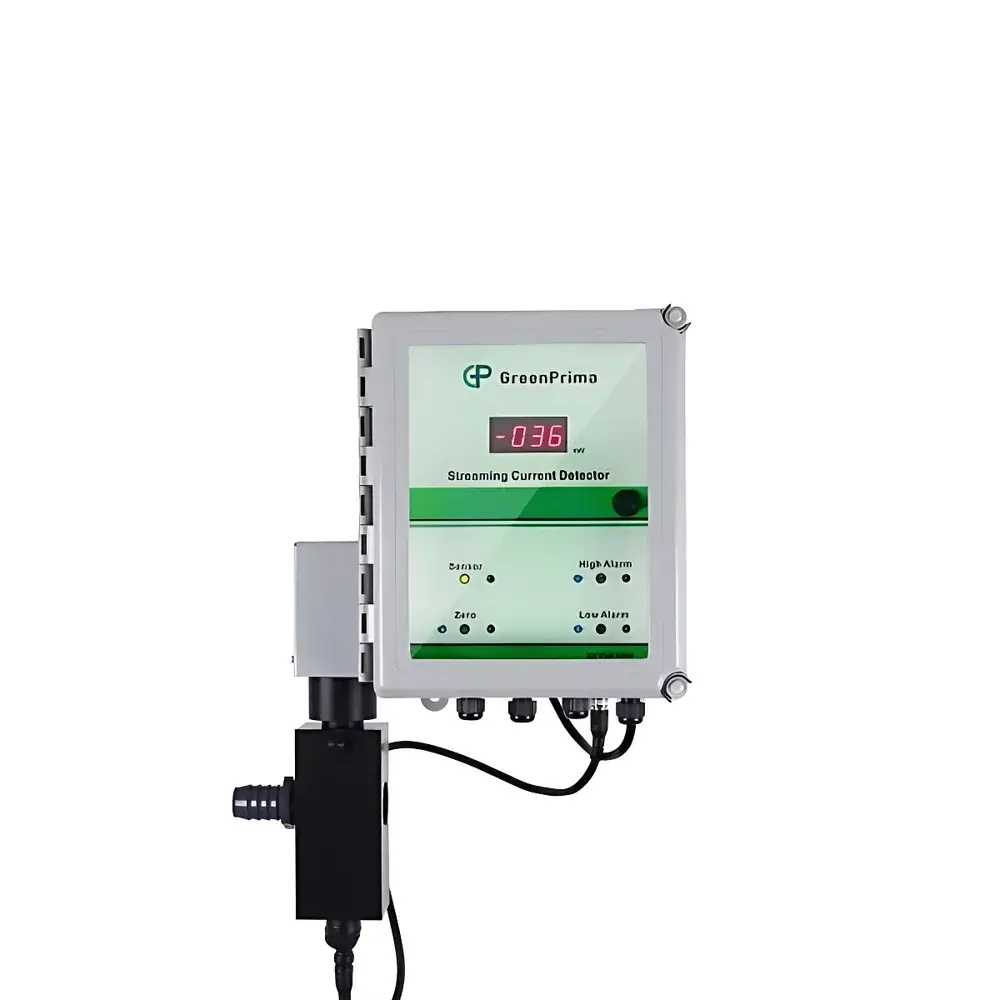
GreenPrima SC D8200 Streaming Current Detector
| Brand | GreenPrima |
|---|---|
| Origin | Germany |
| Manufacturer Type | Manufacturer |
| Origin Category | Imported |
| Model | SC D8200 |
| Power Supply | 100–240 VAC, 50/60 Hz |
| Measurement Range | –1000 to +1000 mV |
| Accuracy | ±0.1% of full scale |
| Display | LED |
| Flow Rate | 1 L/min |
| Inlet Connection | 1/2" NPT |
| Outlet Connection | 3/4" NPT |
| Response Time | ≤1 s |
| Sensor Material | Delrin / 316 Stainless Steel / PTFE |
| Output Signals | 4–20 mA, –10 to +10 V, 0–10 V |
| Communication | MODBUS RTU (RS-485, optional) |
| Alarm Outputs | Dual SPDT relays (high/low) |
| Enclosure Rating | IP65 |
| Dimensions | 279 mm × 152 mm (11.0" × 6.0") |
| Weight | 9 kg |
| Zero Calibration | Automatic |
Overview
The GreenPrima SC D8200 Streaming Current Detector is an industrial-grade, online electrokinetic analyzer engineered for real-time monitoring and control of coagulation efficiency in potable water, wastewater, and process water treatment systems. It operates on the principle of streaming current measurement—a well-established electrophoretic technique that quantifies the net surface charge density of colloidal particles suspended in aqueous media. As a piston-driven flow cell forces water through a precision-machined sensor chamber, shear-induced displacement of the diffuse double layer generates a measurable alternating current between two parallel electrodes embedded in the flow path. This streaming current (SC) signal—expressed in millivolts—is directly proportional to the residual zeta potential of destabilized colloids post-coagulant dosing, thereby serving as a robust, process-relevant surrogate for coagulation endpoint detection.
Key Features
- Automated zero-point calibration eliminates manual drift correction and ensures long-term baseline stability under variable temperature and conductivity conditions.
- Robust sensor construction combining Delrin housing, 316 stainless steel wetted parts, and PTFE seals delivers chemical resistance to chlorine, ferric chloride, aluminum sulfate, and polymeric coagulants across pH 4–10.
- Sub-second response time (≤1 s) enables dynamic feedback control loops compatible with modern SCADA and DCS platforms.
- Dual analog outputs (4–20 mA and ±10 V) plus optional MODBUS RTU (RS-485) support seamless integration into plant-wide automation infrastructure without additional signal conditioning.
- IP65-rated enclosure ensures reliable operation in humid, chemically aggressive environments typical of pump stations, rapid mix basins, and filter influent channels.
- Self-diagnostic LED indicators provide immediate visual status feedback for flow interruption, electrode fouling, and power anomalies—reducing unplanned maintenance interventions.
Sample Compatibility & Compliance
The SC D8200 is validated for continuous operation with raw surface water, clarified effluent, filtered backwash water, and sludge dewatering filtrate. Its design conforms to key international standards governing online water quality instrumentation, including ISO 7027 (turbidity correlation), ASTM D3864 (coagulation control methodology), and EN 1485 (electrokinetic measurement principles). While not a standalone compliance device, its output supports adherence to regulatory frameworks requiring documented optimization of coagulant dosing—such as US EPA Guidance for Enhanced Coagulation (40 CFR Part 141) and EU Drinking Water Directive (2020/2184) Annex I parameters related to particle removal efficiency. The instrument’s analog and digital outputs are compatible with 21 CFR Part 11-compliant data acquisition systems when deployed with audit-trail-enabled PLCs or historian software.
Software & Data Management
The SC D8200 operates as a field-level transducer without embedded firmware-based configuration; all parameterization occurs via external controllers or HMI interfaces. Its standardized analog and MODBUS registers allow direct mapping to supervisory control systems supporting Modbus function codes 03 (Read Holding Registers) and 06 (Write Single Register). Typical register assignments include streaming current value (mV), flow status flag, calibration mode indicator, and relay alarm states. When integrated with laboratory information management systems (LIMS) or cloud-based asset performance platforms, the SC signal serves as a primary input for predictive dosing algorithms, enabling adaptive control strategies that reduce coagulant overfeed by up to 25% compared to fixed-dose or turbidity-based setpoints. Data logging intervals are determined externally, ensuring alignment with site-specific GLP/GMP record retention policies.
Applications
- Real-time coagulant dosage optimization in municipal drinking water treatment plants—particularly at rapid mix and flocculation stages.
- Monitoring charge neutralization efficacy during pre-treatment of feedwater for reverse osmosis (RO) and nanofiltration (NF) membrane systems.
- Control of polymer dosing in sludge conditioning prior to centrifuge, belt press, or filter press dewatering operations.
- Performance verification of electrocoagulation units and hybrid coagulation-flocculation reactors.
- Troubleshooting poor floc formation or filter breakthrough events through trending of streaming current hysteresis patterns.
FAQ
How does streaming current differ from zeta potential measurement?
Streaming current is an indirect, bulk-phase electrokinetic measurement sensitive to net surface charge in flowing colloidal suspensions; it does not require particle sizing or dilution. Zeta potential, by contrast, is typically derived from electrophoretic mobility in static or low-shear conditions and is more common in lab-scale characterization.
Can the SC D8200 be installed in pressurized pipelines?
Yes—it is rated for continuous operation at line pressures up to 6 bar (87 psi) when installed with appropriate isolation valves and pressure-reducing regulators upstream of the inlet fitting.
What maintenance is required for long-term accuracy?
Electrode cleaning every 2–4 weeks (depending on suspended solids concentration) using mild citric acid solution; annual verification of piston seal integrity and calibration against certified reference solutions per manufacturer guidelines.
Is the instrument suitable for seawater or brackish water applications?
Not recommended for sustained use above 5,000 µS/cm conductivity due to signal saturation and accelerated electrode polarization; alternative capacitance-based or titration-coupled methods are advised for high-ionic-strength matrices.
Does the SC D8200 support remote firmware updates?
No—its hardware architecture is fixed-function and does not include programmable memory or network connectivity beyond MODBUS serial interface; configuration changes require physical access or upstream controller reprogramming.
Related Products





