
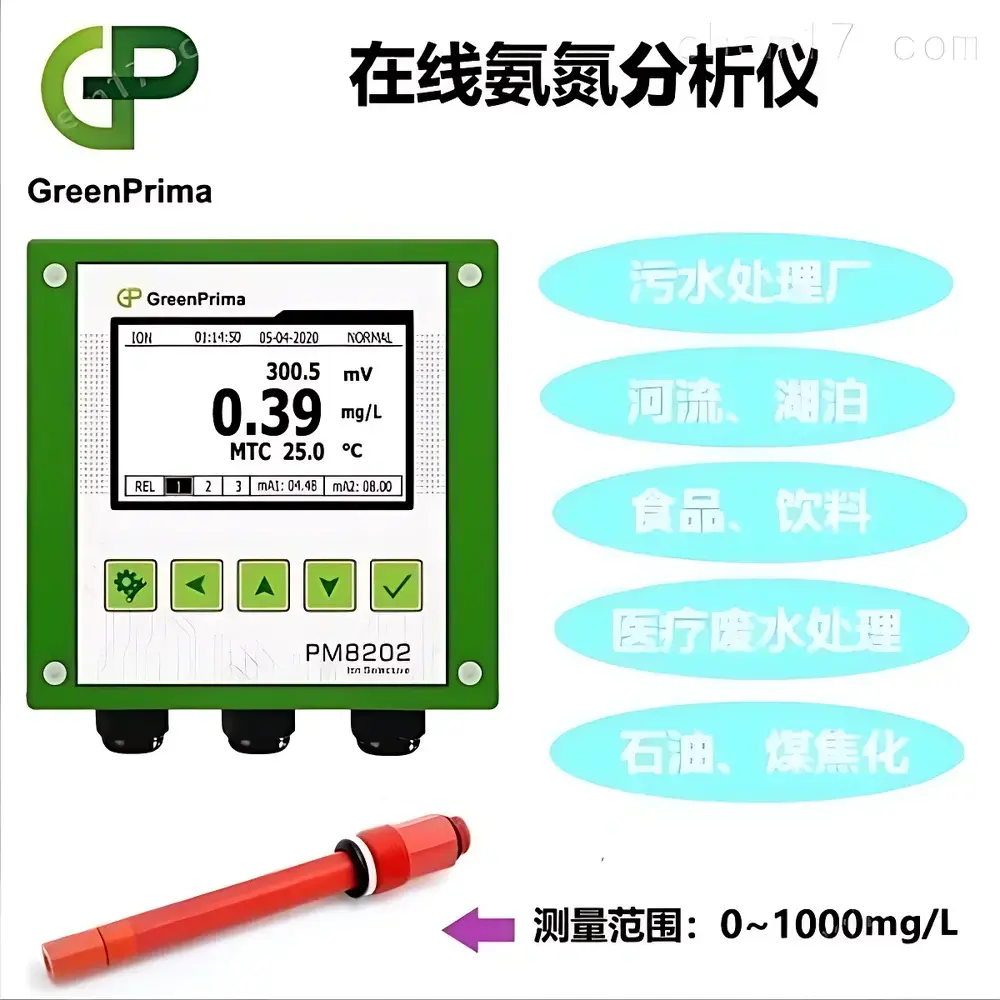
GreenPrima PM 820 2I Online Ammonia Nitrogen Analyzer
| Brand | GreenPrima |
|---|---|
| Origin | UK |
| Manufacturer Type | Manufacturer |
| Origin Category | Imported |
| Model | PM 820 2I |
| Instrument Type | Online |
| Measurement Principle | Ion-Selective Electrode (ISE) Method |
| Measurement Range | 0.00–20,000 ppm |
| Accuracy | ±0.01 / ±0.1 / ±1 ppm |
| Resolution | 0.01 / 0.1 / 1 ppm |
| Temperature Compensation | –10 to 130 °C (manual/automatic, NTC30K or PT1000) |
| Operating Temperature | –10 to 70.0 °C |
| Storage Temperature | –20 to 70.0 °C |
| Display | Backlit dot-matrix LCD |
| Language | English & Chinese |
| Data Storage | 600,000 records |
| Power Supply | 90–260 VAC, 50/60 Hz or 24 VDC optional |
| Output | Two isolated 4–20 mA outputs (max. loop resistance 500 Ω, accuracy 0.1% F.S.) |
| Communication | RS485 Modbus RTU |
| Cleaning Cycle | 0.1–1000 h adjustable |
| cleaning duration | 1–1000 s adjustable |
| Alarm Outputs | Two independent Hi/Lo relay outputs (5 A / 250 VAC / 30 VDC) |
| Enclosure Rating | IP65 |
| Mounting Options | Wall-mount, pipe-mount, panel-mount |
| Dimensions | 144 × 144 × 108 mm |
| Panel Cutout | 138 × 138 mm |
| Weight | 0.87 kg |
Overview
The GreenPrima PM 820 2I Online Ammonia Nitrogen Analyzer is an industrial-grade, continuous monitoring system engineered for reliable, real-time quantification of ammonia nitrogen (NH₃–N) in aqueous matrices using potentiometric ion-selective electrode (ISE) technology. Based on the Nernst equation response of a solid-state, membrane-based ammonium-selective electrode (Bsens730), the analyzer delivers stable electrochemical signal transduction under variable pH and ionic strength conditions—provided appropriate sample conditioning (e.g., pH adjustment to ≥11 with NaOH) is implemented to convert NH₄⁺ to volatile NH₃ for selective detection. Designed for unattended operation in demanding municipal and industrial water environments, it meets fundamental performance requirements for regulatory compliance support in wastewater treatment plants, drinking water distribution systems, cooling tower management, and process water loops where nitrogen speciation impacts biological stability, disinfection by-product formation, and corrosion control.
Key Features
- IP65-rated, fully sealed enclosure with corrosion-resistant housing—suitable for humid, outdoor, or semi-industrial installation environments
- Intuitive dual-language (English/Chinese) graphical interface on backlit dot-matrix LCD—enabling rapid parameter navigation, calibration logging, and status diagnostics without external software
- Dual isolated 4–20 mA analog outputs configurable for ammonia concentration and temperature—compatible with DCS, SCADA, and PLC systems with full span and zero adjustment
- RS485 Modbus RTU serial communication port supporting standard register mapping for remote configuration, data polling, and firmware updates
- Programmable automatic electrode cleaning cycle (interval: 0.1–1000 hours; duration: 1–1000 seconds)—reducing biofouling-induced drift in low-flow or high-suspended-solid applications
- Two independently configurable relay alarm outputs with adjustable hysteresis—supporting fail-safe interlocks for pump activation, chemical dosing, or operator notification
- Built-in temperature compensation using either NTC30K or PT1000 sensor input—ensuring measurement integrity across dynamic thermal profiles from –10 °C to 130 °C
- Password-protected configuration mode prevents unauthorized parameter changes—aligned with operational integrity protocols in GLP- and GMP-regulated facilities
Sample Compatibility & Compliance
The PM 820 2I is validated for use with clarified, low-turbidity aqueous samples—including potable water, secondary effluent, anaerobic digester supernatant, and recirculating industrial process streams. Sample pH must be elevated to ≥11 prior to measurement to ensure complete conversion of ammonium ions (NH₄⁺) to dissolved ammonia gas (NH₃), which diffuses selectively through the hydrophobic membrane of the Bsens730 electrode. The system complies with foundational principles outlined in ISO 7888 (water quality — determination of ammonium — ion-selective electrode method) and supports data traceability frameworks required under EPA Method 350.1 and ASTM D1426. While not intrinsically certified for hazardous area installation, its robust mechanical design and electrical isolation meet IEC 61000-6-2/6-4 immunity and emission standards for industrial environments.
Software & Data Management
No external PC software is required for routine operation; all configuration, calibration, and diagnostic functions are accessible via the front-panel interface. Internal non-volatile memory retains up to 600,000 timestamped records—including NH₃–N concentration, temperature, electrode mV output, calibration coefficients, and system event logs (e.g., cleaning initiation, alarm triggers, power cycles). Data export is supported via Modbus polling at user-defined intervals (1 second to 24 hours), enabling integration into centralized LIMS or historian platforms. Audit trail functionality includes operator ID tagging (via password entry), change timestamps, and version-stamped calibration history—facilitating internal QA reviews and readiness for FDA 21 CFR Part 11–aligned validation when paired with validated IT infrastructure.
Applications
- Continuous monitoring of ammonia breakthrough in granular activated carbon (GAC) or ion exchange polishing units
- Real-time feedback control of breakpoint chlorination in drinking water treatment
- Effluent compliance tracking against discharge permits (e.g., EU Urban Wastewater Treatment Directive, US NPDES limits)
- Process optimization in aquaculture recirculation systems (RAS) to prevent acute toxicity to fish species
- Monitoring of ammonia accumulation in anaerobic digesters and sidestream nitrification units
- Early detection of nitrification failure in biological nutrient removal (BNR) activated sludge basins
FAQ
What sample pretreatment is required before measurement?
A pH adjustment to ≥11 using sodium hydroxide is mandatory to convert NH₄⁺ to NH₃ for selective diffusion across the electrode membrane. Filtration (≤5 µm) is recommended for samples with suspended solids >20 mg/L.
How often must the Bsens730 electrode be calibrated?
Initial two-point calibration (zero and span) is required at commissioning. Subsequent verification is recommended every 7–14 days depending on matrix fouling potential; automated drift checks can be scheduled via the internal diagnostic menu.
Can the analyzer operate on 24 VDC power?
Yes—dual power input options include universal 90–260 VAC, 50/60 Hz or optional 24 VDC, enabling deployment in remote or explosion-protected zones with compatible power supplies.
Is temperature compensation automatic or manual?
Both modes are supported. Automatic compensation uses integrated NTC30K or external PT1000 input; manual offset entry is available for fixed-temperature applications or sensor fault scenarios.
Does the system support MODBUS TCP?
No—the communication interface is RS485 Modbus RTU only. Ethernet-to-RS485 gateways may be used for network integration where required.







