
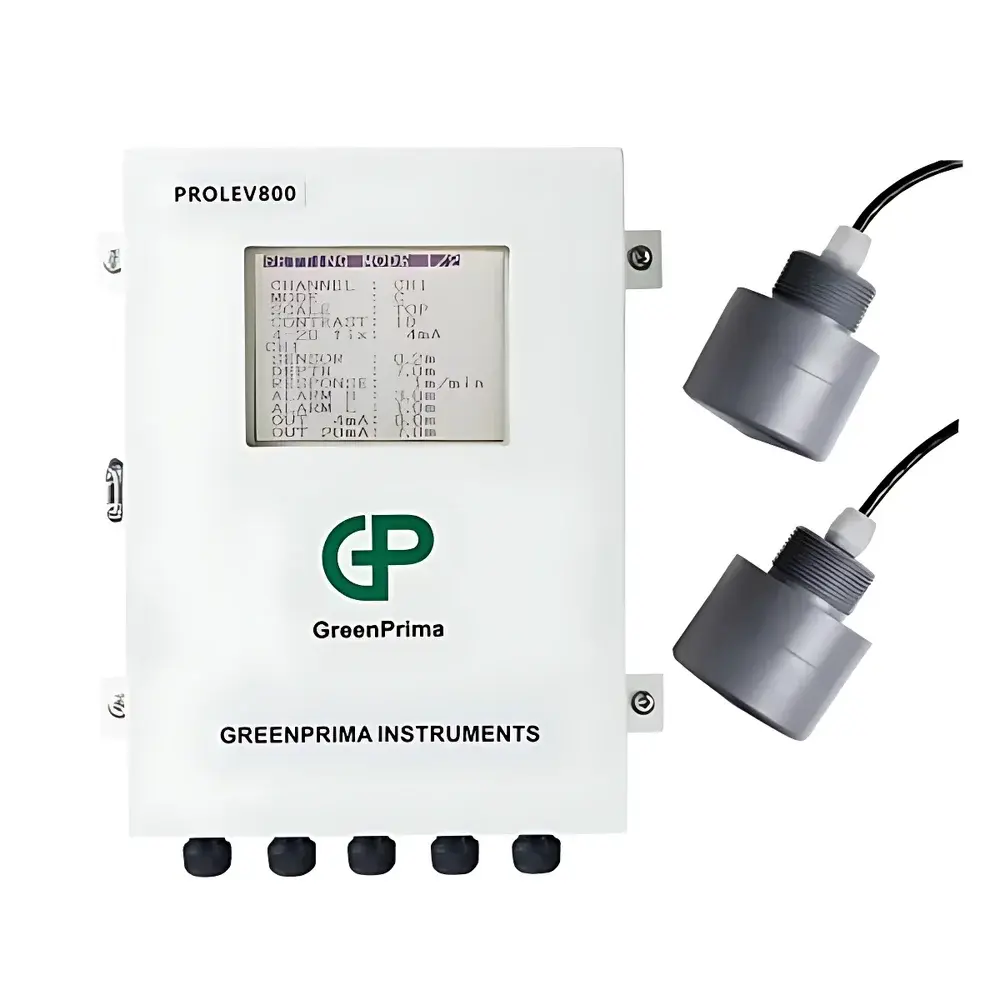
GreenPrima PROLEV800 Ultrasonic Sludge Level Interface Gauge
| Brand | GreenPrima |
|---|---|
| Origin | United Kingdom |
| Manufacturer Type | Original Equipment Manufacturer (OEM) |
| Product Origin | Imported |
| Model | PROLEV800 |
| Price | Upon Request |
| Measurement Range | 0.4–10 m |
| Sensor Capacity | Up to 2 independent transducers |
| Accuracy | ±1 cm |
| Response Time | 1 s |
| Operating Ambient Temperature | –20 to +60 °C |
| Display | Large-backlit LCD with graphical interface (numeric, trend plot, echo waveform) |
| Enclosure Rating | IP68 |
| Weight | 3.6 kg (transmitter), 3 kg (per transducer) |
| Output Signal | 4–20 mA analog (HART-compatible), dual high/low level alarms |
| Communication Interface | RS-232C (cable length ≤10 m) |
| Power Supply | 85–264 VAC, 10 VA |
| Cable Length | 20 m |
Overview
The GreenPrima PROLEV800 Ultrasonic Sludge Level Interface Gauge is an industrial-grade, non-contact level measurement instrument engineered for continuous, real-time monitoring of sludge blanket depth and interface position in wastewater treatment and industrial sedimentation processes. Based on time-of-flight ultrasonic pulse-echo principle, the system emits high-frequency acoustic waves (typically 20–50 kHz) from a submersible or top-mounted transducer; the transit time between emission and reception of the reflected signal from the sludge–liquid interface is precisely measured and converted into distance data. Unlike optical or conductivity-based methods, ultrasonic sensing remains unaffected by turbidity, suspended solids concentration, or chemical composition—making it uniquely suited for heterogeneous, high-solids environments such as primary clarifiers, secondary settling tanks, gravity thickeners, and ash slurry ponds. The PROLEV800 delivers stable interface tracking even under dynamic hydraulic conditions—including variable inflow rates, sludge blanket compression, and seasonal temperature gradients—enabling process engineers to quantify settling velocity, detect early-stage compaction anomalies, and validate solids retention time (SRT) models.
Key Features
- Large backlit LCD display supporting simultaneous numeric readout, real-time echo waveform visualization, and multi-scale trend plotting (5-minute to 48-hour history)
- Dual-transducer capability: single transmitter unit supports two independent ultrasonic probes—ideal for differential interface profiling or redundancy-critical applications
- Embedded microprocessor with adaptive signal filtering algorithms ensures stable detection across varying sludge rheology and surface agitation
- No moving parts or mechanical contact with sludge—eliminates fouling-related drift and reduces scheduled maintenance to visual inspection and periodic calibration verification
- User-configurable parameters including gain, damping, echo threshold, and averaging window via intuitive menu navigation
- Adjustable display brightness optimized for low-light control rooms or outdoor mounting enclosures
- Integrated dual relay outputs for programmable high/low level alarms, configurable for process interlock or SCADA alarm escalation
Sample Compatibility & Compliance
The PROLEV800 is validated for use in municipal and industrial wastewater streams containing total suspended solids (TSS) up to 50,000 mg/L, as well as coal washery effluents, power plant fly ash slurries, and mineral processing tailings. Its IP68-rated transducer housing and chemically resistant PVDF/PVC wetted materials ensure long-term stability in pH 4–11 environments with moderate chloride or sulfate exposure. While not certified for explosive atmospheres (ATEX/IECEx), the device complies with EN 61326-1 (EMC for industrial environments) and EN 61000-6-2/-6-4. It supports integration into GLP/GMP-aligned operations through optional audit-trail-enabled firmware upgrades and configurable 4–20 mA output scaling traceable to NIST-traceable ultrasonic calibration standards.
Software & Data Management
Local data handling is performed entirely onboard: no external PC is required for basic operation. The built-in trend buffer stores 288 data points (one per 10 minutes over 48 hours) with timestamped interface height, echo amplitude, and signal-to-noise ratio metadata. RS-232C serial communication enables ASCII-based polling (Modbus RTU optional via firmware update) for integration with PLCs, DCS systems, or historian platforms such as OSIsoft PI or Ignition SCADA. All configuration changes—including zero/span adjustment, alarm setpoints, and display preferences—are logged with user ID and timestamp. For regulatory reporting, exported CSV logs include ISO 8601 timestamps and are compatible with LIMS validation protocols under FDA 21 CFR Part 11 when deployed with electronic signature-capable host software.
Applications
- Primary and secondary clarifiers: real-time sludge blanket depth monitoring to optimize scraper torque and prevent sludge carryover
- Gravity thickeners and dissolved air flotation (DAF) units: interface level control for feed rate modulation and polymer dosing feedback
- Coal preparation plants: sedimentation tank interface tracking during fine coal recovery and tailings management
- Thermal power stations: ash slurry pond level surveillance to maintain safe overflow margins and support dewatering cycle scheduling
- Biological nutrient removal (BNR) systems: correlation of interface dynamics with MLSS concentration trends and denitrification efficiency indicators
FAQ
Can the PROLEV800 distinguish between multiple layers (e.g., scum, water, sludge)?
No—the device is designed to detect the dominant acoustic impedance discontinuity, typically the water–sludge interface. Multi-layer resolution requires advanced frequency-modulated continuous-wave (FMCW) or multi-frequency ultrasonic systems beyond this model’s architecture.
Is calibration required after initial installation?
Yes—field calibration using a known reference level (e.g., calibrated dip tape or laser rangefinder at zero flow) is mandatory to compensate for transducer mounting offset and sound velocity variations in non-standard media.
What maintenance intervals are recommended for long-term reliability?
Transducer face cleaning every 3–6 months depending on solids loading; annual verification of analog output linearity and alarm relay functionality; no routine replacement of internal components is specified under normal operating conditions.
Does the unit support Modbus TCP or Ethernet connectivity?
Not natively—only RS-232C is provided as standard. Modbus TCP requires an external protocol converter or third-party gateway integrated upstream of the transmitter.
How does temperature variation affect measurement accuracy?
The PROLEV800 incorporates ambient temperature compensation within its microprocessor but does not measure liquid temperature directly; significant deviations (>±10 °C) from factory calibration conditions may introduce ±0.3% full-scale error, mitigated by periodic recalibration in situ.







