
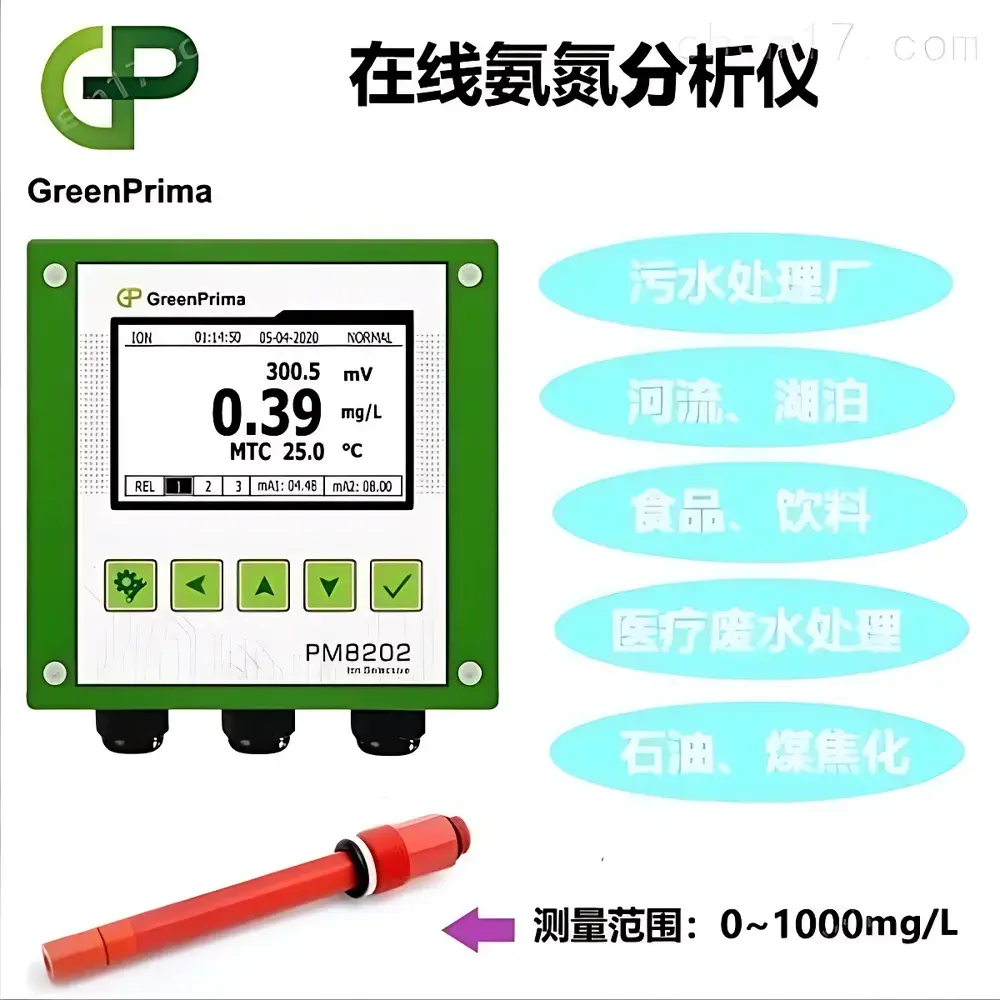
GreenPrima PM8202I Online Ammonia Nitrogen Analyzer
| Brand | GreenPrima |
|---|---|
| Origin | United Kingdom |
| Manufacturer Type | Manufacturer |
| Origin Category | Imported |
| Model | PM8202I |
| Instrument Type | Online |
| Measurement Principle | Ion-Selective Electrode (ISE) Method |
| Measurement Range | 0.00–20,000 ppm |
| Resolution | 0.0 / 0.1 / 1 ppm |
| Accuracy | ±0.01 / ±0.1 / ±1 ppm (depending on range) |
| Temperature Compensation | –10 to 130 °C (manual/automatic |
| Operating Temperature | –10 to 70.0 °C |
| Storage Temperature | –20 to 70.0 °C |
| Display | Backlit large-dot-matrix LCD |
| Language | English & Chinese |
| Data Storage | 600,000 records |
| Power Supply | 90–260 VAC, 50/60 Hz or optional 24 VDC |
| Output | Two isolated 4–20 mA outputs (max. loop resistance 500 Ω, accuracy 0.1% FS) |
| Communication | RS485 Modbus RTU |
| Cleaning Cycle | Adjustable from 0.1 to 1000 h |
| cleaning duration | 1–1000 s |
| Alarm Outputs | Two independent Hi/Lo relay outputs (5 A / 250 VAC / 30 VDC) |
| Mounting Options | Wall-mounted, pipe-mounted, panel-mounted |
| Enclosure Rating | IP65 |
| Dimensions (W×H×D) | 144 × 144 × 108 mm |
| Cutout Size | 138 × 138 mm |
| Weight | 0.87 kg |
Overview
The GreenPrima PM8202I Online Ammonia Nitrogen Analyzer is an industrial-grade, continuous-monitoring instrument engineered for real-time quantification of ammonia nitrogen (NH₃–N) in aqueous matrices using the ion-selective electrode (ISE) principle. Unlike colorimetric or spectrophotometric methods, the ISE-based detection provides direct electrochemical measurement of ammonium ion activity, enabling rapid response, minimal reagent consumption, and stable long-term operation in dynamic water systems. The analyzer integrates a dedicated Bsens730 ammonia-selective electrode with a rugged controller unit, delivering high reproducibility across a broad concentration span—from trace-level monitoring in potable water distribution networks to high-range surveillance in industrial effluent streams and activated sludge processes.
Key Features
- Robust IP65-rated enclosure with fully sealed, gas-tight housing—engineered for reliable deployment in humid, corrosive, or outdoor environments including wastewater pump stations and chemical plant perimeters.
- Large backlit dot-matrix LCD display presenting real-time NH₃–N concentration, temperature, system status, relay activation states, and timestamped operational events—all accessible via intuitive dual-language (English/Chinese) menu navigation.
- Configurable resolution and accuracy tiers (0.0/0.1/1 ppm; ±0.01/±0.1/±1 ppm) allow optimization for specific regulatory or process control requirements without hardware modification.
- Dual isolated 4–20 mA analog outputs support seamless integration into existing SCADA, DCS, or PLC architectures—each output independently assignable to measured NH₃–N value or compensated temperature signal.
- RS485 Modbus RTU interface enables bidirectional communication for remote configuration, data polling, firmware updates, and diagnostic logging—fully compliant with industrial automation interoperability standards.
- Programmable automatic electrode cleaning sequence (interval: 0.1–1000 h; duration: 1–1000 s) mitigates fouling in suspended-solids-rich media such as municipal influent or anaerobic digester supernatant.
- Two user-configurable relay outputs with adjustable hysteresis provide fail-safe alarm signaling for exceedance events—rated for industrial load switching up to 5 A at 250 VAC.
Sample Compatibility & Compliance
The PM8202I is validated for continuous operation in raw water, clarified effluent, tertiary-treated discharge, cooling tower makeup, and recirculating industrial process streams. Its ISE sensor exhibits selectivity against common interferents—including potassium, sodium, calcium, and magnesium ions—within typical municipal and industrial water matrices. While not a certified reference method per ISO 5667-3 or ASTM D1426, the analyzer meets functional performance criteria aligned with EPA Method 350.1 (ammonia electrode) and supports routine compliance verification under local discharge permits. The system architecture accommodates GLP/GMP-aligned data integrity practices through timestamped, non-erasable internal storage of 600,000 measurement records, supporting audit-ready historical review.
Software & Data Management
Data acquisition and system configuration are managed locally via the front-panel interface or remotely via Modbus-enabled supervisory software. All stored records include date/time stamps, measured values, temperature readings, calibration timestamps, and cleaning event logs. Optional PC-based configuration utilities support batch export to CSV or Excel formats for trend analysis, regulatory reporting, or integration with LIMS platforms. No cloud dependency or proprietary subscription service is required—the device operates autonomously with full local data sovereignty. Firmware updates are performed via USB or Modbus upload, ensuring long-term maintainability without vendor lock-in.
Applications
- Real-time monitoring of ammonia breakthrough in granular activated carbon (GAC) or ion exchange polishing units within drinking water treatment plants.
- Process control feedback in nitrification/denitrification basins—supporting DO and alkalinity dosing algorithms in biological nutrient removal (BNR) systems.
- Effluent compliance verification at municipal wastewater treatment works prior to surface water discharge.
- Ammonia accumulation tracking in closed-loop cooling systems to prevent microbiologically influenced corrosion (MIC).
- Quality assurance in pharmaceutical water-for-injection (WFI) distribution loops where low-level NH₃–N may indicate biofilm regrowth or resin exhaustion.
FAQ
What calibration frequency is recommended for the Bsens730 ammonia electrode?
Calibration should be performed at least once per week under stable conditions; daily calibration is advised when measuring highly variable or contaminated samples. Two-point calibration (zero and span) using certified NH₄Cl standards is required to maintain traceable accuracy.
Can the PM8202I operate in seawater or brackish water applications?
The Bsens730 electrode is optimized for freshwater and low-salinity effluents (< 5 g/L TDS). For marine or high-ionic-strength matrices, additional junction potential compensation and frequent maintenance are necessary—consult GreenPrima’s application engineering team for site-specific validation protocols.
Is the system compliant with FDA 21 CFR Part 11 for electronic records?
While the PM8202I does not implement electronic signatures or role-based access controls required for full Part 11 compliance, its immutable local data log, time-stamped audit trail, and password-protected configuration meet foundational ALCOA+ principles for regulated environments when used with supplementary procedural controls.
Does the analyzer support automatic temperature compensation?
Yes—integrated NTC30K or PT1000 temperature sensors enable either manual or automatic temperature compensation across –10 to 130 °C, correcting for thermodynamic drift in electrode potential according to the Nernst equation.
What maintenance intervals are required beyond electrode calibration?
Electrode membrane replacement is recommended every 6–12 months depending on sample fouling potential; reference electrolyte refill every 3 months; and periodic inspection of O-rings and cable seals to preserve IP65 integrity.







