
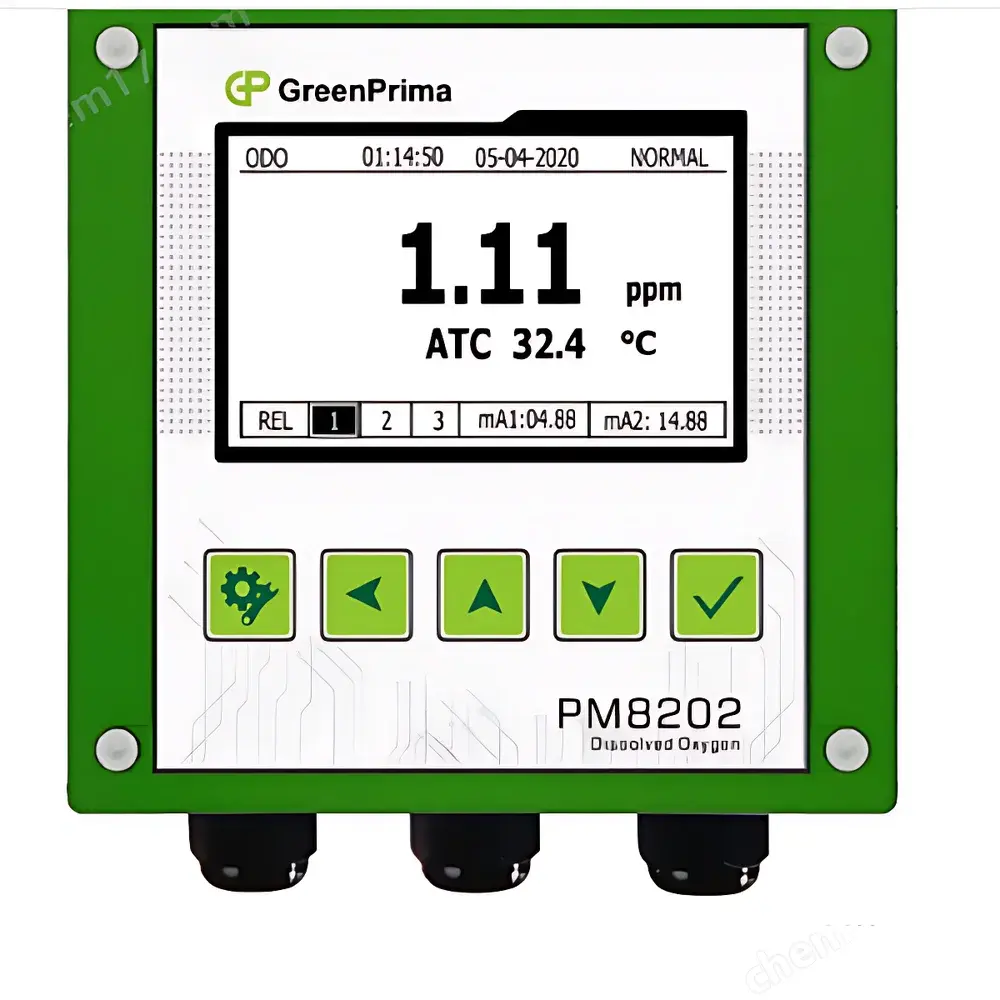
GreenPrima PM8202O Fluorescence-Based Dissolved Oxygen Analyzer
| Brand | GreenPrima |
|---|---|
| Origin | United Kingdom |
| Manufacturer Type | Original Equipment Manufacturer (OEM) |
| Product Category | Imported Instrument |
| Model | PM8202O |
| Instrument Type | Online Analyzer |
| Measurement Principle | Fluorescence Quenching |
| Measurement Range | 0.00–20.00 ppm |
| Resolution | 0.01 ppm |
| Accuracy | ±0.01 ppm |
| Temperature Compensation | –10 to 130 °C (manual/automatic, NTC30K or PT1000 selectable) |
| Operating Temperature | –10 to 70.0 °C |
| Storage Temperature | –20 to 70.0 °C |
| Display | Backlit large-dot-matrix LCD |
| Language Interface | English & Chinese |
| Data Storage Capacity | 600,000 records |
| Power Supply | 90–260 VAC, 50/60 Hz or optional 24 VDC |
| Analog Outputs | Two isolated 4–20 mA outputs (max. loop resistance 500 Ω, accuracy 0.1% FS, configurable for DO or temperature) |
| Digital Communication | RS485 Modbus RTU |
| Cleaning Output | Adjustable interval (0.1–1000 h) and duration (1–1000 s) |
| Alarm Outputs | Two independent Hi/Lo relay outputs (5 A / 250 VAC / 30 VDC, hysteresis adjustable) |
| Enclosure Rating | IP65 |
| Mounting Options | Wall-mounted, pipe-mounted, panel-mounted |
| Dimensions (W×H×D) | 144 × 144 × 108 mm |
| Panel Cutout | 138 × 138 mm |
| Weight | 0.87 kg |
| Electrode Material | 316L stainless steel |
| Optional Feature | Air-driven self-cleaning system |
| Security | Password-protected configuration interface |
Overview
The GreenPrima PM8202O is an online fluorescence-based dissolved oxygen (DO) analyzer engineered for continuous, high-reliability monitoring in demanding water quality applications. It operates on the principle of dynamic fluorescence quenching—where molecular oxygen modulates the lifetime and intensity of fluorescent emission from a proprietary ruthenium-based luminophore immobilized on the sensor surface. Unlike electrochemical Clark-type sensors, this optical method requires no oxygen consumption during measurement, eliminates membrane diffusion limitations, and avoids electrolyte depletion or polarization drift. As a result, the PM8202O delivers inherently stable output with zero signal drift over extended deployment periods—even under low-flow or stagnant conditions typical of wastewater effluent channels, aquaculture recirculation systems, and natural surface water bodies.
Key Features
- True maintenance-free operation: No membranes, no electrolyte refills, no cathode/anode replacement—reducing total cost of ownership and field service frequency.
- Zero-oxygen-consumption sensing: Enables accurate DO quantification in low-circulation environments without perturbing the local oxygen gradient.
- Digital sensor architecture: Integrated microcontroller and temperature-compensated photodetection ensure immunity to electromagnetic interference and long-term signal integrity.
- Robust 316L stainless steel probe housing: Corrosion-resistant construction rated for continuous immersion in aggressive municipal, industrial, and marine-influenced waters.
- Configurable air-pulse cleaning system (optional): Mitigates biofouling and particulate accumulation on the sensing window—critical for long-term unattended operation in turbid or organically rich matrices.
- Multi-mode temperature compensation: Supports both NTC30K and PT1000 probes; automatic or manual compensation across –10 to 130 °C ensures traceable accuracy under varying thermal regimes.
- Industrial-grade I/O: Dual isolated 4–20 mA analog outputs (programmable for DO concentration or temperature), RS485 Modbus RTU for SCADA integration, and two programmable relay alarms with adjustable hysteresis.
- Secure configuration management: Password-protected setup prevents unauthorized parameter changes—supporting audit readiness under GLP/GMP-aligned operational protocols.
Sample Compatibility & Compliance
The PM8202O is validated for use across heterogeneous aqueous matrices including activated sludge effluents, raw and treated wastewater, river and lake surface water, aquaculture ponds, cooling tower circuits, and potable water distribution networks. Its optical design renders it insensitive to hydrogen sulfide, chlorine residuals, and heavy metal ions that commonly poison amperometric electrodes. While not certified to a single harmonized standard, its measurement methodology aligns with the performance criteria outlined in ISO 5814:2012 (Water quality — Determination of dissolved oxygen — Electrochemical probe method) and ASTM D888-22 (Standard Test Methods for Dissolved Oxygen in Water), adapted for optical transduction. The device’s data logging (600,000 timestamped records), configurable alarm events, and Modbus-compliant communication support compliance with internal QA/QC procedures and external regulatory frameworks requiring electronic record retention.
Software & Data Management
Data acquisition and system diagnostics are managed locally via the backlit dot-matrix LCD interface, supporting bilingual (English/Chinese) navigation for international deployment. All measurements—including DO concentration, temperature, sensor status flags, and cleaning cycle logs—are time-stamped and stored onboard with non-volatile memory. Export is facilitated through Modbus polling by supervisory control systems, enabling seamless integration into existing PLCs, DCS platforms, or cloud-based environmental dashboards. The absence of analog signal conditioning stages eliminates calibration drift-related data artifacts, and the lack of consumables removes variability introduced by membrane aging or electrolyte batch differences—enhancing inter-laboratory reproducibility and longitudinal trend reliability.
Applications
- Real-time DO control in activated sludge basins and denitrification zones of municipal wastewater treatment plants.
- Process optimization in industrial bioreactors and fermentation vessels where oxygen transfer rate (OTR) directly impacts yield and metabolic pathway selection.
- Early-warning monitoring of hypoxic events in reservoirs, estuaries, and coastal zones subject to eutrophication pressures.
- Health surveillance in intensive aquaculture systems—especially recirculating aquaculture systems (RAS)—where sub-lethal DO fluctuations affect feed conversion ratios and disease susceptibility.
- Regulatory compliance reporting for discharge permits requiring continuous DO telemetry per EPA NPDES or EU WFD Annex V requirements.
FAQ
Does the PM8202O require periodic calibration?
No. Due to the inherent stability of the fluorescence quenching mechanism and absence of electrochemical degradation pathways, the sensor exhibits negligible long-term drift. A one-time factory calibration is traceable to NIST-certified standards; field verification using air-saturated water or Winkler titration is recommended only for QA/QC validation—not routine recalibration.
Can the sensor operate in seawater or brackish environments?
Yes. The 316L stainless steel body and optically sealed sensing element are corrosion-resistant to chloride concentrations up to 35,000 mg/L. Temperature compensation remains effective across the full salinity range encountered in estuarine and marine settings.
Is the air self-cleaning function compatible with hazardous area installations?
The optional air-pulse module uses instrument-grade compressed air (oil-free, dew point ≤ –20 °C) at ≤ 0.7 MPa. When installed in Zone 2 or Class I, Division 2 areas, appropriate pneumatic isolation and spark-proof solenoid valves must be specified per IEC 60079-14 and NFPA 496 guidelines.
How does the PM8202O handle biofouling in untreated wastewater?
The combination of smooth optical window geometry, optional air-pulse cleaning, and chemical resistance of the luminophore matrix significantly delays biofilm formation. Field trials in primary clarifier effluent demonstrate >6 months of stable operation between manual inspections when the cleaning interval is set to 4–6 hours.
What cybersecurity safeguards are implemented in the Modbus interface?
The RS485 port implements read-only register access by default. Write access to configuration registers requires prior authentication via password-protected command sequence—a design aligned with ISA/IEC 62443-3-3 SL1 requirements for basic cyber resilience in process instrumentation.
Related Products







