
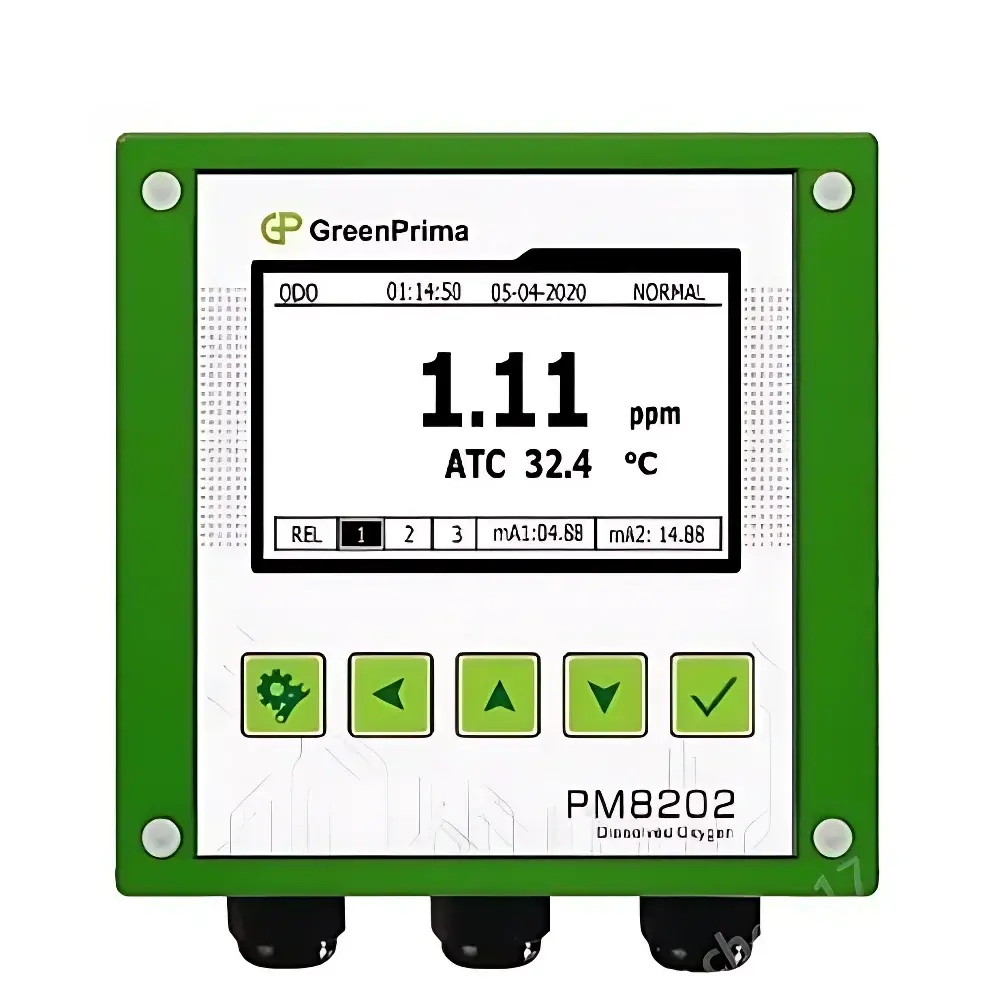
GreenPrima PM8202O Fluorescence-Based Online Dissolved Oxygen Analyzer
| Brand | GreenPrima |
|---|---|
| Origin | United Kingdom |
| Manufacturer Type | Original Equipment Manufacturer (OEM) |
| Product Category | Imported Instrument |
| Model | PM8202O |
| Instrument Type | Online Analyzer |
| Measurement Principle | Fluorescence Quenching |
| Measurement Range | 0.00–20.00 ppm |
| Accuracy | ±0.01 ppm |
| Resolution | 0.01 ppm |
| Temperature Compensation Range | −10 to +130 °C (NTC30K or PT1000 selectable) |
| Operating Temperature | −10 to +70.0 °C |
| Storage Temperature | −20 to +70.0 °C |
| Display | Backlit Graphic LCD |
| Language Interface | English & Chinese |
| Data Storage Capacity | 600,000 records |
| Power Supply | 90–260 VAC, 50/60 Hz or 24 VDC (optional) |
| Output | Dual isolated 4–20 mA (max. loop resistance 500 Ω, accuracy 0.1% FS) |
| Cleaning Function | Optional air-pulse self-cleaning (interval: 0.1–1000 h |
| duration | 1–1000 s) |
| Alarm Outputs | Two independent Hi/Lo relay outputs (5 A / 250 VAC / 30 VDC) |
| Enclosure Rating | IP65 |
| Mounting Options | Wall-mount, pipe-mount, panel-mount |
| Dimensions (W×H×D) | 144 × 144 × 108 mm |
| Panel Cutout | 138 × 138 mm |
| Weight | 0.87 kg |
| Electrode Material | 316L stainless steel |
| Sensor Type | Digital, embedded signal processing |
Overview
The GreenPrima PM8202O is an online dissolved oxygen (DO) analyzer engineered for continuous, high-stability monitoring in demanding water quality applications. It employs optical fluorescence quenching technology—where molecular oxygen modulates the intensity and lifetime of fluorescent emission from a ruthenium-based luminophore immobilized on the sensor surface. Unlike electrochemical Clark-type sensors, this method requires no oxygen consumption, zero electrolyte, and no gas-permeable membrane. As a result, the PM8202O delivers inherently drift-free measurements with no dependence on sample flow velocity, making it uniquely suited for low-circulation environments such as aquaculture tanks, sediment porewater interfaces, and stagnant wastewater holding basins.
Key Features
- Fluorescence-based detection ensures long-term stability without signal drift—eliminating routine calibration intervals under stable thermal and chemical conditions.
- Digital sensor architecture with embedded temperature compensation (NTC30K or PT1000 configurable) enables accurate DO reporting across a broad thermal range (−10 to +130 °C).
- Robust 316L stainless steel sensing body resists corrosion in aggressive wastewater, seawater, and industrial effluent matrices.
- Two fully isolated 4–20 mA analog outputs support simultaneous transmission of DO concentration and process temperature—each configurable for linear or square-root scaling.
- RS485 interface compliant with Modbus RTU protocol facilitates seamless integration into SCADA, DCS, and PLC-based control systems.
- Optional air-pulse self-cleaning mechanism mitigates biofouling and particulate accumulation—critical for extended unattended operation in raw sewage or algal-rich surface waters.
- Backlit graphic LCD provides real-time DO value, temperature, status flags, and diagnostic indicators in either English or Chinese—supporting multilingual operational teams.
- Local password protection restricts access to configuration menus, preventing unauthorized parameter changes during routine maintenance or operator shifts.
Sample Compatibility & Compliance
The PM8202O is validated for use in municipal and industrial wastewater streams, natural surface waters (rivers, lakes, reservoirs), aquaculture recirculating systems, and pretreatment influent channels. Its non-consumptive measurement principle avoids localized oxygen depletion at the sensor surface—ensuring representative readings even in hypoxic or anaerobic microzones. The instrument complies with general requirements for environmental monitoring instrumentation per ISO 5814:2012 (Water quality — Determination of dissolved oxygen — Electrochemical probe method) and supports traceable data acquisition aligned with GLP and GMP documentation practices. While not certified for drinking water compliance per US EPA Method 360.1 or ISO 5815-1, its performance characteristics meet typical QA/QC thresholds for process control and regulatory trend monitoring in non-potable water contexts.
Software & Data Management
Data logging is handled internally with non-volatile memory capable of storing up to 600,000 timestamped records—including DO concentration, temperature, sensor status, and cleaning event logs. Internal clock synchronization supports chronological integrity for audit trails. All stored data are exportable via Modbus register polling or manual retrieval through the front-panel interface. The system supports configurable alarm hysteresis and dual relay outputs for automated process intervention (e.g., triggering aerator activation upon DO drop below threshold). No proprietary software is required for basic operation; however, optional PC-based configuration utilities (available under NDA) provide advanced diagnostics, firmware updates, and batch export functionality compatible with CSV and Excel formats.
Applications
- Real-time DO supervision in activated sludge bioreactors and oxidation ditches for optimized aeration energy management.
- Continuous monitoring of dissolved oxygen saturation in fish hatcheries and shrimp ponds to prevent hypoxia-induced mortality.
- Regulatory compliance tracking in wastewater discharge points subject to local environmental agency reporting requirements.
- Long-term ecological studies involving diel DO cycling in eutrophic lakes or tidal estuaries.
- Performance verification of membrane aerators, fine-bubble diffusers, and mechanical surface aerators.
- Integration into smart irrigation or hydroponic nutrient delivery systems where root-zone oxygenation is critical.
FAQ
Does the PM8202O require periodic recalibration?
No—fluorescence quenching is a physical phenomenon unaffected by electrode aging or electrolyte depletion. Field verification using air-saturated water or Winkler titration is recommended only after sensor replacement or exposure to extreme chemical contamination.
Can the sensor operate in seawater or brackish environments?
Yes—the 316L stainless steel housing and fluoropolymer-coated optical window resist chloride-induced pitting and biofouling. Salinity compensation is not applied, as fluorescence lifetime response is minimally affected by ionic strength within typical marine ranges (0–40 ppt).
Is temperature compensation automatic or manual?
Both modes are supported. Automatic compensation uses integrated NTC30K or PT1000 thermistors; manual offset adjustment is available for applications where external reference thermometry is preferred.
What maintenance intervals are recommended for the air-pulse cleaning system?
Cleaning frequency should be empirically determined based on site-specific fouling rates. Default factory settings suggest 24-hour intervals with 10-second pulses—but programmable ranges (0.1–1000 h / 1–1000 s) allow optimization for low-fouling or high-solids environments.
How is data integrity ensured during power interruptions?
All logged data are written to non-volatile flash memory with atomic write operations. The internal real-time clock retains time/date information for up to 72 hours on backup capacitor charge, ensuring continuity of timestamped records after brief outages.







