
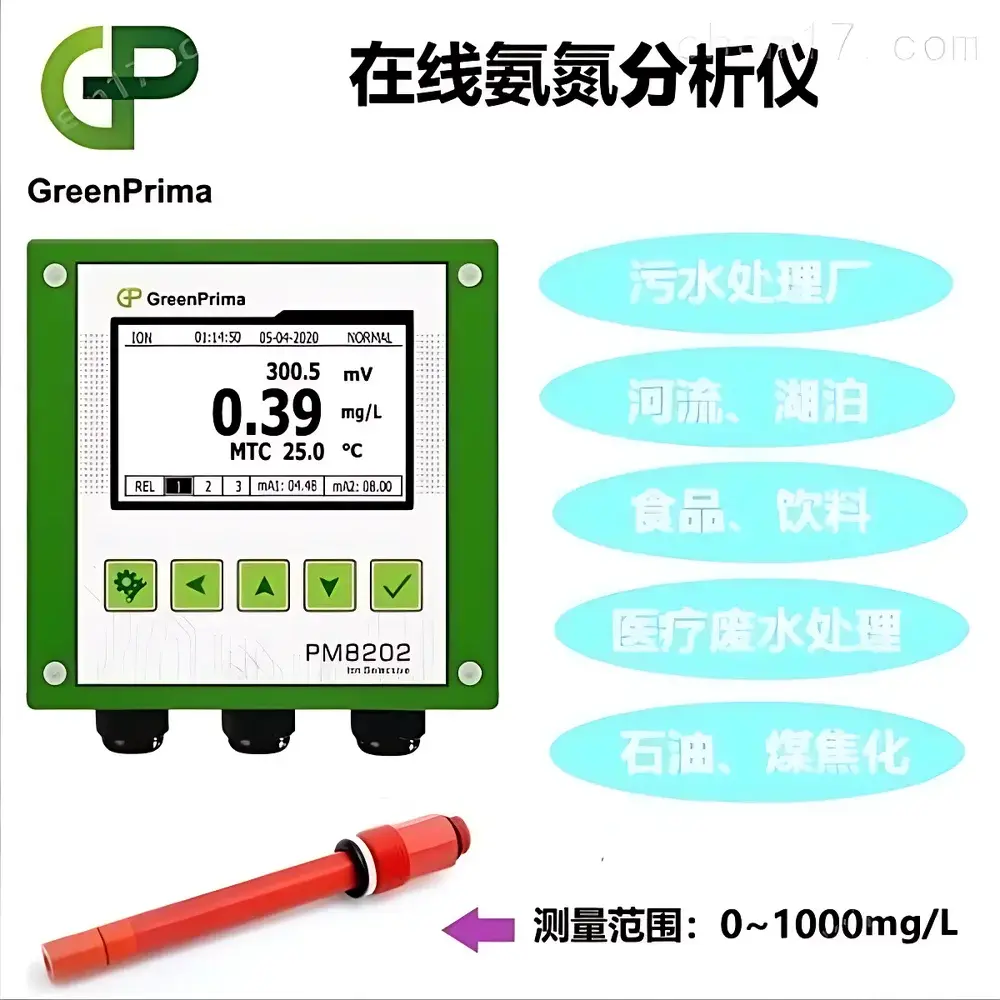
GreenPrima PM8202I Online Ammonia-Nitrogen Analyzer
| Brand | GreenPrima |
|---|---|
| Origin | United Kingdom |
| Manufacturer Type | Original Equipment Manufacturer (OEM) |
| Product Origin | Imported |
| Model | PM8202I |
| Instrument Type | Online Analyzer |
| Measurement Principle | Ion-Selective Electrode (ISE) Method |
| Measurement Range | 0.00–20,000 ppm NH₃–N |
| Accuracy | ±0.01 ppm / ±0.1 ppm / ±1 ppm (range-dependent) |
| Resolution | 0.01 / 0.1 / 1 ppm |
| Temperature Compensation | –10 to +130 °C (manual/automatic |
| Operating Temperature | –10 to +70.0 °C |
| Storage Temperature | –20 to +70.0 °C |
| Display | Backlit dot-matrix LCD |
| Languages | English & Chinese |
| Data Storage | 600,000 records |
| Power Supply | 90–260 VAC, 50/60 Hz or optional 24 VDC |
| Output | Two isolated 4–20 mA outputs (max. loop resistance 500 Ω, accuracy ±0.1% FS) |
| Communication | RS485 Modbus RTU |
| Cleaning Cycle | Adjustable interval (0.1–1000 h), duration (1–1000 s) |
| Alarm Outputs | Two independent Hi/Lo relay outputs (5 A / 250 VAC / 30 VDC) |
| Enclosure Rating | IP65 |
| Mounting Options | Wall-mounted, pipe-mounted, panel-mounted |
| Dimensions (W×H×D) | 144 × 144 × 108 mm |
| Cutout Size | 138 × 138 mm |
| Weight | 0.87 kg |
Overview
The GreenPrima PM8202I Online Ammonia-Nitrogen Analyzer is an industrial-grade, continuous-monitoring instrument engineered for real-time quantification of total ammonia nitrogen (NH3–N) in aqueous matrices using the ion-selective electrode (ISE) principle. Unlike optical or colorimetric methods, the ISE-based detection provides direct electrochemical measurement of ammonium ion activity under varying pH and ionic strength conditions—making it especially suitable for dynamic wastewater treatment environments where rapid response and robustness against turbidity or colored interferents are critical. The system comprises a microprocessor-controlled transmitter (PM8202I controller) and the Bsens730 ammonia-selective electrode, which employs a gas-permeable membrane to isolate the sensing layer from sample fouling while enabling selective diffusion of dissolved NH3. This configuration ensures stable baseline performance across extended deployment cycles in primary, secondary, and tertiary treatment stages—including nitrification/denitrification monitoring, effluent compliance verification, and influent load assessment.
Key Features
- IP65-rated fully sealed enclosure with corrosion-resistant housing—designed for harsh municipal and industrial wet-process environments.
- Backlit high-contrast dot-matrix LCD display showing real-time NH3–N concentration, temperature, timestamp, relay status, and diagnostic indicators.
- Dual-language interface (English/Chinese) with intuitive menu navigation—reducing operator training time and minimizing misconfiguration risk.
- Two programmable 4–20 mA analog outputs assignable to measured NH3–N value, temperature, or alarm status—with galvanic isolation and full-scale accuracy of ±0.1%.
- RS485 Modbus RTU communication port supporting integration into SCADA, DCS, or PLC-based control systems for centralized data acquisition and remote parameter adjustment.
- Configurable cleaning cycle (0.1–1000 hours) and cleaning duration (1–1000 seconds) via integrated solenoid valve driver—enabling automated maintenance without external timers.
- Two independent relay outputs with user-defined high/low setpoints and adjustable hysteresis—supporting cascade control logic for dosing pumps or diversion valves.
- Password-protected configuration mode prevents unauthorized changes to calibration constants, alarm thresholds, or communication settings—aligning with operational integrity requirements in regulated utilities.
Sample Compatibility & Compliance
The PM8202I is validated for use in raw sewage, activated sludge effluents, membrane bioreactor (MBR) permeate, reclaimed water, and industrial process streams with suspended solids ≤ 50 mg/L and oil/grease content < 10 mg/L. It complies with ISO 7888:1985 (water quality — determination of ammonia-nitrogen — potentiometric method using ion-selective electrodes) and meets functional equivalency benchmarks referenced in EPA Method 350.1 and ASTM D1426–15a. While not intrinsically certified for hazardous locations, its IP65 rating satisfies NEMA 4X requirements for outdoor or semi-outdoor installation adjacent to biological treatment units. All firmware and calibration protocols support audit-trail generation per GLP and GMP-aligned operational practices, including timestamped calibration logs and event-triggered data snapshots.
Software & Data Management
Data logging is performed autonomously onboard the PM8202I controller, storing up to 600,000 timestamped records—including NH3–N concentration, temperature, electrode potential (mV), calibration status, and relay activation events. Logged data can be retrieved locally via USB export or remotely via Modbus polling. The embedded firmware supports automatic temperature compensation using either NTC30K thermistors or PT1000 RTDs, with selectable linear or non-linear algorithms optimized for wastewater thermal profiles. Calibration routines follow a two-point standardization protocol traceable to NIST-certified NH4Cl reference solutions, and all calibration parameters—including slope, offset, and isopotential point—are retained in non-volatile memory with checksum validation. Firmware updates are performed via secure signed binary upload to ensure version control and cybersecurity compliance.
Applications
- Real-time monitoring of ammonia breakthrough in denitrification basins and post-anoxic zones.
- Effluent compliance tracking against regulatory limits (e.g., EU Urban Wastewater Treatment Directive, US Clean Water Act NPDES permits).
- Optimization of aeration energy consumption by feeding dissolved oxygen (DO) controllers with NH3–N trend data.
- Early warning detection of nitrifier inhibition due to toxic shock loads (e.g., heavy metals, chlorinated compounds).
- Process validation during commissioning of new MBR or moving-bed biofilm reactor (MBBR) installations.
- Supporting ISO 5667-3 sampling strategy by providing continuous context for discrete grab-sample analysis.
FAQ
What is the recommended calibration frequency for the Bsens730 electrode in wastewater applications?
Calibration should be performed at least once every 7 days under stable conditions; however, daily verification using a single-point check standard (e.g., 5 ppm NH3–N) is advised in high-fouling or variable-load environments.
Can the PM8202I measure free ammonia (NH3) separately from total ammonia nitrogen (TAN)?
No—the instrument reports total ammonia nitrogen (NH3–N) as defined by standard methods. Free ammonia concentration must be calculated separately using concurrent pH and temperature measurements via established equilibrium models (e.g., Emerson et al., 1975).
Is the electrode compatible with chlorinated disinfection sidestreams?
Chlorine residuals > 0.5 mg/L may oxidize the electrode’s gas-permeable membrane over time; dechlorination or activated carbon filtration upstream is strongly recommended for long-term stability.
Does the system support FDA 21 CFR Part 11-compliant electronic records?
While the PM8202I maintains tamper-evident calibration and event logs, full Part 11 compliance requires integration with a validated third-party LIMS or historian platform that enforces electronic signatures, audit trails, and role-based access control.
How does temperature compensation affect measurement uncertainty across the full operating range?
The built-in NTC30K/PT1000 sensor reduces thermal drift to < ±0.05 ppm/°C within –10 to +50 °C; outside this band, accuracy degrades gradually due to membrane permeability shifts and electrolyte viscosity changes—consult application engineering for site-specific validation protocols.
Related Products







