
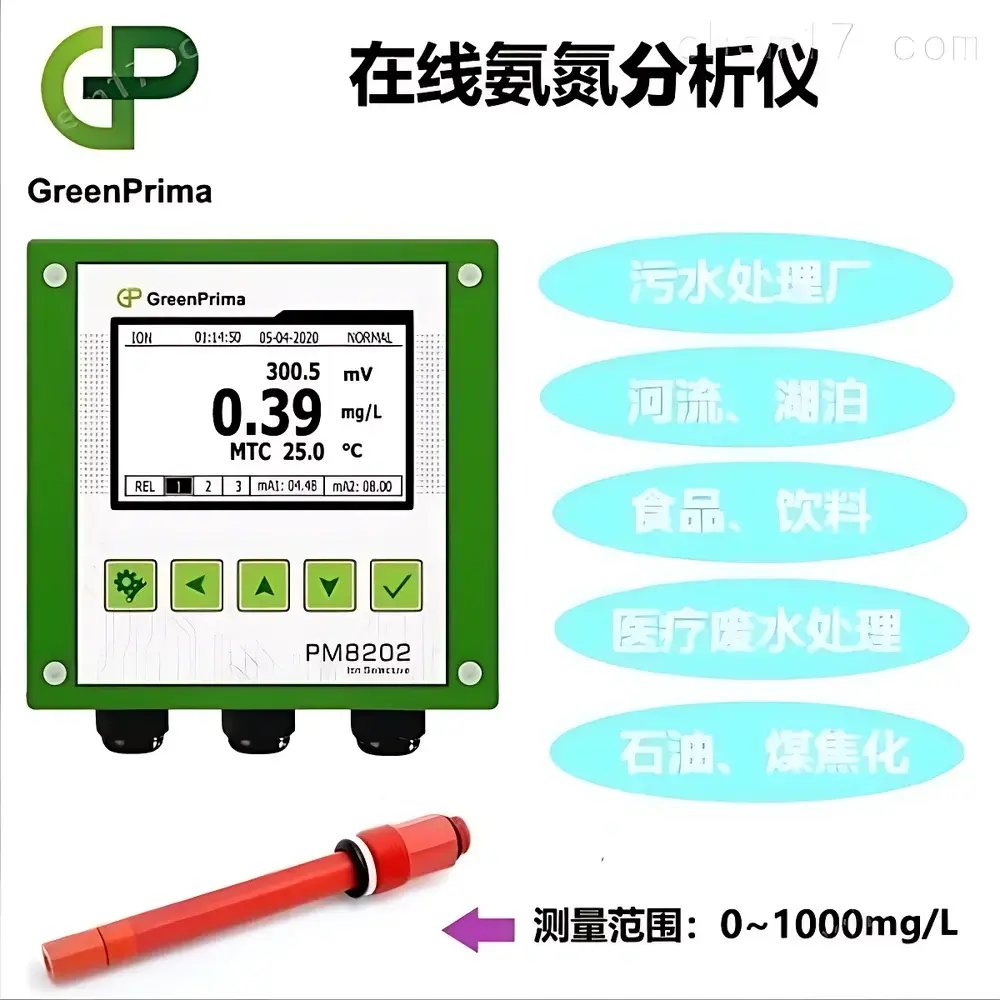
GreenPrima PM8202I Online Ammonia Nitrogen Analyzer
| Brand | GreenPrima |
|---|---|
| Origin | United Kingdom |
| Manufacturer Type | Original Equipment Manufacturer (OEM) |
| Product Category | Imported |
| Model | PM8202I |
| Instrument Type | Online Analyzer |
| Measurement Principle | Ion-Selective Electrode (ISE) Method |
| Measurement Range | 0.00–20,000 ppm NH₃–N |
| Accuracy | ±0.01 ppm / ±0.1 ppm / ±1 ppm (depending on range selection) |
| Resolution | 0.01 / 0.1 / 1 ppm |
| Temperature Compensation | –10 to +130 °C (NTC30k or PT1000 sensor support) |
| Operating Temperature | –10 to +70.0 °C |
| Storage Temperature | –20 to +70.0 °C |
| Display | Backlit dot-matrix LCD |
| Language Interface | English & Chinese |
| Data Storage Capacity | 600,000 records |
| Power Supply | 90–260 VAC, 50/60 Hz or optional 24 VDC |
| Analog Outputs | Two isolated 4–20 mA outputs (max. loop resistance 500 Ω, accuracy ±0.1% FS) |
| Digital Communication | RS485 Modbus RTU |
| Cleaning Control Output | Adjustable interval (0.1–1000 h) and duration (1–1000 s) |
| Alarm Outputs | Two independent Hi/Lo relay outputs (5 A / 250 VAC / 30 VDC) |
| Enclosure Rating | IP65 |
| Mounting Options | Wall-mount, pipe-mount, panel-mount |
| Dimensions (W×H×D) | 144 × 144 × 108 mm |
| Panel Cutout | 138 × 138 mm |
| Weight | 0.87 kg |
Overview
The GreenPrima PM8202I Online Ammonia Nitrogen Analyzer is an industrial-grade, continuous monitoring instrument engineered for real-time quantification of ammonia nitrogen (NH₃–N) in aqueous matrices using the ion-selective electrode (ISE) principle. Unlike colorimetric or photometric methods, the ISE-based approach provides direct electrochemical detection of ammonium ions (NH₄⁺) in solution, offering rapid response (11 for total ammonia conversion) is implemented. Designed for deployment in municipal water supply networks, wastewater treatment plants, industrial effluent streams, and cooling water circuits, the PM8202I delivers reliable, low-maintenance measurement without reliance on optical path integrity or chemical reagent dosing systems.
Key Features
- Robust IP65-rated enclosure with fully sealed, corrosion-resistant housing suitable for indoor and outdoor installation in humid or chemically aggressive environments.
- Dual-mode temperature compensation using either NTC30k thermistor or PT1000 platinum resistance sensor, enabling accurate correction across –10 to +130 °C operational range.
- High-resolution backlit dot-matrix LCD display showing real-time NH₃–N concentration, measured temperature, system time, relay status, and diagnostic flags—all accessible via intuitive bilingual (English/Chinese) menu navigation.
- Two configurable 4–20 mA analog outputs supporting simultaneous transmission of primary measurement value and temperature signal; each output is galvanically isolated with ±0.1% full-scale accuracy.
- RS485 Modbus RTU interface compliant with industry-standard protocol for seamless integration into SCADA, DCS, or PLC-based supervisory control architectures.
- Programmable cleaning cycle with independently adjustable interval (0.1–1000 hours) and duration (1–1000 seconds), minimizing biofouling and drift in extended unattended operation.
- Two user-configurable relay alarm outputs with programmable hysteresis, rated at 5 A / 250 VAC / 30 VDC, supporting fail-safe shutdown or process interlock functions.
- Onboard data logging capacity of 600,000 timestamped records—including concentration, temperature, calibration events, and system diagnostics—enabling retrospective trend analysis and regulatory audit readiness.
Sample Compatibility & Compliance
The PM8202I is validated for use with potable water, secondary-treated wastewater, industrial process water, and recirculating cooling systems. Sample compatibility requires pH ≥ 11.0 during measurement (achieved via inline alkalinization) to ensure complete conversion of NH₄⁺ to volatile NH₃, which partitions into the electrolyte layer of the gas-permeable membrane surrounding the ISE sensing element. The analyzer complies with general requirements of ISO 5667-3 for water sampling and ISO 15839 for online water quality sensors. While not certified to specific EPA or ASTM standard methods (e.g., EPA 350.1 or ASTM D1426), its performance characteristics align with the functional requirements of continuous emission monitoring systems (CEMS) and process water quality assurance programs governed by ISO 9001, ISO 14001, and EU Water Framework Directive reporting protocols.
Software & Data Management
Data acquisition and configuration are managed locally via the front-panel interface; no external software is required for routine operation. All logged entries include UTC timestamps, sensor ID, measurement value, temperature reading, and event type (e.g., “Calibration Start”, “Alarm Triggered”). Export of historical data is supported through manual USB dump (optional accessory) or periodic polling via Modbus register reads. The device supports GLP-compliant audit trails: every calibration, parameter change, or alarm activation is permanently recorded with operator ID (if enabled via password-protected access levels) and timestamp. Password protection (three-tier: operator, engineer, administrator) prevents unauthorized modification of critical settings, satisfying baseline requirements for controlled environment documentation per FDA 21 CFR Part 11 Annex 11 principles.
Applications
- Real-time monitoring of ammonia breakthrough in granular activated carbon (GAC) or ion exchange polishing units within drinking water treatment facilities.
- Effluent compliance tracking at municipal wastewater treatment plants discharging to sensitive receiving waters under national discharge permits.
- Process control of nitrification/denitrification basins, where rapid NH₃–N feedback informs aeration rate modulation and carbon dosing decisions.
- Monitoring of ammonia slip in boiler feedwater systems to prevent copper alloy corrosion and steam turbine fouling.
- Leachate quality assessment in landfill management systems, particularly during active degradation phases characterized by elevated ammoniacal nitrogen release.
FAQ
What sample pretreatment is required prior to measurement?
A minimum pH of 11.0 must be maintained upstream of the sensor using sodium hydroxide dosing; this ensures quantitative conversion of ammonium to ammonia gas, enabling selective diffusion across the membrane.
How often does the ammonia ISE require calibration?
Initial two-point calibration is recommended at commissioning; subsequent verification intervals depend on application severity—typically every 7–30 days in stable municipal water, or daily in high-fouling industrial effluents.
Can the PM8202I measure total ammonia (NH₃ + NH₄⁺) directly?
No—it measures free ammonia (NH₃) selectively; total ammonia concentration is inferred assuming complete pH-driven equilibrium conversion, requiring accurate upstream pH control and temperature measurement.
Is the instrument compatible with hazardous area classifications?
The standard PM8202I is rated for non-hazardous locations only (IP65); explosion-proof variants with ATEX/IECEx certification are available upon request as custom configurations.
Does the analyzer support remote firmware updates?
Firmware upgrades require physical access and local USB connection; over-the-air (OTA) updates are not supported in the current hardware revision.







