
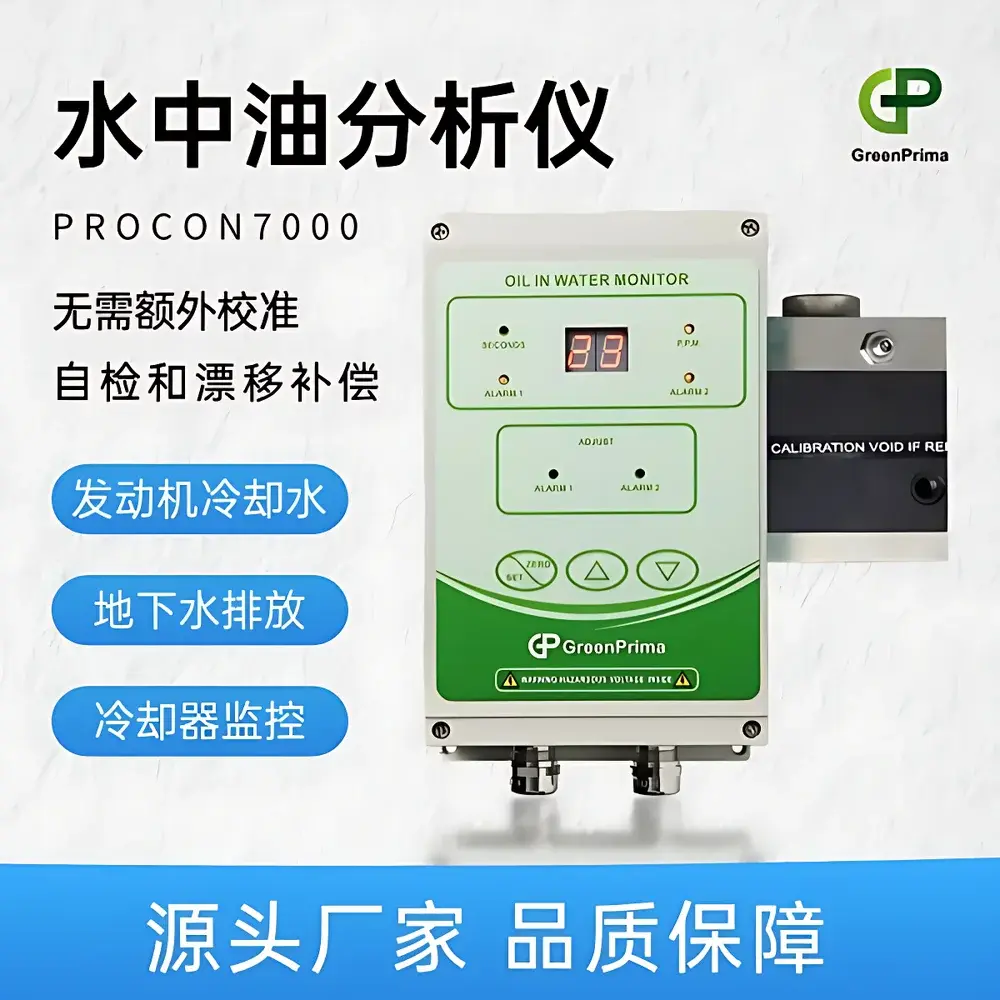
GreenPrima PR-OCON7000 Online Oil-in-Water Analyzer
| Brand | GreenPrima |
|---|---|
| Origin | UK |
| Manufacturer Type | Manufacturer |
| Origin Category | Imported |
| Model | PR-OCON7000 |
| Instrument Type | Online |
| Measurement Principle | Fluorescence-based Optical Detection (Non-Extractive) |
| Measurement Range | 0–99 ppm |
| Accuracy | ±2 ppm |
| Alarm Setpoint Range | 1–98 ppm (adjustable) |
| Alarm Delay | Alarm 1: 0–60 s |
| Alarm 2 | 10–240 s (both adjustable) |
| Display | 240 × 128 pixel touchscreen |
| Analog Outputs | 0/4–20 mA (min. load 820 Ω), 0–5 V / 1–5 V DC (min. load 50 kΩ) |
| Sample Flow Rate | 0.1–2 L/min |
| Sample Temperature | 1–40 °C |
| Sample Pressure | 0.1–10 bar |
| Ambient Temperature | 1–60 °C |
| Humidity | ≤90% RH at 55 °C |
| Enclosure Rating | IP55 |
| Electrical Safety | EN 61010-1, IEC 664 Category II |
| Weight | 2.25 kg |
| Dimensions (H×W×D) | 215 × 242 × 73 mm |
| Power Supply | 230 V / 115 V AC or 24 V AC |
| Max. Power Consumption | 10 VA |
Overview
The GreenPrima PR-OCON7000 Online Oil-in-Water Analyzer is an industrial-grade, fluorescence-based optical sensor engineered for continuous, real-time monitoring of hydrocarbon contamination in aqueous streams. Unlike solvent-extraction or gravimetric methods, the PR-OCON7000 employs a non-contact, extractive-free excitation-emission principle: UV light (typically 254–280 nm) induces native fluorescence in aromatic hydrocarbons (e.g., BTEX, PAHs, mineral oils), and the intensity of emitted light (300–450 nm) is quantitatively correlated to oil concentration via factory-calibrated photometric algorithms. This method eliminates reagent consumption, sample pretreatment, and interferences from suspended solids up to 50 ppm—making it especially suitable for turbid cooling water, condensate return lines, and wastewater effluents where particulate load varies dynamically. The analyzer operates under ISO 9001-certified manufacturing protocols and complies with EN 61010-1 for electrical safety in industrial environments.
Key Features
- Automated self-diagnostic routine with built-in drift compensation—performed prior to each measurement cycle to ensure long-term baseline stability
- Configurable measurement intervals (1–3600 seconds), enabling optimization between responsiveness and sensor longevity
- Touchscreen HMI (240 × 128 pixels) with intuitive navigation, multilingual interface support (English, German, French, Spanish), and on-device data logging (up to 30 days at 1-min resolution)
- Dual independent alarm outputs with fully programmable setpoints (1–98 ppm), delay timers (Alarm 1: 0–60 s; Alarm 2: 10–240 s), and dry-contact relay ratings of 8 A @ 240 V AC
- Flexible analog output configuration: selectable 0/4–20 mA (min. 820 Ω load) or 0–5 V / 1–5 V DC (min. 50 kΩ load), compatible with PLCs, DCS, and SCADA systems
- External start/stop trigger capability via isolated digital input—enabling synchronization with process pumps or sampling valves
- IP55-rated enclosure with corrosion-resistant aluminum housing, rated for ambient operation from 1 °C to 60 °C and humidity up to 90% RH at 55 °C
- No field calibration required; factory calibration traceable to NPL (UK National Physical Laboratory) reference standards
Sample Compatibility & Compliance
The PR-OCON7000 is validated for use with freshwater, boiler condensate, engine cooling water, and pre-treated industrial wastewater containing mineral oils, synthetic lubricants, diesel, and light fuel oils. It tolerates sample temperatures from 1 °C to 40 °C and pressures from 0.1 to 10 bar—compatible with standard inline flow cells (optional stainless-steel wetted parts available). While not intended for raw sewage or highly emulsified refinery sidestreams without prior phase separation, its solid discrimination capability (up to 50 ppm suspended solids) ensures stable performance in moderately fouling applications. The device meets EN 61010-1 for safety in measurement/control laboratories and industrial settings. Its analog outputs and alarm logic support integration into facilities operating under ISO 14001 environmental management systems and align with EPA Method 1664B screening intent for hydrocarbon discharge monitoring.
Software & Data Management
Data acquisition is supported via optional USB interface (USB-A host port), enabling direct export of time-stamped concentration logs (.CSV), system event history, and diagnostic reports. No proprietary software is required—data files are readable in Excel, LabVIEW, or Python pandas. For enterprise integration, the 4–20 mA output supports Modbus RTU over RS-485 (with optional adapter), allowing seamless ingestion into Historian platforms such as OSIsoft PI or Emerson DeltaV. Audit trails—including alarm activation timestamps, parameter changes, and firmware updates—are retained onboard and exportable. While the PR-OCON7000 does not implement FDA 21 CFR Part 11 electronic signature controls (as it lacks user authentication), its deterministic measurement architecture and immutable internal logging meet GLP-aligned documentation requirements for environmental QA/QC programs.
Applications
- Continuous monitoring of lubricating oil leakage across heat exchanger tubes in power plant cooling circuits
- Early detection of fuel oil ingress in steam turbine condensate return lines—preventing boiler tube scaling and corrosion
- Effluent compliance verification prior to discharge from metalworking, food processing, and petrochemical facilities
- Groundwater remediation site surveillance, particularly where diesel-range organics (DRO) or gasoline-range organics (GRO) are target analytes
- Pre-treatment validation for membrane filtration or activated carbon units handling oily wastewater streams
FAQ
Does the PR-OCON7000 require periodic recalibration?
No. The instrument uses factory-established photometric calibration curves traceable to NPL-certified oil-in-water standards. Drift compensation occurs automatically before every analysis cycle; no user-performed calibration is necessary under normal operating conditions.
Can it measure emulsified oil?
Yes—within limits. The fluorescence response is proportional to dissolved and finely dispersed aromatic hydrocarbons. Highly stable oil-in-water emulsions (e.g., those stabilized by surfactants) may yield elevated readings compared to gravimetric methods; users should validate against site-specific reference methods if regulatory reporting is required.
Is the flow cell included?
The PR-OCON7000 is supplied as a standalone analyzer. A compatible inline flow cell (stainless steel or PVDF body, ½” NPT connections) is available as an optional accessory, including temperature and pressure sensors for full stream characterization.
What maintenance is required?
Routine maintenance consists of quarterly inspection of the optical window for fouling and cleaning with isopropyl alcohol and lint-free wipes. No consumables, lamps, or reagents are used—the LED excitation source has a rated lifetime exceeding 50,000 hours.
How is compliance with discharge limits enforced?
The dual-programmable alarm system enables hardwired interlocks—for example, triggering pump shutdown or diversion valves when oil concentration exceeds permitted thresholds defined by local environmental permits (e.g., EU WFD Annex V or US Clean Water Act NPDES limits).







