
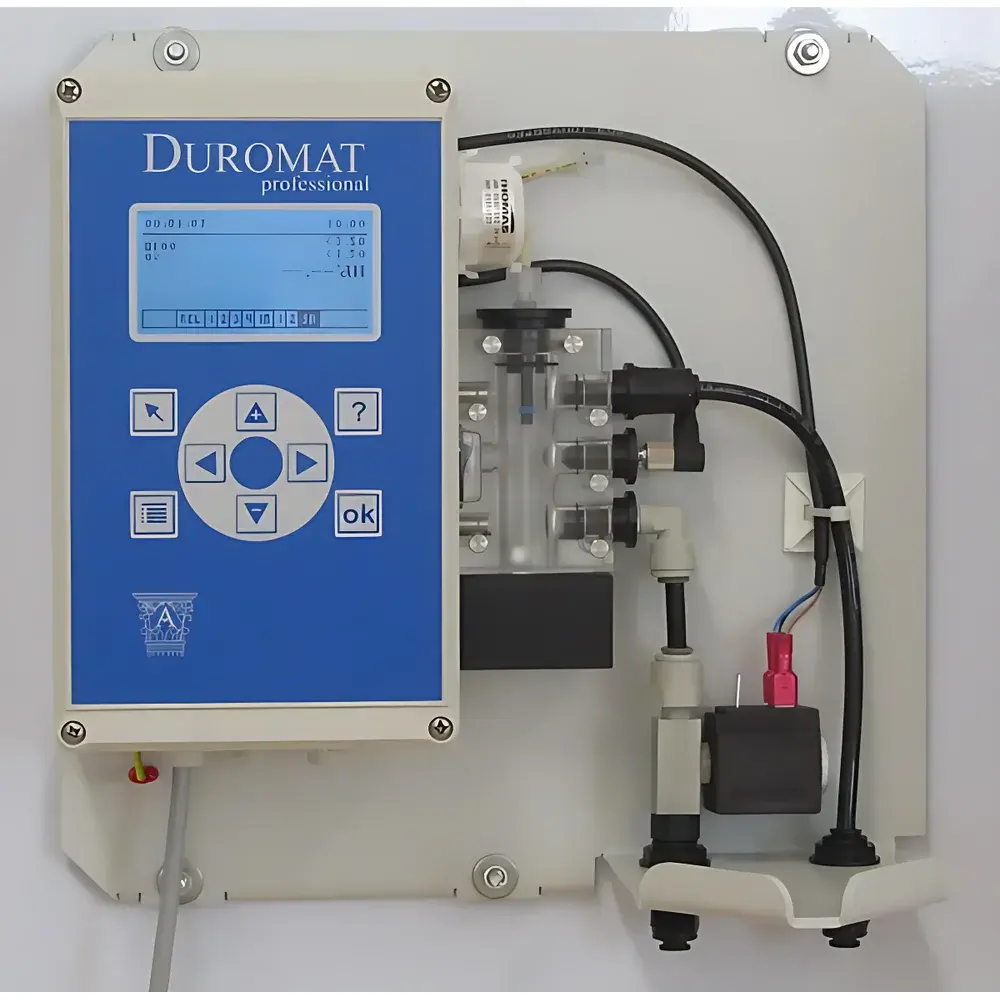
German-made Online Total Hardness Monitor Model 2800
| (English product name follows international B2B naming convention | origin + function + model + device type) |
|---|---|
| Origin | Germany |
| Manufacturer Type | Authorized Distributor |
| Origin Category | Imported |
| Model | 2800 |
| Instrument Type | Online Water Quality Analyzer |
| Measured Parameter | Total Calcium & Magnesium Hardness (as CaCO₃) |
| Measurement Principle | DPD-based Colorimetric Titration |
| Accuracy | ±5% of selected reagent range upper limit |
| Repeatability | ±2.5% of selected reagent range upper limit |
| Dimensions | 300 × 300 × 200 mm (H × W × D) |
| Weight | 4 kg |
| Enclosure Rating | IP65 |
| Power Supply | 85–265 VAC, 47–63 Hz |
| Power Consumption | 25 VA (operational), 3.5 VA (standby) |
| Sample Temperature Range | 5–40 °C |
| Ambient Operating Temperature | 10–40 °C |
| Sample pH Range | 4–10 |
| Interferent Limits | Fe < 3 ppm, Cu < 0.2 ppm, Al < 0.1 ppm, Mn < 0.2 ppm |
| Sample Pressure Range | 0.2–5 bar (recommended: 1–2 bar) |
| Measurement Cycle | Programmable interval (5–360 min), external trigger, or flow-pulse synchronized |
| Analysis Time | ~3 minutes (hardness-dependent) |
| Display | Graphical backlit LCD |
| Output Interfaces | 4 programmable relay outputs (250 VAC, 4 A max), 1 isolated 0/4–20 mA analog output (750 Ω max), CAN bus interface |
| Digital Inputs | 2 programmable (IN1: analysis start / flow switch / pulse meter |
| IN2 | system reset) |
| Flushing Duration | Adjustable (15–1800 s) |
| Data Storage | SD card (event logs, fault records, measurement history) |
| Units | °dH, °f, ppm CaCO₃, mmol/L, mg/L, mval/L, °e |
| Mounting | Wall-mounted |
Overview
The German-engineered Online Total Hardness Monitor Model 2800 is a dedicated, laboratory-grade analyzer designed for continuous, unattended quantification of total calcium and magnesium hardness in water streams—expressed equivalently as calcium carbonate (CaCO₃). It employs a validated DPD (N,N-diethyl-p-phenylenediamine)-based colorimetric titration method, combining precise reagent dosing with photometric endpoint detection to deliver high reproducibility in real-world industrial environments. Unlike optical absorption-only sensors, this instrument performs a true stoichiometric reaction: DPD reacts selectively with oxidized metal ions under controlled pH and complexation conditions, generating a stable magenta-colored complex proportional to total hardness concentration. The system’s closed-loop fluidic architecture minimizes carryover and ensures consistent sample conditioning—critical for applications where scaling, precipitation, or membrane fouling must be proactively managed. Designed for integration into automated water treatment control systems, the Model 2800 operates without manual intervention for extended periods, supporting regulatory compliance in sectors governed by USP , ASTM D1126, and ISO 6059.
Key Features
- DPD colorimetric titration methodology—traceable to NIST-traceable hardness standards and validated per EPA Method 130.1 principles
- Self-contained reagent delivery with low-consumption cartridge design—typical reagent lifetime exceeds 3 months at 15-minute cycle intervals
- Programmable measurement frequency (5–360 minutes), external pulse synchronization (e.g., flow meter pulses), or demand-triggered analysis
- Graphical backlit LCD interface with multilingual support (English, German, French, Spanish, Chinese)—no PC required for configuration or diagnostics
- Four independently configurable relay outputs for alarm staging, pump control, or soft-start valve actuation
- Dual digital inputs enabling seamless integration with PLCs, SCADA systems, or mechanical flow meters
- Onboard SD card logging with timestamped measurement values, diagnostic flags, calibration events, and fault codes—retention configurable up to 12 months
- Robust IP65-rated enclosure suitable for indoor utility rooms, boiler houses, and outdoor kiosk installations (with sunshade)
- Low-power standby mode (3.5 VA) and wide-input AC power supply (85–265 VAC) ensure operational resilience across global electrical infrastructures
Sample Compatibility & Compliance
The Model 2800 is optimized for clean-to-moderately challenging aqueous matrices. Validated performance requires sample pH between 4.0 and 10.0, with strict upper limits on transition metal interference: iron < 3 ppm, copper < 0.2 ppm, aluminum < 0.1 ppm, and manganese < 0.2 ppm. These constraints align with ISO 5667-3 sampling guidelines and prevent DPD oxidation side reactions that compromise endpoint accuracy. Sample temperature must remain within 5–40 °C; integrated thermistor compensation corrects for minor thermal drift in photometric gain. For regulated environments—including pharmaceutical purified water (PW) and water-for-injection (WFI) loops—the instrument supports audit-ready operation: all calibrations, maintenance actions, and parameter changes are time-stamped and stored locally. While not inherently 21 CFR Part 11 compliant out-of-the-box, its event-logged architecture provides foundational data integrity for GMP/GLP validation protocols when deployed with approved SOPs and electronic signature workflows.
Software & Data Management
No proprietary software is required for basic operation—configuration, calibration, and troubleshooting occur directly via the front-panel interface. However, optional firmware updates and advanced report generation (CSV export, trend charts, alarm summaries) are supported through the manufacturer’s secure web-based Configuration Utility (accessible via Ethernet or USB). All measurement data, including raw absorbance readings, titrant volume consumed, and endpoint confidence metrics, are stored on the removable SD card in standardized, human-readable text files. The CAN bus interface enables deterministic, low-latency communication with third-party controllers using SAE J1939 or custom OEM-defined message frames—eliminating protocol translation layers common in Modbus RTU deployments. Analog 0/4–20 mA output is fully isolated and scalable per user-defined range (e.g., 0–500 ppm CaCO₃), with hardware-level HART compatibility available upon request.
Applications
- Boiler feedwater and condensate monitoring—preventing scale formation in high-pressure steam systems
- Groundwater desalination pretreatment—optimizing antiscalant dosing and RO membrane protection
- Pharmaceutical water systems (PW, WFI)—continuous verification of softener breakthrough per EU Annex 1 and USP
- Municipal drinking water distribution—tracking hardness stability post-lime-soda softening
- Food & beverage process water—ensuring consistency in CIP rinse cycles and product formulation
- Industrial cooling tower make-up—correlating hardness with conductivity-based blowdown control
FAQ
What hardness units does the Model 2800 support?
The instrument natively displays results in seven interchangeable units: °dH (German degrees), °f (French degrees), ppm CaCO₃, mmol/L, mg/L, mval/L, and °e (English degrees)—all mathematically interconvertible in real time.
Can the same unit measure both hardness and alkalinity?
Yes—by swapping the reagent cartridge and updating the method selection in the menu, the analyzer executes a separate, optimized endpoint titration for total alkalinity (as CaCO₃) using bromocresol green–methyl red indicator chemistry.
Is field calibration possible without lab-grade standards?
Field calibration requires certified hardness standard solutions traceable to NIST SRM 3109a or equivalent. The built-in two-point calibration routine accepts user-defined low/high reference values; automatic slope and offset calculation ensures metrological traceability.
How is sample line clogging mitigated?
The system incorporates programmable flush cycles (15–1800 seconds) triggered before or after each analysis. Optional 5-µm inline filtration and pressure monitoring via the digital input interface further enhance long-term reliability in suspended-solid-prone streams.
Does the instrument meet EMC and safety directives for CE marking?
Yes—the Model 2800 complies with EN 61326-1 (EMC for laboratory equipment) and EN 61010-1 (safety requirements for electrical equipment), bearing full CE marking under the EU Low Voltage and EMC Directives.
Related Products







