
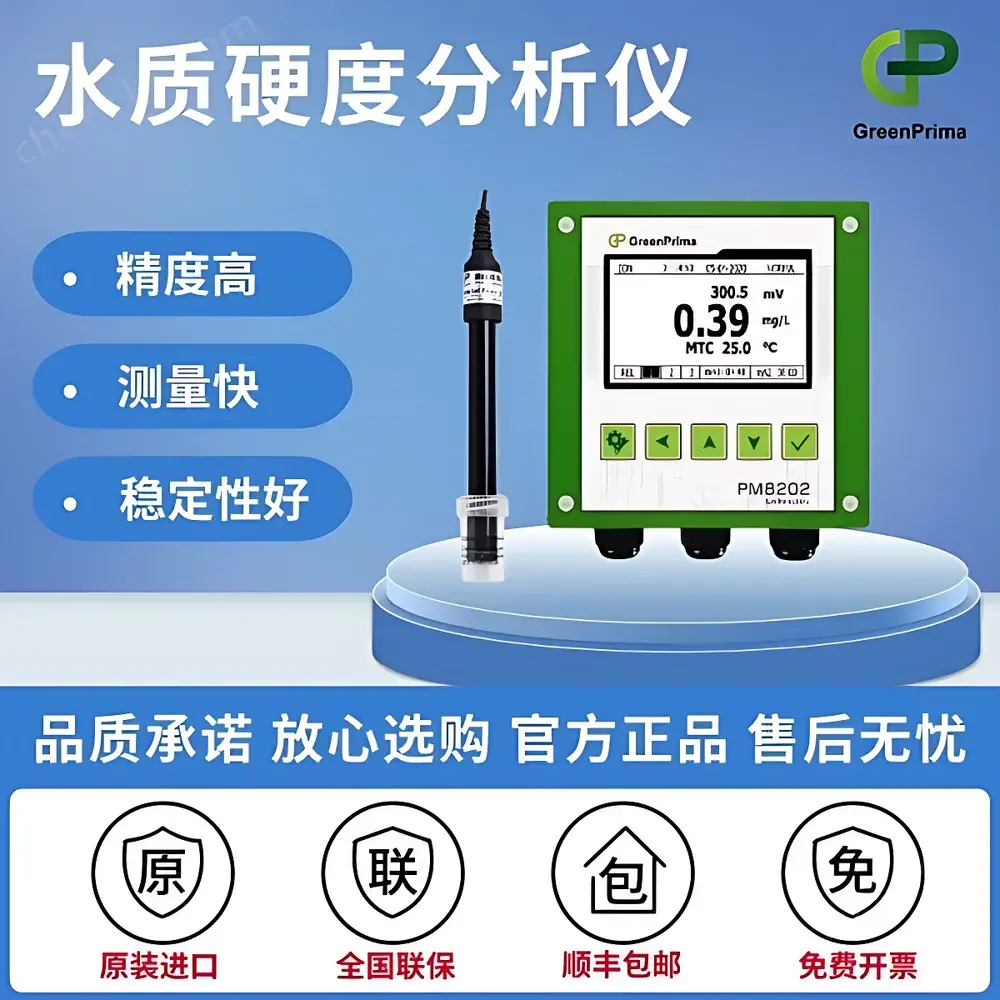
GreenPrima PM8202I Calcium Hardness Analyzer
| Brand | GreenPrima |
|---|---|
| Origin | United Kingdom |
| Manufacturer Type | Original Equipment Manufacturer (OEM) |
| Product Origin | Imported |
| Model | PM8202I |
| Measurement Principle | Potentiometric Ion-Selective Electrode (ISE) for Calcium |
| Range | 0.00–20,000 ppm Ca²⁺ (as CaCO₃ equivalent) |
| Resolution | 0.01 / 0.1 / 1 ppm (user-selectable) |
| Accuracy | ±0.01 ppm (≤10 ppm), ±0.1 ppm (10–100 ppm), ±1 ppm (>100 ppm) |
| Temperature Compensation | -10 to +130 °C (NTC30k or PT1000 sensor, manual/automatic) |
| Operating Temperature | -10 to +70.0 °C |
| Storage Temperature | -20 to +70.0 °C |
| Display | Backlit high-resolution dot-matrix LCD |
| Language Support | English & Chinese |
| Data Storage Capacity | 600,000 records |
| Power Supply | 90–260 VAC, 50/60 Hz |
| Optional | 24 VDC |
| Output | Two isolated 4–20 mA analog outputs (max. loop resistance 500 Ω, accuracy ±0.1% FS), configurable for calcium concentration and temperature |
| Relay Output | One multifunctional relay (cleaning trigger, periodic alarm, fault alert) |
| Enclosure Rating | IP67-rated sealed housing |
| Electrode | Integrated BSENS740 calcium-selective composite electrode |
| Calibration | Two-point calibration with standard solutions (e.g., 100 ppm & 1000 ppm Ca²⁺) |
| Compliance | Designed per IEC 61000-6-2 (EMC immunity), IEC 61000-6-4 (EMC emission), and EN 61326-1 (laboratory & industrial measurement equipment) |
Overview
The GreenPrima PM8202I Calcium Hardness Analyzer is a dedicated, potentiometric online analyzer engineered for continuous, reagent-free quantification of calcium ion concentration—expressed as total hardness (CaCO₃ equivalent)—in aqueous process streams. It operates on the principle of ion-selective electrode (ISE) potentiometry, where the BSENS740 calcium-specific composite electrode generates a Nernstian voltage response proportional to the logarithm of free Ca²⁺ activity in solution. This electrochemical method eliminates dependence on colorimetric chemistry, optical path integrity, or fluidic manifolds—thereby avoiding reagent consumption, tubing fouling, and optical drift common in spectrophotometric or titrimetric systems. The analyzer is calibrated against traceable calcium standards and incorporates automatic temperature compensation using either NTC30k or PT1000 sensors, ensuring thermodynamic rigor across dynamic thermal environments—from chilled groundwater intake to high-temperature boiler feedwater loops.
Key Features
- True reagent-free operation: No chemical dosing, no waste generation, no consumables beyond electrode lifetime
- IP67-rated rugged enclosure: Fully sealed against dust and immersion up to 1 m for 30 minutes—suitable for outdoor, washdown, and hazardous area installations (non-classified zones)
- Intuitive dual-language interface: Graphical dot-matrix LCD with backlight enables seamless navigation in English or Chinese; parameter configuration, calibration logging, and real-time diagnostics accessible without external software
- Multi-tier resolution and accuracy: Selectable resolution (0.01 / 0.1 / 1 ppm) matched to application-critical uncertainty requirements—validated per ISO 5725-2 for precision and trueness
- Dual isolated 4–20 mA outputs: Independently configurable for calcium concentration and temperature signals, each with full-scale accuracy ≤±0.1% and galvanic isolation for noise rejection in electrically noisy plant environments
- Configurable relay logic: Supports automated electrode cleaning cycles, scheduled maintenance alerts, and fault-triggered shutdowns—integrated into PLC or DCS control schemes via dry-contact closure
- Onboard data integrity: Stores 600,000 timestamped readings (Ca²⁺, temperature, system status) with cyclic overwrite protection and time-stamped event logging for audit readiness
Sample Compatibility & Compliance
The PM8202I is validated for use with low-to-moderate ionic strength waters—including surface water, groundwater, reverse osmosis permeate, deionized water, and recirculating industrial cooling water. It tolerates suspended solids ≤50 mg/L and turbidity ≤100 NTU when installed with optional flow-through cell or immersion probe housings. Interference from magnesium, sodium, potassium, and alkalinity is minimized through electrode selectivity optimization (log KCa,Mg ≈ -2.8) and built-in ionic strength adjustment algorithms. The analyzer complies with EN 61326-1 (electromagnetic compatibility for measurement equipment), IEC 61000 series for industrial immunity, and supports GLP/GMP-aligned operational documentation—calibration records, verification logs, and maintenance history are exportable via USB or Modbus RTU (optional). While not intrinsically safe, it meets ATEX Zone 2/Class I Div 2 installation guidelines when deployed with appropriate barrier systems.
Software & Data Management
Data acquisition and configuration are managed entirely via the front-panel interface; no proprietary PC software is required for routine operation. However, optional Modbus RTU (RS-485) communication enables integration with SCADA, MES, or historian platforms for centralized trend analysis and alarm aggregation. All stored data include UTC timestamps, measurement units, electrode potential (mV), temperature, and calibration metadata—enabling traceability per FDA 21 CFR Part 11 Annex 11 requirements when paired with validated electronic signature workflows. Firmware updates are performed via microSD card, with version rollback capability and SHA-256 checksum validation to ensure integrity.
Applications
- Pharmaceutical water systems: Real-time monitoring of purified water (PW) and water for injection (WFI) hardness per USP and EU Ph. Eur. 2.2.38
- Power generation: Feedwater and condensate hardness surveillance to prevent scale formation in HRSGs and turbines
- Electroplating & anodizing baths: Control of calcium ingress that compromises bath stability and deposit quality
- Food & beverage processing: Verification of rinse water hardness prior to CIP cycle validation
- Microelectronics ultrapure water (UPW): Detection of calcium breakthrough in final polishing stages (target: <1 ppb, with PM8202I used for upstream guard monitoring)
- Municipal desalination pretreatment: Optimization of antiscalant dosing based on raw seawater or brackish water hardness profiles
FAQ
What calcium species does the PM8202I measure?
It measures free, hydrated Ca²⁺ ions in aqueous solution—not total calcium bound in complexes or precipitates. Results are reported as ppm CaCO₃ equivalent per ASTM D1126 and ISO 6059.
Can the analyzer be used in high-pH boiler water?
Yes—provided the BSENS740 electrode is operated within its specified pH range (2–12) and temperature limits (-10 to +130 °C); sodium error is compensated algorithmically above pH 10.5.
Is calibration traceable to NIST standards?
Calibration solutions must be prepared from NIST-traceable calcium standards (e.g., NIST SRM 3109a); the instrument itself does not hold metrological certification but supports documented calibration procedures compliant with ISO/IEC 17025.
How often does the electrode require replacement?
Typical service life is 12–18 months in clean, low-fouling applications; reduced to 6–9 months in high-silica or high-sulfate waters. Performance degradation is monitored via slope stability (±30 mV) diagnostics.
Does the unit support remote diagnostics?
Via optional Modbus RTU, yes—parameters including electrode mV output, temperature, calibration status, and relay state are readable remotely; however, firmware updates and calibration initiation require local access.





