
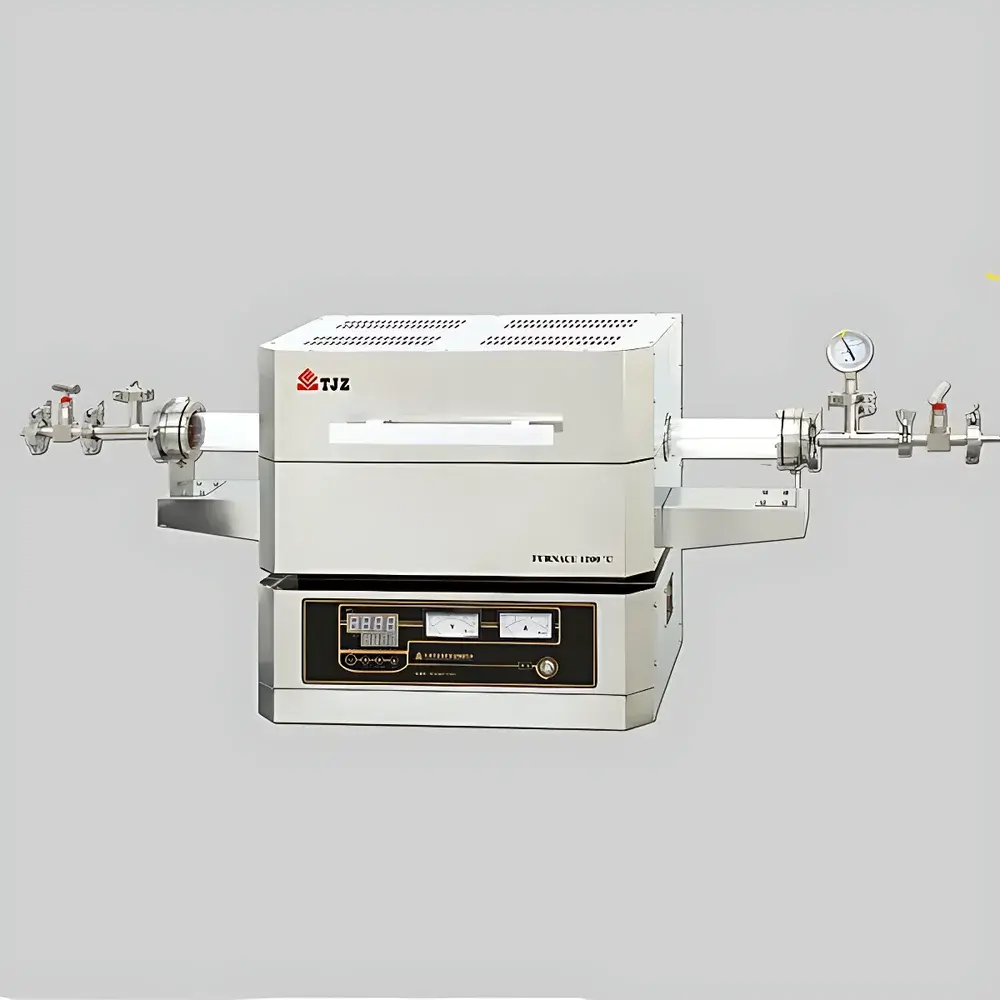
ZHONGHUAN FURNACE ZHX-B05123K Stainless Steel High-Temperature Vacuum & Atmosphere Tube Furnace
| Brand | ZHONGHUAN FURNACE |
|---|---|
| Origin | Tianjin, China |
| Model | ZHX-B05123K |
| Instrument Type | Tube Furnace |
| Max Temperature | 1200 °C |
| Temperature Control Accuracy | ±1 °C |
| Max Power | 3 kW |
| Heating Time to Max Temp | 15 min |
| Heating Element | OCr27Al7Mo2 High-Resistance Alloy Wire |
| Internal Chamber Dimensions | Φ60/53 mm × 1000 mm |
| Chamber Construction | Dual-Hinged Top-Opening Molybdenum Silicate Fiber Insulation |
| Sealing | Dual-Ring Flange Seal |
| Cooling | Auto-Activated Surface-Cooling Fan (Triggered at 50 °C Surface Temp) |
| Control System | AI-Based PID with Self-Tuning & Programmable Ramp/Soak Profiles (50 Segments, Domestic |
| Communication | RS-485 Interface (Optional PC Integration for Remote Monitoring & Multi-Furnace Management) |
Overview
The ZHONGHUAN FURNACE ZHX-B05123K is a high-performance, vertically oriented tube furnace engineered for precise thermal processing under controlled vacuum or reactive/inert atmospheres. Designed for materials synthesis, sintering, annealing, and heat treatment applications in academic research labs, quality control facilities, and R&D centers, it integrates robust mechanical architecture with thermally optimized insulation and intelligent process control. Its core operating principle relies on resistive Joule heating via high-stability OCr27Al7Mo2 alloy wire elements embedded within a multi-layered, vacuum-formed polycrystalline mullite fiber chamber—delivering exceptional thermal uniformity (±3 °C over the central 200 mm zone) and energy efficiency (up to 50% reduction in standby heat loss compared to conventional ceramic board linings). The furnace operates across a continuous temperature range of ambient to 1200 °C, with programmable ramp rates from 0.1 to 30 °C/min and sustained isothermal stability ≤±1 °C over 24-hour dwell periods.
Key Features
- Dual-hinged top-opening furnace chamber enables 110° rearward rotation for unobstructed access to the entire 1000 mm hot zone—eliminating the need for sample pushing tools and minimizing thermal shock during loading/unloading.
- Quick-connect flange system with single stainless steel clamp simplifies gas line attachment/detachment, reducing installation time and mitigating mechanical stress-induced quartz or alumina tube fracture.
- Dual-ring sealing technology at both ends ensures leak rates <5×10⁻³ mbar·L/s under vacuum conditions and maintains atmosphere integrity up to 0.2 MPa positive pressure (N₂, Ar, H₂, forming gas).
- Integrated surface temperature monitoring with auto-triggered axial cooling fan activates when external casing exceeds 50 °C—maintaining operator safety and prolonging structural component lifespan.
- Comprehensive safety architecture includes door-interlocked power cutoff, independent overtemperature cutout (with audible/visual alarm), and grounded chassis leakage detection compliant with IEC 61000-6-3 EMC standards.
Sample Compatibility & Compliance
The ZHX-B05123K accommodates standard OD 60 mm / ID 53 mm fused silica, high-purity alumina, or recrystallized silicon carbide tubes up to 1000 mm in length. Its modular gas inlet/outlet configuration supports integration with mass flow controllers (MFCs), vacuum pumps (rotary vane or turbomolecular), and gas purging systems for sequential atmosphere switching. The furnace meets ISO 9001 manufacturing traceability requirements and conforms to key laboratory safety directives including EN 61000-6-2 (immunity) and EN 61000-6-4 (emission). When equipped with optional RS-485–to–Ethernet gateways and validated software, it supports 21 CFR Part 11-compliant electronic records and audit trails for GLP/GMP environments.
Software & Data Management
The furnace’s embedded controller features an RS-485 port supporting Modbus RTU protocol for seamless integration into centralized lab management platforms. Optional professional software enables real-time temperature logging, multi-furnace synchronization, alarm event timestamping, and export of CSV/Excel-formatted reports—including ramp rate deviation analysis, dwell time compliance verification, and thermal profile overlay comparisons. With full support for SCADA-level architectures, up to 200 units can be monitored concurrently with configurable user permissions, data retention policies, and automated backup to network-attached storage (NAS) or cloud repositories.
Applications
- Controlled-atmosphere synthesis of metal oxides, perovskites, and battery cathode precursors (e.g., LiCoO₂, NMC)
- Vacuum-assisted degassing and binder burnout in ceramic green bodies prior to sintering
- In-situ reduction studies using H₂/N₂ mixtures for catalyst activation (e.g., Ni/Al₂O₃, Cu/ZnO)
- Thermal stability evaluation of polymer composites and carbon-based nanomaterials
- Calibration of thermocouples and reference materials per ASTM E220 and ISO 17025 protocols
FAQ
What vacuum level can this furnace achieve with standard configuration?
With a compatible two-stage rotary vane pump, the system typically reaches ≤5×10⁻² mbar; for high-vacuum operation (<1×10⁻⁴ mbar), a turbomolecular pump and vacuum gauge upgrade are recommended.
Is the furnace compatible with hydrogen atmosphere processing?
Yes—when used with certified H₂-compatible fittings, leak-tested gas lines, and appropriate ventilation, the dual-ring flange design supports safe operation up to 10% H₂ in N₂ at temperatures ≤1000 °C.
Can custom tube lengths or diameters be accommodated?
The standard hot zone supports 1000 mm tubes; custom configurations (e.g., 600 mm or 1200 mm) are available upon request, subject to recalibration of thermal uniformity mapping and power distribution validation.
Does the controller support third-party SCADA integration?
Yes—the Modbus RTU interface allows direct integration with Ignition, Siemens SIMATIC, or Rockwell FactoryTalk systems using standard register mapping documentation provided upon order.
What maintenance intervals are recommended for long-term reliability?
Inspect heating element continuity and insulation resistance every 200 operational hours; replace mullite fiber lining after 1,500 cumulative hours at ≥1100 °C or visible structural degradation.
Related Products



