
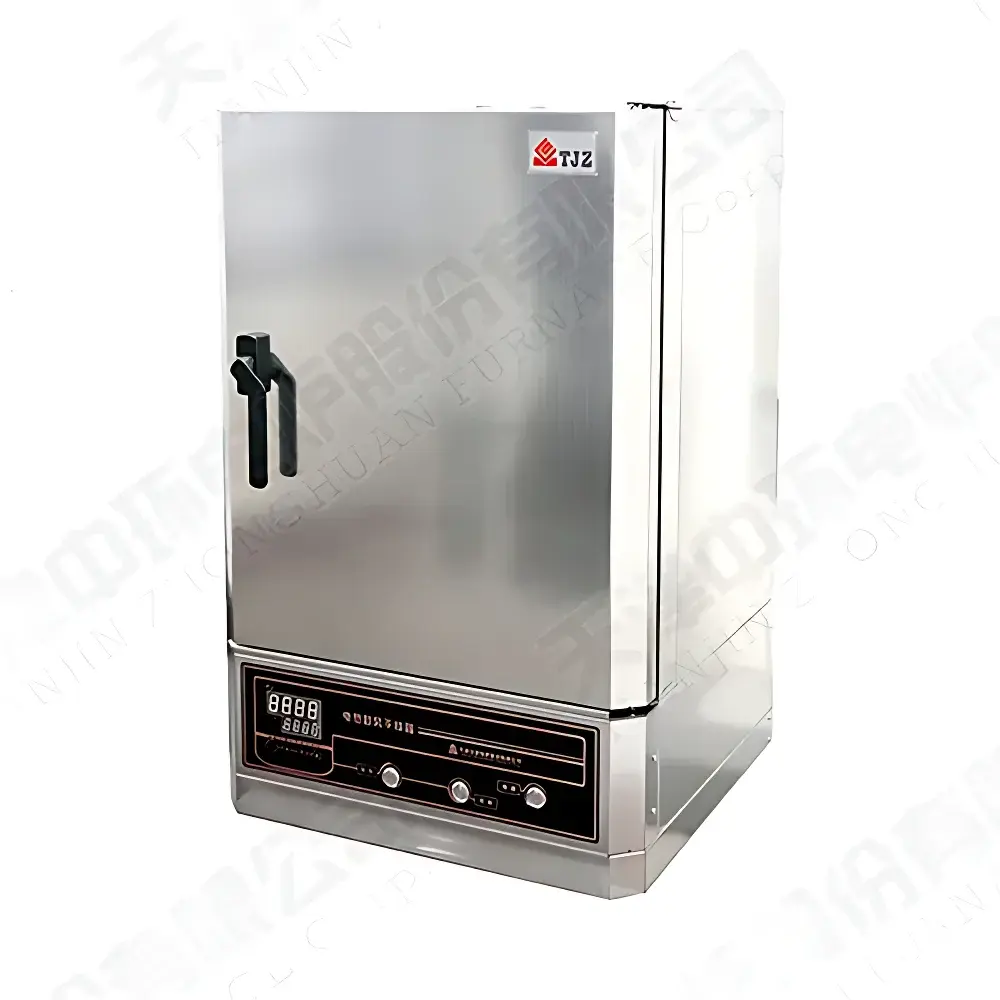
Zhonghuan Furnace DHB Stainless Steel Forced-Air Drying Oven
| Brand | Zhonghuan Furnace |
|---|---|
| Origin | Tianjin, China |
| Model | DHB |
| Instrument Type | Forced-Air Drying Oven |
| Maximum Operating Temperature | 250 °C |
| Heating Method | Electric Resistance Heating with Forced Convection |
| Chamber Material | Stainless Steel (AISI 304) |
| External Construction | Stainless Steel Clad |
| Temperature Uniformity | ±1.5 °C at 100 °C (typical, per ISO 17025-compliant validation) |
| Compliance | Designed to support GLP/GMP-relevant thermal processing workflows |
Overview
The Zhonghuan Furnace DHB Stainless Steel Forced-Air Drying Oven is an engineered thermal processing system designed for precise, repeatable, and contamination-controlled drying, sterilization, and thermal aging applications in regulated laboratory and quality control environments. Utilizing a robust electric resistance heating system coupled with a calibrated axial fan-driven forced-air circulation architecture, the DHB ensures rapid heat transfer and high spatial temperature uniformity across its working chamber. Its maximum operating temperature of 250 °C meets common requirements for moisture removal from powders, glassware conditioning, polymer curing pre-tests, and depyrogenation of non-critical labware. The oven’s thermally stable stainless steel construction—both interior chamber and exterior housing—provides long-term corrosion resistance, ease of decontamination, and compatibility with aqueous, organic, and mildly acidic sample residues.
Key Features
- Stainless steel inner chamber and outer casing (AISI 304 grade), minimizing oxidation risk and supporting routine cleaning with ethanol, isopropanol, or mild alkaline detergents
- Forced-air convection system with adjustable airflow velocity, enabling accelerated equilibration and improved thermal homogeneity (±1.5 °C at 100 °C, verified per internal calibration protocol)
- Digital PID temperature controller with real-time display, programmable ramp/soak profiles, and over-temperature safety cutoff (independent mechanical thermostat)
- Double-layer insulated door with silicone gasket seal, reducing external surface temperature rise and improving energy efficiency
- Standard 2–3 adjustable stainless steel shelves (load capacity: 15 kg per shelf, uniformly distributed)
- Front-access design with reinforced viewing window (heat-resistant borosilicate glass), allowing visual monitoring without compromising chamber integrity
Sample Compatibility & Compliance
The DHB accommodates a broad range of sample formats—including Petri dishes, weighing boats, crucibles, glass vials, aluminum pans, and standard-sized lab trays—within its defined chamber volume. Its stainless steel chamber eliminates leachable metal ions, making it suitable for residue analysis prep, gravimetric moisture determination (per ASTM E1868), and pre-sterilization conditioning of reusable components. While not certified as a Class B autoclave or ISO 13485 medical device, the DHB supports laboratory workflows aligned with ISO/IEC 17025 accreditation requirements when operated under documented procedures. Its thermal performance characteristics are validated using NIST-traceable PT100 sensors during installation qualification (IQ) and operational qualification (OQ) protocols.
Software & Data Management
The DHB operates via an embedded microcontroller-based interface with no external PC dependency. All temperature setpoints, dwell times, and ramp rates are stored locally with non-volatile memory retention. Optional RS-485 Modbus RTU output enables integration into centralized building management systems (BMS) or LIMS for event logging (e.g., door open/close, temperature deviation alarms). Audit trail functionality—including user ID, timestamp, parameter changes, and alarm history—is available via optional data logger module compliant with FDA 21 CFR Part 11 requirements when paired with validated software.
Applications
- Moisture content determination in pharmaceutical excipients, food ingredients, and soil samples (aligned with USP & AOAC methods)
- Pre-drying of filter membranes and analytical filters prior to gravimetric particulate analysis
- Thermal stabilization of reference standards and calibration weights
- Conditioning of desiccants and silica gel prior to humidity chamber use
- Depyrogenation of glassware used in endotoxin testing (at ≥250 °C for ≥30 min, per USP )
- Accelerated aging studies of packaging materials and adhesives under controlled thermal stress
FAQ
What is the recommended calibration frequency for the DHB oven?
Annual calibration against NIST-traceable references is recommended; additional verification should occur after maintenance, relocation, or if process deviations exceed ±1.0 °C.
Can the DHB be used for sterilization of surgical instruments?
No—it is not a medical-grade sterilizer and lacks validation for microbial kill kinetics; it is intended for lab-scale thermal conditioning and drying only.
Is the chamber volume customizable?
Standard chamber dimensions are fixed per model variant; custom internal configurations (e.g., shelf count, port cutouts) require factory consultation and may affect warranty terms.
Does the DHB support remote monitoring via Ethernet or Wi-Fi?
Not natively; connectivity is limited to RS-485 Modbus RTU. Ethernet/Wi-Fi gateways must be externally integrated and validated by the end user.
How is temperature uniformity verified during qualification?
Using a minimum of nine calibrated PT100 sensors placed in a 3×3 grid per ICH Q5C and ISO 17025 Annex A.3 guidelines, with data logged at 15-second intervals over three consecutive cycles.



