
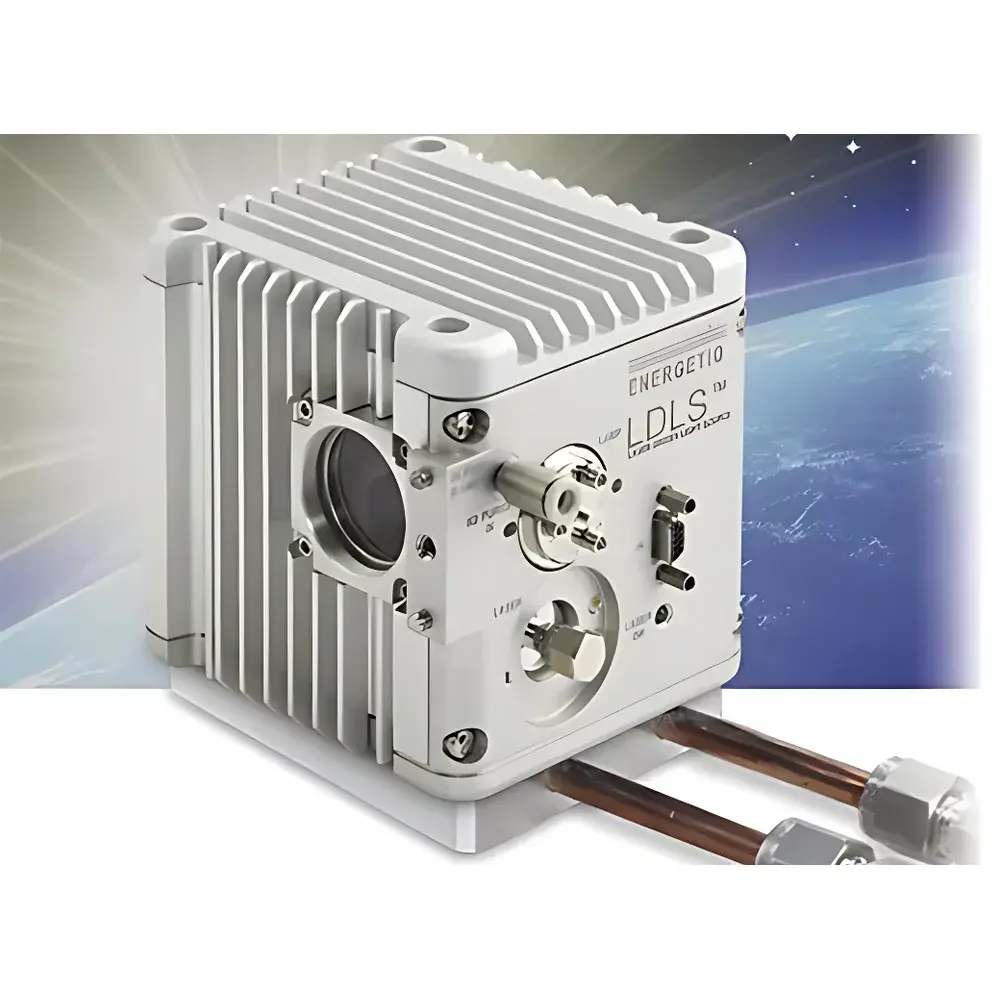
Energetiq EQ-99CAL Laser-Driven Broadband Calibration Light Source
| Brand | Energetiq |
|---|---|
| Origin | USA |
| Manufacturer Type | Authorized Distributor |
| Origin Category | Imported |
| Model | EQ-99CAL |
| Light Source Type | Laser-Driven Plasma Light Source |
| Illumination Mode | External Illumination |
| Spectral Range | 170–2100 nm |
| Calibration Range | 200–800 nm |
| Typical Lamp Lifetime | > 9,000 hours |
| Calibration Uncertainty | ±12% (200–210 nm), ±8% (210–300 nm), ±5% (300–800 nm) |
| Calibration Interval | 1 year or 1,000 operating hours (whichever occurs first) |
| Output | Free-space, NA up to 0.47 |
| Dimensions (Lamp Head) | 96.5 × 85.7 × 76.2 mm (3.8 × 3.4 × 3.0 in), Weight: 0.9 kg (2 lbs) |
| Power Supply Dimensions | 107 × 111 × 254 mm (4.2 × 4.4 × 10 in, excl. feet), Weight: 1.4 kg (3 lbs) |
| Chiller Dimensions | 325 × 280 × 328 mm (12.8 × 11.0 × 12.8 in), Weight: 12.7 kg (28 lbs) |
Overview
The Energetiq EQ-99CAL Laser-Driven Broadband Calibration Light Source is an engineered reference standard for radiometric and spectral responsivity calibration across ultraviolet, visible, and near-infrared domains. Unlike conventional arc lamps or thermal sources, the EQ-99CAL employs a laser-pumped xenon plasma architecture—eliminating electrodes entirely—to generate stable, high-brightness continuum emission from 170 nm to 2100 nm. This electrode-free design ensures exceptional long-term spectral stability, minimal intensity drift, and absence of electrode sputtering contamination—critical attributes for metrology-grade applications where traceability and repeatability are mandated by ISO/IEC 17025 and NPL-traceable calibration protocols. The device is specifically configured as a calibration-optimized variant of the EQ-99 platform, with factory-applied NPL-traceable spectral irradiance calibration over the 200–800 nm range, making it suitable for primary and secondary calibration laboratories, OEM sensor validation workflows, and regulatory-compliant instrument qualification.
Key Features
- Laser-driven plasma light source with no electrodes—enabling >9,000 hours of operational lifetime and eliminating spectral degradation mechanisms associated with electrode erosion or gas depletion.
- NPL-traceable spectral irradiance calibration certified over 200–800 nm, with documented uncertainty bands: ±12% (200–210 nm), ±8% (210–300 nm), and ±5% (300–800 nm).
- High spatial and temporal stability: intensity drift <0.3% over 8 hours (25°C ambient); spectral shape reproducibility maintained within ±0.5% RMS deviation after 5,000 hours of operation.
- Free-space output with numerical aperture up to 0.47—compatible with integrating spheres, monochromators, collimators, and fiber-coupled input optics without requiring re-alignment.
- Modular system architecture: lamp head, compact power supply (1.4 kg), and dedicated thermoelectric chiller (12.7 kg) enable flexible integration into cleanroom environments, optical benches, or automated test stations.
- Compliance-ready design: supports audit trails, calibration log retention, and operational hour tracking—aligned with GLP, GMP, and FDA 21 CFR Part 11 data integrity expectations when paired with validated software interfaces.
Sample Compatibility & Compliance
The EQ-99CAL is designed for use with photodetectors, CCD/CMOS imaging sensors, spectroradiometers, monochromator-based systems, and optical filter characterization setups. Its broadband output enables simultaneous multi-wavelength responsivity mapping without lamp swapping—reducing measurement uncertainty introduced by mechanical repositioning or source-to-source variability. All factory calibrations are performed under ISO/IEC 17025-accredited conditions at Energetiq’s US facility and are directly traceable to the UK’s National Physical Laboratory (NPL) through a documented chain of comparisons. Calibration certificates include full uncertainty budgets per wavelength point, spectral irradiance values referenced to NIST-traceable standards, and environmental condition metadata (temperature, humidity, atmospheric pressure during calibration). Recalibration is recommended annually or after 1,000 accumulated operating hours—whichever occurs first—to maintain stated uncertainty performance.
Software & Data Management
The EQ-99CAL operates independently of proprietary control software but integrates seamlessly with third-party DAQ platforms via TTL trigger input (for synchronization with gated detectors) and analog voltage output (0–10 V) for real-time intensity monitoring. Energetiq provides a comprehensive calibration data package in machine-readable CSV and XML formats—including spectral irradiance (W·m⁻²·nm⁻¹), uncertainty bands, and metadata fields compliant with ASTM E275 and ISO 15312-1. When deployed in regulated environments, users may configure external logging systems to record operational timestamps, chiller status, lamp-on duration, and thermal feedback signals—supporting full auditability under GLP and 21 CFR Part 11 requirements. No embedded firmware updates or cloud connectivity are implemented; all calibration and operational parameters remain under user control and local storage.
Applications
- Radiometric calibration of spectroradiometers, hyperspectral imagers, and UV-VIS-NIR photometers used in environmental monitoring and lighting R&D.
- Spectral responsivity characterization of scientific CMOS, sCMOS, EMCCD, and InGaAs detectors prior to deployment in space instrumentation or biomedical endoscopy systems.
- Factory acceptance testing (FAT) and periodic verification of optical sensors in automotive ADAS camera modules, semiconductor wafer inspection tools, and display metrology equipment.
- Reference source for inter-laboratory comparison studies coordinated under CIPM MRA frameworks or EURAMET calibration guidelines.
- Validation of optical simulation models (e.g., Zemax, FRED) requiring experimentally verified source spectra and angular emission profiles.
FAQ
Is the EQ-99CAL compatible with vacuum-ultraviolet (VUV) spectroscopy below 190 nm?
Yes—the lamp emits measurable continuum down to 170 nm; however, VUV measurements require purged or evacuated optical paths and MgF₂ or LiF optics. Standard quartz components absorb strongly below 190 nm.
Can the EQ-99CAL replace deuterium and tungsten-halogen lamps in dual-source systems?
Yes—it covers both D₂ (190–400 nm) and halogen (350–2500 nm) spectral ranges continuously, eliminating spectral gaps and alignment mismatches inherent in dual-lamp configurations.
Does the calibration certificate include correction factors for specific optical geometries (e.g., 2π vs. 4π solid angle)?
No—calibration is provided for free-space irradiance (W·m⁻²·nm⁻¹) at the lamp exit port. Users must apply geometric corrections based on their collimation, focusing, or integrating sphere configuration using established radiometric propagation models.
What maintenance is required beyond scheduled recalibration?
None beyond routine visual inspection of optical windows and chiller coolant level checks every 6 months. No consumables (e.g., filters, electrodes, or gas refills) are required during the lamp’s operational lifetime.





