
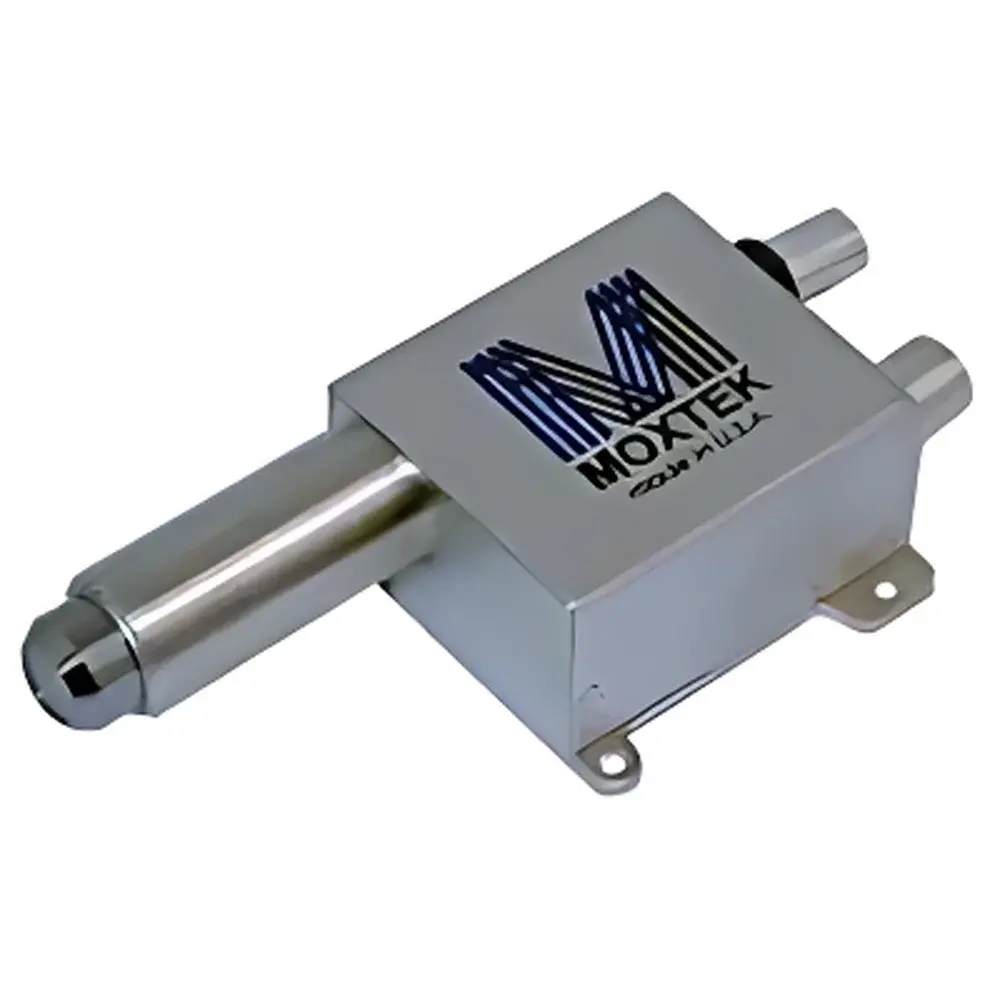
Moxtek XPIN-BT Silicon PIN Photodiode X-ray Detector
| Brand | Moxtek |
|---|---|
| Origin | USA |
| Model | XPIN-BT |
| Active Area | 6 mm² or 13 mm² |
| Silicon Thickness | 625 µm |
| Beryllium Window Thickness | 8 µm or 25 µm |
| Collimator Materials | Tungsten / Cobalt / Titanium / Aluminum |
| Energy Resolution (FWHM) | < 170 eV (6 mm²), < 230 eV (13 mm²) |
| Peak-to-Background Ratio | 3600:1 @ 1 keV (6 mm², typical), 3000:1 @ 1 keV (13 mm², typical) |
Overview
The Moxtek XPIN-BT is a high-performance silicon p-i-n (PIN) photodiode X-ray detector engineered for precision energy-dispersive X-ray spectroscopy (EDS) and low-energy X-ray fluorescence (XRF) applications. Operating on the principle of direct X-ray photon absorption in high-resistivity silicon, the detector generates charge carriers proportional to incident photon energy—enabling quantitative spectral analysis from approximately 0.1 keV to 12 keV. Its intrinsic design incorporates a fully integrated thermoelectric cooler (TEC) and regulated bias supply, ensuring stable operating temperature (±0.1 °C control) and consistent depletion depth—critical for minimizing thermal noise and preserving energy resolution over extended acquisition periods. Unlike discrete detector–preamp configurations, the XPIN-BT’s monolithic integration eliminates signal degradation from parasitic capacitance and cable-induced noise, delivering superior signal integrity in compact benchtop, portable, or OEM instrumentation platforms.
Key Features
- High energy resolution: < 170 eV FWHM at Mn Kα (5.9 keV) for the 6 mm² active area; < 230 eV FWHM for the 13 mm² variant—meeting ASTM E1552–22 requirements for spectral fidelity in elemental quantification.
- Ultra-thin beryllium entrance window (8 µm or 25 µm options) enabling efficient detection of soft X-rays down to boron (B Kα, 0.183 keV) while maintaining vacuum integrity and mechanical robustness.
- 625 µm thick high-purity silicon substrate—optimized for high quantum efficiency (>95% at 5.9 keV) and count-rate capability up to 100 kcps without significant pulse pile-up under standard shaping times.
- Compact trapezoidal housing (24.5 × 15.5 × 12.7 mm) with standardized 10-32 threaded mounting interface—designed for seamless integration into spectrometer chambers, handheld analyzers, and micro-XRF stages.
- Integrated TEC and low-noise bias regulation eliminate external temperature controllers and HV supplies—reducing system footprint, power consumption, and calibration drift across ambient temperatures from 10 °C to 40 °C.
Sample Compatibility & Compliance
The XPIN-BT supports both vacuum and helium-purged measurement environments. Its hermetically sealed package meets MIL-STD-883H Method 1014.10 for moisture resistance and is rated IP65 when installed with appropriate feedthroughs. The detector complies with RoHS Directive 2011/65/EU and conforms to IEC 61000-6-3 (EMC emission limits). For regulated analytical laboratories, its deterministic response and traceable calibration protocol support GLP/GMP workflows; raw pulse height data output enables full auditability required under FDA 21 CFR Part 11 when paired with compliant DPP firmware (e.g., MXDPP-200 v3.2+ with secure logging).
Software & Data Management
The XPIN-BT outputs analog pulses compatible with industry-standard digital pulse processors—including Moxtek’s MXDPP-200 (supporting real-time pile-up rejection, adaptive shaping, and on-board spectrum accumulation) or third-party DPPs meeting IEEE 1014–2020 timing specifications. Spectral data is delivered via USB 2.0 or LVDS interface in standard .spc or .qdf format. SDKs (C/C++, Python) provide low-level register access for custom firmware integration, while Moxtek’s Spectrum Studio software offers automated peak deconvolution, matrix correction (ZAF/Liberty), and ISO 11348-compliant limit-of-detection calculation. All spectral acquisitions include embedded metadata: timestamp, detector temperature, bias voltage, live time, and real time—ensuring full traceability per ISO/IEC 17025:2017 Clause 7.7.
Applications
- Lab-based and field-deployable XRF analyzers for alloy verification, mining geochemistry, and environmental soil screening (Pb, Cd, As, Hg).
- OEM integration into electron microprobe (EPMA) and scanning electron microscope (SEM) EDS systems requiring high spatial resolution and low-voltage sensitivity.
- Thin-film thickness and composition analysis in semiconductor process control (e.g., SiO₂/SiNₓ stack metrology).
- Art conservation science—non-destructive pigment identification in historical manuscripts and painted surfaces.
- Academic research in synchrotron beamlines where compact, low-power detectors are required for multi-element mapping at sub-100 nm resolution.
FAQ
What cooling method does the XPIN-BT use, and what is its operational temperature range?
The XPIN-BT employs a single-stage thermoelectric cooler (TEC) to maintain the silicon diode at –15 °C ± 0.1 °C. It operates continuously within an ambient range of 10 °C to 40 °C without external chiller support.
Can the XPIN-BT be used in air or only under vacuum?
The 8 µm Be window version requires vacuum or helium purge for optimal transmission below 1 keV; the 25 µm variant permits operation in air for elements Na and heavier, though with reduced light-element sensitivity.
Is factory calibration provided, and is it NIST-traceable?
Each unit ships with a certificate of conformance including energy scale calibration using Mn Kα, Cu Kα, and Ag Kα reference lines. Calibration is traceable to NIST SRM 1261 (X-ray line energies) and performed in accordance with ISO/IEC 17025-accredited procedures.
Does the detector support dead-time correction?
Yes—when used with the MXDPP-200 or compatible DPPs supporting live-time mode, the system applies paralyzable dead-time correction algorithms per IEEE 1014–2020 Annex C, ensuring accurate count-rate linearity up to 95% of maximum throughput.
What mechanical interfaces are available for mounting?
Standard configuration includes a 10-32 threaded base with Ø12.7 mm clear aperture. Custom flanges (CF-16, KF-16) and O-ring grooves are available upon request for UHV compatibility.





