
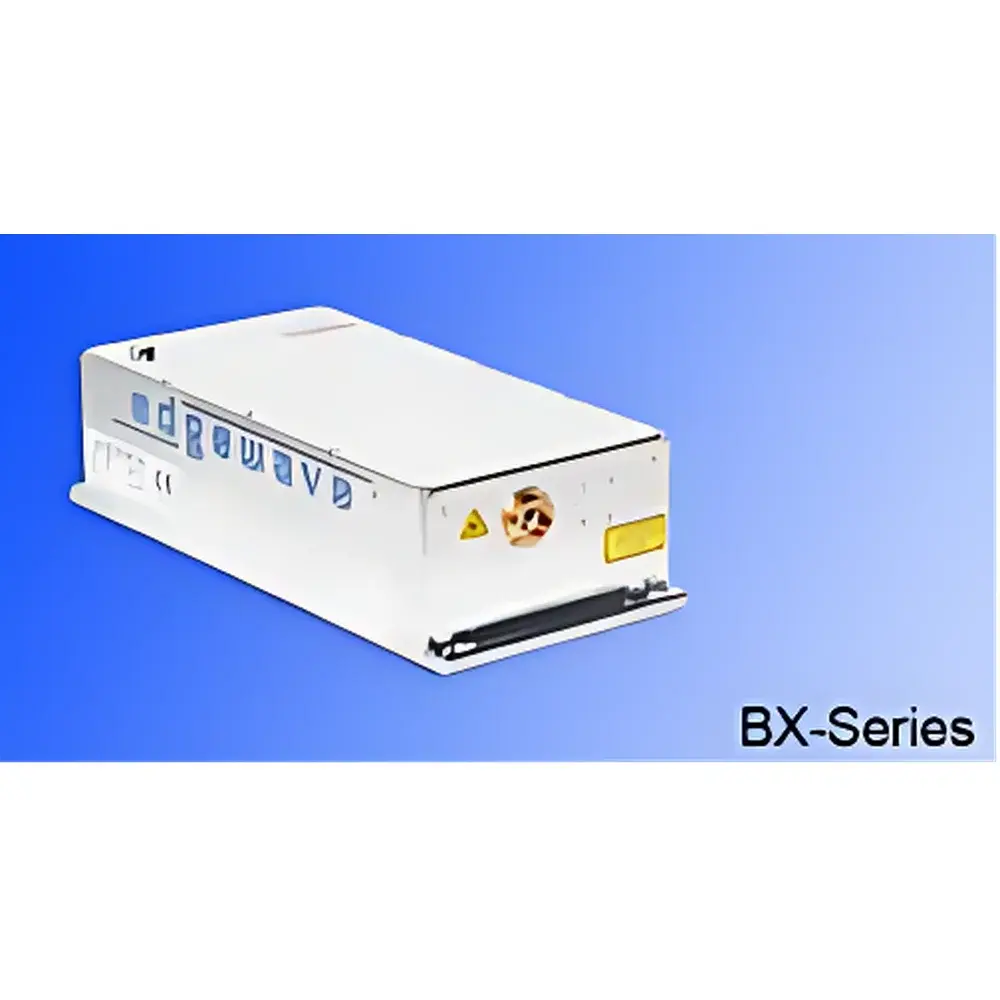
InnoSlab High-Power DPSS Nanosecond Laser System
| Origin | Germany |
|---|---|
| Manufacturer Type | Authorized Distributor |
| Origin Category | Imported |
| Model | InnoSlab |
| Core Technology | Solid-State Diode-Pumped Slab Laser |
| Beam Shaping Capability | Customizable (Gaussian, 1D Top-Hat, 2D Square Top-Hat) |
| Wavelength Options | 1064 nm / 532 nm / 355 nm / 266 nm |
| Pulse Energy | Up to 60 mJ |
| Pulse Width | < 4 ns |
| Peak Power | Up to 7 MW |
| Repetition Rate | Up to 150 kHz |
| Average Output Power | Up to 600 W |
| Beam Quality | M² < 2.0 |
| Polarization Ratio | >100:1 |
| Energy Stability (RMS) | ≤4% |
| Beam Ellipticity (Far-Field) | <10% |
| Beam Diameter | 3 mm (nominal) |
| Divergence (Full Angle) | 225–500 µrad |
| Warm-up Time | 15–30 min |
Overview
The InnoSlab High-Power DPSS Nanosecond Laser System is a diode-pumped solid-state (DPSS) slab laser engineered for industrial and scientific applications demanding high peak power, exceptional beam quality, and stable nanosecond pulse delivery. Based on the patented InnoSlab geometry—a thin, rectangular gain medium with side-pumping and multi-pass amplification—the system achieves superior thermal management and scalable energy extraction without compromising spatial coherence. Unlike conventional rod or fiber architectures, the InnoSlab design enables uniform gain distribution and low thermo-optic distortion, resulting in M² < 2.0 across all standard configurations. The laser operates in actively Q-switched mode using electro-optic (EO) modulation, delivering sub-4 ns pulses at repetition rates from single-shot up to 150 kHz. Harmonic generation modules (SHG, THG, FHG) provide wavelength flexibility at 1064 nm (IR), 532 nm (green), 355 nm (UV), and 266 nm (DUV), supporting material processing across a broad absorption spectrum.
Key Features
- Customizable beam profile architecture: configurable output from fundamental Gaussian to 1D linear top-hat and 2D square top-hat intensity distributions—enabling uniform energy deposition for precision ablation and structuring.
- High-energy nanosecond pulses: up to 60 mJ per pulse with < 4 ns duration, yielding peak powers exceeding 7 MW—critical for nonlinear interaction, plasma initiation, and cold ablation of dielectrics and semiconductors.
- Thermally robust slab gain medium: monolithic Nd:YAG or Nd:YVO₄ geometry with edge-cooling ensures long-term power stability and minimal wavefront distortion under sustained operation.
- Industrial-grade reliability: designed for 24/7 integration into automated production lines; includes integrated temperature stabilization, sealed optical cavity, and redundant safety interlocks compliant with IEC 60825-1:2014 Class 4 requirements.
- Multi-wavelength platform: factory-aligned harmonic generation with >60% conversion efficiency (IR → green), >30% (green → UV), and >15% (UV → DUV), supported by motorized wavelength selection and real-time power monitoring.
- Low RMS energy fluctuation: ≤4% (typical <2% for IR models), achieved via active pump diode current regulation and cavity-length feedback control—essential for process repeatability in regulated manufacturing environments.
Sample Compatibility & Compliance
The InnoSlab laser demonstrates broad compatibility with optically opaque and transparent materials—including silicon wafers, fused silica, sapphire, borosilicate glass, ITO/PEDOT:PSS thin films, FR-4 PCB substrates, and carbon-fiber-reinforced polymers (CFRP). Its short pulse duration and high peak irradiance enable precise subsurface modification without thermal damage zones—validated per ASTM F2971-14 (laser micromachining of medical devices) and ISO 11146-2:2019 (laser beam width, divergence, and beam propagation ratio measurement). All systems ship with CE marking, RoHS compliance documentation, and optional FDA 21 CFR Part 11–ready audit trail logs when paired with certified control software. Full GLP/GMP traceability packages—including calibration certificates traceable to PTB (Physikalisch-Technische Bundesanstalt) standards—are available upon request.
Software & Data Management
Control is executed via the InnoLaser Control Suite (ILCS), a Windows-based application supporting local HMI operation and remote Ethernet/IP integration. ILCS provides real-time monitoring of pulse energy, repetition rate, internal cavity temperature, harmonic conversion efficiency, and beam pointing stability. All operational parameters are logged with timestamped metadata and exportable in CSV or HDF5 format for SPC analysis. Optional API support (C/C++, .NET, Python) enables seamless integration with PLC-driven motion stages (e.g., Aerotech A3200), vision-guided alignment systems, and MES platforms such as Siemens Opcenter Execution. For regulated environments, optional 21 CFR Part 11 compliance modules include electronic signatures, role-based access control, and immutable audit trails with SHA-256 hashing.
Applications
- Photovoltaics: Edge isolation, trench cutting, and selective emitter doping in crystalline Si solar cells; P1–P3 patterning of CIGS and perovskite thin-film stacks.
- Display Manufacturing: Laser-induced graphene (LIG) patterning on PET substrates; micro-structuring of touch sensor electrodes; non-thermal glass scribing for OLED panel separation.
- Microelectronics: Via drilling in HDI PCBs; trimming of thick-film resistors; removal of passivation layers on IC packages without substrate damage.
- Aerospace & Automotive: Surface texturing of turbine blade coatings for enhanced adhesion; ablation of thermal barrier coatings (TBCs); precision machining of ceramic matrix composites (CMCs).
- Scientific Research: Pump source for OPOs and ultrafast amplifier seeding; time-resolved LIBS spectroscopy; laser-induced breakdown spectroscopy (LIBS) calibration standards development.
FAQ
What cooling method does the InnoSlab laser require?
The system operates with closed-loop chiller cooling (recommended coolant: deionized water + 20% ethylene glycol); minimum flow rate: 8 L/min; temperature stability: ±0.3°C.
Is harmonic generation module included by default?
Standard configurations include IR (1064 nm) output only; SHG (532 nm), THG (355 nm), and FHG (266 nm) modules are optional but factory-aligned and pre-qualified for each model variant.
Can the laser be synchronized with external equipment?
Yes—TTL-compatible trigger inputs (sync-in) and outputs (pulse-ready, Q-switch fire) support sub-10 ns jitter synchronization with motion controllers, cameras, and detectors.
What maintenance intervals are recommended?
No routine optics cleaning or alignment is required within first 10,000 operating hours; annual preventive maintenance includes diode lifetime assessment, thermal interface inspection, and power calibration verification.
Is OEM integration support available?
Yes—dedicated engineering support includes mechanical footprint drawings, electrical interface schematics, SDK documentation, and custom firmware adaptation for embedded control architectures.





