
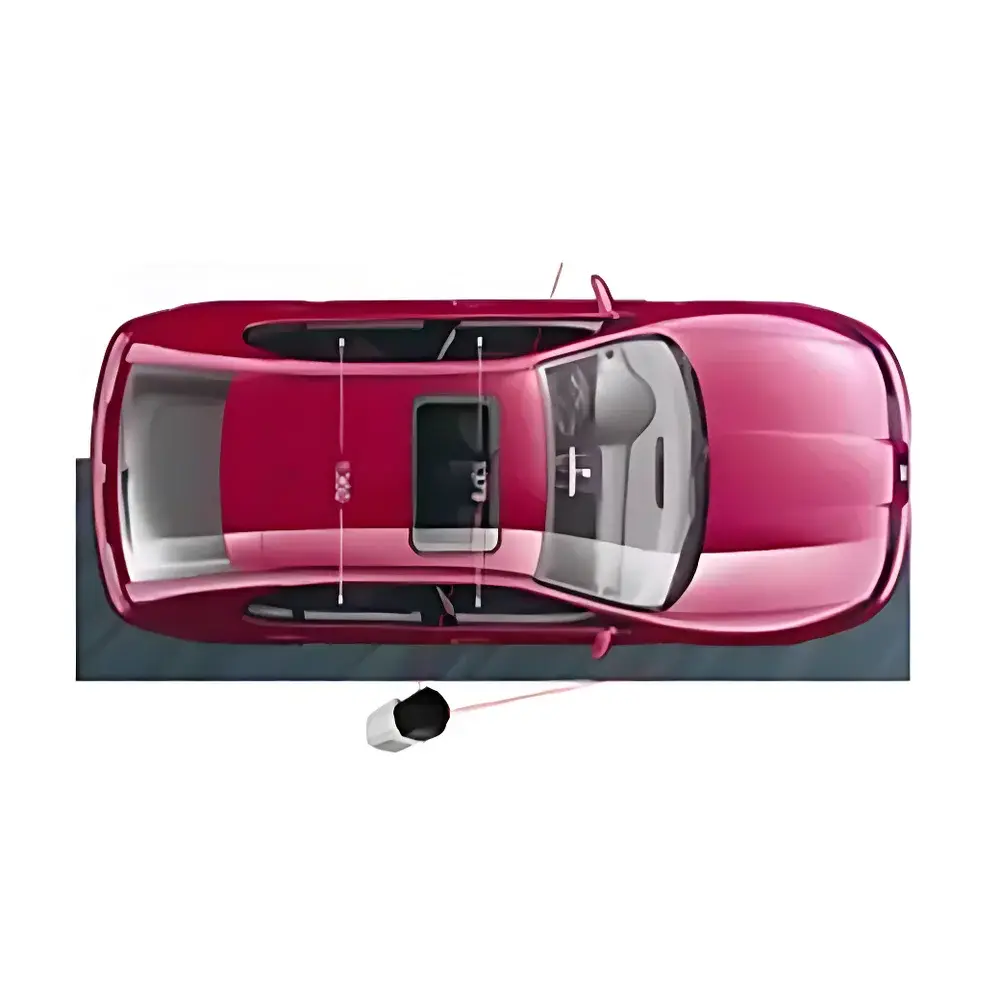
TEO TEO Whole-Vehicle Thermal Imaging Inspection System
| Brand | TEO |
|---|---|
| Origin | Beijing, China |
| Manufacturer Type | Authorized Distributor |
| Regional Classification | Domestic (PRC) |
| Model | TEO |
| Price Range | USD 70,000 – 112,000 |
Overview
The TEO TEO Whole-Vehicle Thermal Imaging Inspection System is an industrial-grade, inline thermal validation platform engineered for end-of-line quality assurance in automotive manufacturing. It operates on the principle of passive infrared thermography—capturing spatial temperature distribution across vehicle surfaces using uncooled microbolometer-based infrared cameras—and correlates thermal signatures with functional status of embedded heating and cooling components. Designed for seamless integration into existing four-wheel alignment or exhaust emission testing stations, the system performs non-contact, real-time functional verification without requiring process interruption or operator retraining. Its architecture supports concurrent operation with standard vehicle inspection workflows, enabling thermal pass/fail evaluation within typical station dwell times (≤90 seconds per vehicle).
Key Features
- Modular multi-camera configuration: Standard deployment uses four synchronized IR cameras (3–6 optional), each positioned to cover critical thermal zones—side mirrors, steering wheel, front/rear seat surfaces, HVAC vents, and rear window defroster grid.
- IR-transparent workflow integration: Cameras mount directly onto existing alignment racks or exhaust test stands; no structural modification required. Vehicle entry/exit sequence remains identical to conventional inspection protocols.
- Automated thermal logic engine: Software applies component-specific thermal thresholds, ramp-rate analysis, and spatial uniformity checks—e.g., verifying rear-window heater trace continuity via localized ΔT gradient mapping across conductive busbars.
- Industrial I/O synchronization: Hardware triggers (start button, column light, buzzer) and barcode scanning (VIN acquisition via RS-485) are tightly coupled with image capture timing to ensure traceable, time-stamped event logging.
- Ruggedized control layer: Embedded industrial PC with dual-display output manages camera streaming, thermal analytics, and HMI interaction—operating continuously in ambient temperatures from 5 °C to 40 °C and relative humidity up to 85% non-condensing.
Sample Compatibility & Compliance
The system accommodates all mass-production passenger vehicles (sedans, hatchbacks, SUVs) with standard OEM thermal subsystem configurations. It validates components compliant with ISO 14520-1 (gaseous fire suppression systems reference thermal response), SAE J2210 (HVAC performance test procedures), and GB/T 25985–2010 (Chinese national standard for automotive heating/cooling system testing). All thermal measurements adhere to ASTM E1934–19 guidelines for qualitative infrared inspection of electrical and mechanical systems. Data audit trails meet GLP-compliant record retention requirements, supporting internal quality audits and Tier-1 supplier documentation obligations.
Software & Data Management
The proprietary TEO Thermal Inspector Suite runs on Windows 10 IoT Enterprise and provides role-based access control, configurable pass/fail criteria per component, and automated report generation in PDF and CSV formats. Each inspection session logs raw thermal frames (16-bit radiometric TIFF), annotated analysis overlays, and metadata including VIN, timestamp, operator ID, station ID, and environmental ambient reading. Audit logs comply with FDA 21 CFR Part 11 principles through electronic signature support, immutable event sequencing, and user-action traceability. Historical datasets integrate with MES platforms via OPC UA or RESTful API endpoints for SPC trend analysis and root-cause correlation with assembly line parameters.
Applications
- End-of-line functional verification of resistive heating elements: rearview mirror heaters, heated steering wheels, seat cushion/backrest warming grids.
- Thermal performance validation of HVAC evaporator/condenser output, including airflow-dependent surface cooling uniformity assessment.
- Detection of open-circuit or high-resistance faults in rear window defogger traces via localized thermal discontinuity mapping.
- Verification of thermal management logic in battery-electric vehicle (BEV) cabin preconditioning systems during pre-delivery inspection.
- Support for APQP Stage 3 (Production Trial Run) and PPAP submission by generating statistically significant thermal reliability datasets per model year.
FAQ
Does the system require vehicle power-on or battery load cycling during inspection?
No. The system detects active thermal emission only when components are energized by the vehicle’s standard ignition state (e.g., ACC or ON)—no external power injection or CAN bus stimulation is needed.
Can it detect latent defects such as partial heater element degradation?
Yes. By analyzing thermal rise time constants and steady-state temperature gradients—not just absolute values—the software identifies deviations indicative of aging resistance wires or delaminated heating films.
Is calibration traceable to national standards?
Each IR camera ships with NIST-traceable calibration certificate (per ISO/IEC 17025 accredited lab), and field recalibration is supported annually via blackbody source verification protocol.
How is infrared transmission loss addressed for vehicles with low-emissivity (low-E) side windows?
The solution avoids direct side-glass imaging: cameras target exposed metal/plastic surfaces adjacent to heaters (e.g., mirror housings, seat frame mounts) and rely on conductive heat transfer signatures rather than through-glass radiation.
What cybersecurity measures are implemented in the industrial PC?
The system deploys Windows Defender Application Control (WDAC), disabled SMBv1, TLS 1.2+ encrypted communications, and firmware write-protection—fully aligned with ISO/SAE 21434 automotive cybersecurity management system (CSMS) recommendations.



