
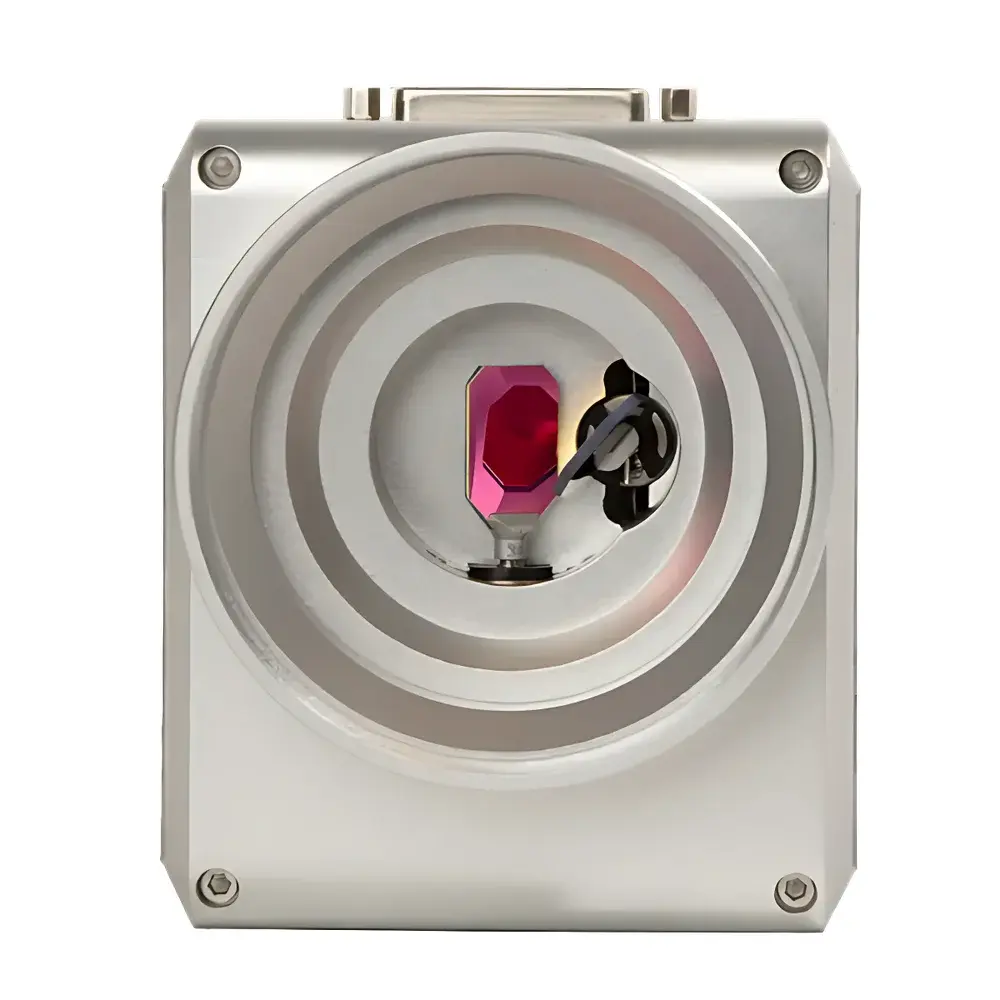
Novanta Cambridge Technology Versia-2D High-Performance Dual-Axis Laser Scanning Galvanometer
| Brand | Novanta |
|---|---|
| Origin | United Kingdom |
| Manufacturer | Cambridge Technology (a Novanta company) |
| Model | Versia-2D |
| Aperture | 14 mm |
| Scan Angle | ±21° |
| Repeatability | <2 µrad |
| Long-Term Drift | <25 µrad (24 h, single axis, after 30 min warm-up) |
| Thermal Drift | <10 µrad/°C (offset), <10 ppm/°C (gain) |
| Wavelength Range | CO₂ (9.2–10.6 µm, up to 200 W), Fiber (1040–1090 nm, up to 200 W), Green (532 nm), UV (353–357 nm) |
| Interface Options | XY2-100 (16-bit), NVL-100 (20-bit) |
| IP Rating | IP54 |
| Power Supply | 48 V DC, 5 A RMS |
| Operating Temperature | 15–40 °C |
| Weight | 2.12 kg |
| Dimensions (L×W×H) | 99 × 99 × 132.2 mm |
Overview
The Novanta Cambridge Technology Versia-2D is a high-performance, dual-axis galvanometric laser scanning system engineered for precision industrial and scientific applications requiring robust vector scanning capability, thermal stability, and deterministic motion control. Based on Cambridge Technology’s proprietary digital servo architecture and patented dynamic balancing technology, the Versia-2D operates on the principle of electromagnetic torque-driven mirror deflection—where two orthogonal galvanometer motors precisely reposition highly reflective, low-inertia mirrors to steer a collimated laser beam in real time across a planar field. Its closed-loop design incorporates high-resolution position feedback via integrated capacitive or optical encoders, enabling sub-microradian angular resolution and exceptional trajectory fidelity. Unlike open-loop systems, the Versia-2D supports bidirectional communication protocols (XY2-100 and NVL-100), allowing real-time status interrogation, error reporting, and adaptive tuning—critical for integration into ISO 9001-certified manufacturing lines and GLP-compliant R&D environments.
Key Features
- Optimized 14 mm clear aperture optics compatible with high-power industrial lasers—including CO₂ (up to 200 W), fiber (1040–1090 nm), green (532 nm), and UV (353–357 nm) sources—enabling broad spectral flexibility without mechanical retrofitting.
- Closed-loop angular repeatability better than 2 µrad, with long-term drift limited to <25 µrad over 24 hours (after standard 30-minute thermal stabilization), ensuring measurement continuity across multi-shift production cycles.
- Thermal coefficient performance: <10 µrad/°C offset drift and <10 ppm/°C gain drift—validated per ASTM E2905-21 for environmental sensitivity testing—making it suitable for uncontrolled ambient workshops and climate-stable cleanrooms alike.
- Dual interface support: Legacy XY2-100 (16-bit command resolution) and modern NVL-100 (20-bit command resolution), enabling seamless migration from analog to digital control ecosystems while preserving legacy software investments.
- IP54-rated enclosure provides protection against dust ingress and water splashing—meeting IEC 60529 requirements for operation in semi-industrial settings such as laser micromachining cells and display panel repair stations.
- Integrated thermal management architecture, including thermally compensated coil windings and low-CTE mirror substrates, minimizes hysteresis and ensures consistent step-and-settle behavior across operating temperature ranges (15–40 °C).
Sample Compatibility & Compliance
The Versia-2D is designed for integration into laser-based material processing platforms where beam positioning accuracy directly determines feature fidelity—particularly in OLED thin-film patterning, PCB microvia drilling, and medical device marking. It complies with CE marking directives (2014/30/EU EMC, 2014/35/EU LVD) and meets RoHS 2011/65/EU substance restrictions. For regulated industries, its deterministic response time (<400 µs full-angle step, 1% settling), traceable calibration chain (NIST-traceable encoder verification available), and deterministic jitter profile (<230 µs tracking error) support qualification under FDA 21 CFR Part 11 when deployed with compliant host controllers and audit-trail-enabled software. The system is routinely specified in ISO 13485-certified medical laser OEM designs and aligns with ISO 11146-1:2019 beam parameter measurement standards for scanner-induced wavefront distortion assessment.
Software & Data Management
Cambridge Technology provides the CT Studio software suite—compatible with Windows 10/11 and MATLAB® Simulink®—to configure scan parameters, perform dynamic calibration (including nonlinearity correction and cross-coupling compensation), and log real-time position telemetry. All firmware updates are digitally signed and delivered via secure HTTPS endpoints, satisfying integrity requirements outlined in IEC 62443-4-2. When interfaced with validated third-party motion controllers (e.g., SCANLAB RTC6/RTC7, Aerotech A3200), the Versia-2D supports synchronized data logging with timestamped encoder feedback, enabling post-process root-cause analysis of positional deviations. Audit trails—including configuration changes, calibration events, and thermal history—are exportable in CSV or XML formats for internal quality review or regulatory submission.
Applications
- OLED and micro-LED display manufacturing: precise pixel isolation, encapsulation layer ablation, and TFT trimming using UV and green wavelengths.
- High-precision laser marking: permanent UID serialization on aerospace components and surgical instruments, meeting MIL-STD-130 and UDI requirements.
- Microfluidic device fabrication: selective polymer ablation and channel definition in PMMA and COC substrates at sub-10 µm feature sizes.
- Scientific instrumentation: beam steering in confocal microscopy, optical coherence tomography (OCT) reference arm modulation, and adaptive optics testbeds.
- Automotive LiDAR development: rapid prototyping of non-mechanical scanning architectures for solid-state beam steering validation.
FAQ
What laser wavelengths and power levels is the Versia-2D rated for?
The Versia-2D supports CO₂ (9.2–10.6 µm, up to 200 W), fiber (1040–1090 nm, up to 200 W), green (532 nm), and UV (353–357 nm) sources. Maximum power ratings assume proper beam conditioning, cooling, and manufacturer-approved coatings—consult Cambridge Technology’s Application Engineering team for wavelength-specific optical path validation.
Does the Versia-2D require external water cooling?
No. Unlike the Lightning II series, the Versia-2D uses conduction-based thermal management and operates reliably with ambient air cooling within its specified temperature range (15–40 °C). Forced-air assistance may be recommended in high-duty-cycle applications exceeding 70% duty cycle.
Can the Versia-2D be calibrated in-house?
Yes—using CT Studio and an external interferometric angle metrology system (e.g., Keysight M9300A or Zygo Verifire), users may perform full-field linearity, orthogonality, and gain matching calibrations. Factory calibration certificates (ISO/IEC 17025 accredited) are available upon request.
Is the Versia-2D compatible with EtherCAT or other real-time industrial networks?
The native interfaces are XY2-100 and NVL-100. Integration with EtherCAT, PROFINET, or SERCOS III requires an intermediary motion controller (e.g., Beckhoff AX5000, Trio MC464) that translates network commands into analog/digital scan signals per Cambridge Technology’s interoperability guidelines.
What maintenance intervals are recommended for long-term reliability?
No scheduled maintenance is required under normal operating conditions. Cambridge Technology recommends annual verification of encoder zero-point stability and thermal drift performance using traceable reference instrumentation—documentation of these checks satisfies ISO 9001 clause 7.1.5.2 for monitoring and measuring resource control.




