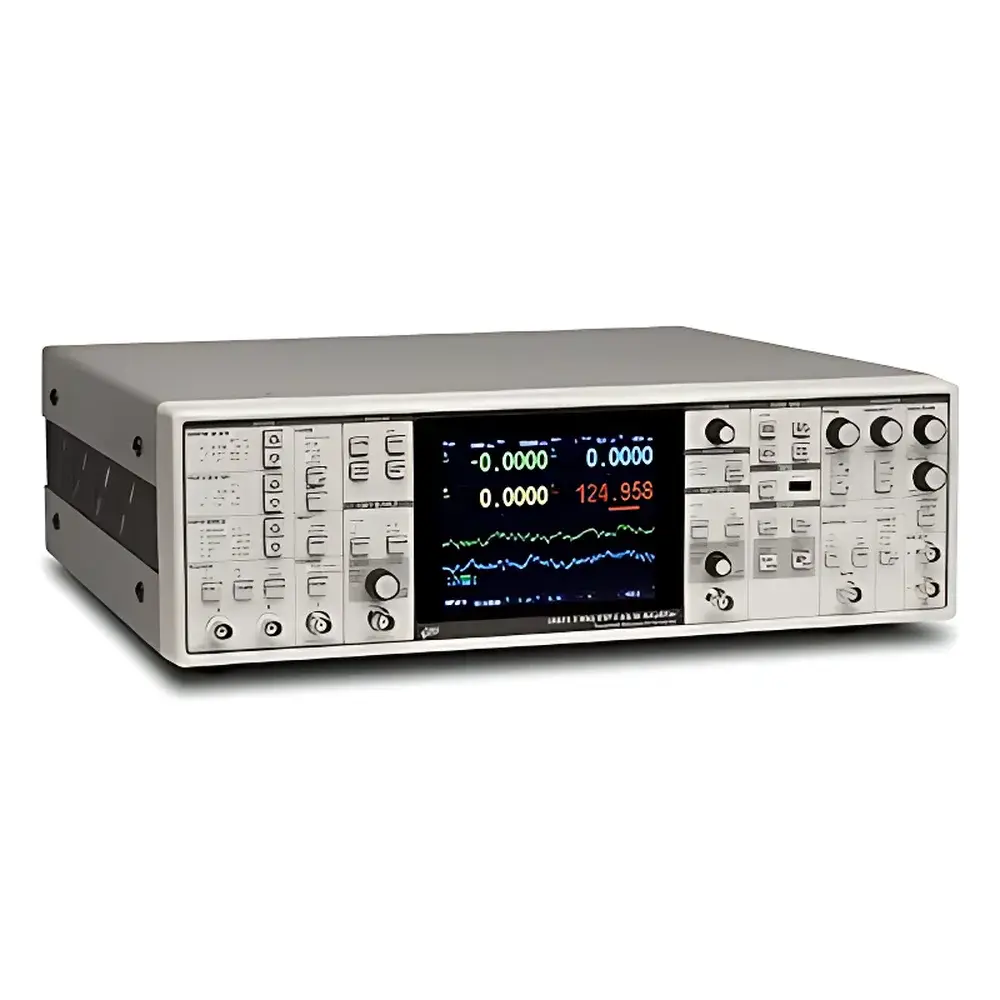
Stanford Research Systems SR865 2 MHz Digital Lock-in Amplifier
| Brand | SRS/Stanford Research Systems |
|---|---|
| Origin | USA |
| Model | SR865 |
| Frequency Range | DC to 2 MHz |
| Dynamic Reserve | 120 dB |
| Reference Modes | Single and Dual Reference |
| Internal Oscillator Range | 1 mHz to 2 MHz |
| Timebase I/O | 10 MHz TTL-compatible Input/Output |
| Display | 7″ capacitive touchscreen (800 × 480) with dual-channel time-domain and FFT visualization |
| Memory | 8 million points (internal waveform buffer) |
| Data Export | ASCII via USB mass storage |
| Interfaces | GPIB (IEEE-488.2), RS-232, USB 2.0 (CDC & MSC), 10/100 Ethernet, HDMI video output |
| Scan Capabilities | Sweep of reference frequency, amplitude, and DC offset |
| Compliance | CE, RoHS, FCC Class A |
Overview
The Stanford Research Systems SR865 is a high-performance, dual-phase digital lock-in amplifier engineered for precision extraction of periodic signals buried in noise—down to microvolt-level amplitudes—across a continuous frequency range from DC to 2 MHz. Unlike analog predecessors or hybrid architectures, the SR865 employs a fully digital signal processing (DSP) architecture with 24-bit ADCs, real-time FPGA-based demodulation, and synchronous sampling referenced to a low-phase-noise internal oscillator. This design eliminates drift, harmonic distortion, and gain nonlinearity inherent in analog multipliers, delivering stable, repeatable measurements under varying environmental conditions. Its 120 dB dynamic reserve enables reliable detection of signals whose amplitude is as low as 1 µV in the presence of broadband noise exceeding 100 mV—critical for applications such as scanning probe microscopy, optical heterodyne detection, impedance spectroscopy, and low-temperature physics experiments where signal integrity is non-negotiable.
Key Features
- 2 MHz full-bandwidth operation—eliminates need for separate mid-frequency and high-frequency lock-in systems
- Dual-reference mode supporting simultaneous measurement of carrier and sideband components (e.g., for AM/FM demodulation or parametric resonance studies)
- Integrated sweep engine enabling automated parameter sweeps: reference frequency, output amplitude, and DC bias—programmable via front panel or remote interface
- 10 MHz TTL-compatible timebase input/output for precise synchronization across multiple SR865 units or with external timing sources (e.g., arbitrary waveform generators, delay generators, or atomic clocks)
- 7-inch capacitive touchscreen display rendering up to four real-time data channels—including X, Y, R, θ, FFT magnitude, and time-domain waveforms—with configurable scaling, cursors, and overlay options
- 8-million-point internal waveform memory with timestamped acquisition; exportable as ASCII (.csv) directly to USB flash drives without host PC dependency
- Comprehensive connectivity suite: GPIB (IEEE-488.2 compliant), RS-232, USB 2.0 (dual-mode CDC for SCPI command control and MSC for file transfer), 10/100 Ethernet (LXI-C compliant), and HDMI video output for live presentation or documentation integration
Sample Compatibility & Compliance
The SR865 interfaces natively with a broad range of transducers and signal sources—including photodiodes, piezoresistive sensors, SQUIDs, Hall probes, and RF/microwave mixers—via its differential BNC inputs (1 MΩ || 25 pF, AC/DC coupled) and programmable input gain (1 nV–1 V full scale). Input noise floor is specified at ≤ 6 nV/√Hz at 1 kHz, optimized for low-frequency stability. The instrument complies with CE marking requirements (2014/30/EU EMC Directive and 2011/65/EU RoHS Directive), FCC Part 15 Class A emissions limits, and meets essential safety requirements per IEC 61010-1:2010. Its firmware architecture supports audit-ready operation in regulated environments: SCPI command logging, user-accessible configuration snapshots, and deterministic trigger timing align with GLP and GMP documentation workflows.
Software & Data Management
Remote operation is supported through standard SCPI over all communication interfaces, enabling seamless integration into LabVIEW, MATLAB, Python (PyVISA), and EPICS-based control systems. The included Cross-platform SR865 Control Software provides intuitive GUI-based instrument configuration, real-time plotting, batch data logging, and FFT analysis—including windowing (Hanning, Flat Top, Rectangular), zero-padding, and spectral averaging. All acquired datasets include embedded metadata (timestamp, sensitivity setting, time constant, filter slope, reference phase), ensuring traceability. ASCII exports preserve full numerical precision (16-digit floating point), compatible with ISO/IEC 17025-compliant data review pipelines. Firmware updates are delivered via signed .bin files over Ethernet or USB, with checksum verification and rollback capability.
Applications
- Scanning tunneling and atomic force microscopy (STM/AFM) for sub-Angstrom displacement detection
- Optical beam deflection and interferometric sensing in vacuum and cryogenic environments
- Resonant cavity characterization and Q-factor measurement in microwave and THz photonics
- Low-frequency impedance spectroscopy of battery electrodes and solid-state electrolytes
- Parametric amplification and nonlinear response mapping in superconducting circuits
- Modulated absorption and photothermal spectroscopy in trace gas detection systems
FAQ
What is the maximum achievable time constant on the SR865?
The SR865 supports time constants from 10 µs to 30 ks (30,000 seconds), selectable in 1–3–10 decade steps, with 6 dB/octave, 12 dB/octave, 18 dB/octave, and 24 dB/octave low-pass filter slopes.
Can the SR865 operate as a standalone signal source without an external reference?
Yes—the internal oscillator functions as a fully programmable reference source (1 mHz–2 MHz), with adjustable amplitude (1 mV–5 Vpp), DC offset (±5 V), and waveform shape (sine, square, triangle), eliminating dependency on external function generators.
Is the HDMI output capable of mirroring the full touchscreen interface?
The HDMI port outputs a fixed-resolution (1024×600) video stream replicating the active display viewport—including live plots, menus, and status bars—with no latency penalty to measurement performance.
How does the dual-reference mode handle phase relationships between two independent signals?
Each reference channel maintains independent phase adjustment (−180° to +180°, 0.01° resolution) and can be locked to separate input sources or derived from harmonics of the same oscillator—enabling vector decomposition of modulated signals with known sideband spacing.
Does the SR865 support external clock locking for ultra-low-jitter synchronization?
While the 10 MHz timebase I/O supports disciplined synchronization, the SR865 does not implement PLL-based external clock locking; its internal oven-controlled crystal oscillator (OCXO) provides ±50 ppb stability over 0–50 °C, sufficient for most metrology-grade applications requiring long-term phase coherence.