
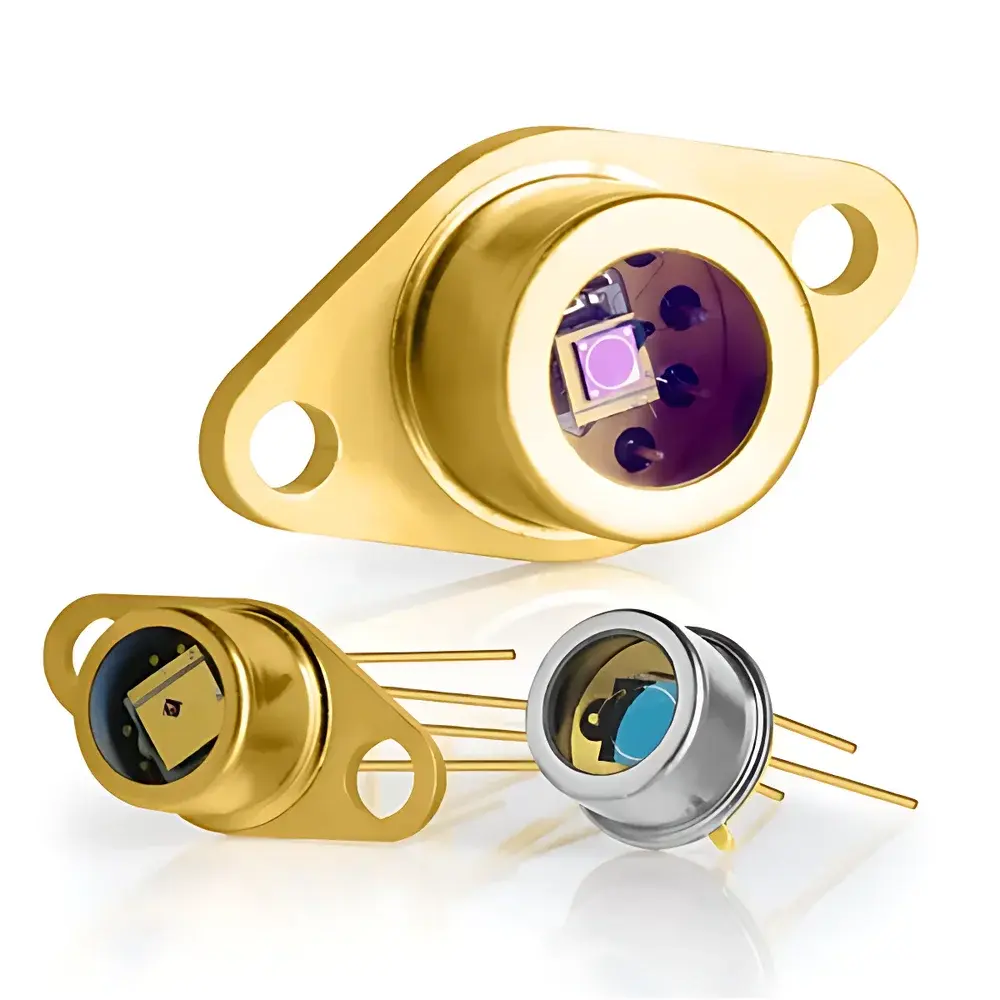
Laser Components IG26 Series Extended-Wavelength InGaAs Photodiode Detector
| Brand | Laser Components |
|---|---|
| Model | IG26 Series |
| Detector Type | PIN Photodiode |
| Cutoff Wavelength | 2.6 µm |
| Spectral Range | 0.8–2.6 µm |
| Typical Responsivity @ 2.0 µm | 1.45 A/W |
| Operating Temperature | −40 °C to +85 °C (TE-cooled variants available) |
| Shunt Resistance | >10⁹ Ω (typ. at 0 V, 25 °C) |
| Dark Current | <10 nA (typ. at −5 V, 25 °C) |
| Capacitance | <20 pF (typ. at −5 V, 25 °C) |
| Active Area Options | 0.05–1.0 mm² |
| Package | TO-8, TO-46, or OEM hermetic ceramic |
Overview
The Laser Components IG26 Series Extended-Wavelength InGaAs Photodiode Detector is a high-performance, thermoelectrically (TE) coolable PIN photodiode engineered for precision radiometric and spectroscopic measurements in the short-wave infrared (SWIR) spectral region. Unlike standard InGaAs detectors limited to ~1.7 µm, the IG26 series extends the cutoff wavelength to 2.6 µm through optimized epitaxial layer composition and passivation design—enabling reliable detection across the full 0.8–2.6 µm range. Its operation is based on photon absorption in the intrinsic In0.53Ga0.47As absorption layer lattice-matched to InP substrates, generating electron-hole pairs collected under reverse bias. This solid-state, no-moving-parts architecture ensures long-term stability, low noise, and high linearity—critical for quantitative applications such as laser power monitoring, gas absorption spectroscopy (e.g., CO, CH4, H2O), and non-contact thermometry in industrial process control.
Key Features
- Extended spectral response up to 2.6 µm with 50% cutoff wavelength ≥2.45 µm—validated per IEC 60793-1-42 and ISO 11146 calibration protocols
- High responsivity of 1.45 A/W at 2.0 µm (typ.), supporting low-noise signal acquisition even at sub-mW optical power levels
- Exceptional temperature stability: responsivity drift <±0.05 %/°C and dark current variation <±3 % over −20 °C to +60 °C (uncooled); TE-cooled variants maintain <±0.01 %/°C drift in stabilized operation
- Low dark current (10⁹ Ω) minimize Johnson–Nyquist noise and enable high dynamic range (>100 dB)
- Multiple active area options (0.05, 0.2, 0.5, and 1.0 mm²) with corresponding capacitance values (5–20 pF) to match bandwidth requirements from DC to >100 MHz
- Hermetically sealed TO-8 and TO-46 packages, plus custom ceramic OEM housings compliant with MIL-STD-883H mechanical shock and humidity resistance testing
Sample Compatibility & Compliance
The IG26 detector is compatible with free-space collimated beams, fiber-coupled inputs (FC/PC, SMA-905), and integration into spectrometer slit assemblies (e.g., with Czerny–Turner or transmission grating optics). It meets the optical interface requirements of ISO 13694 (laser beam parameter measurements) and ASTM E1421 (standard practice for SWIR spectroscopy). For regulated environments, TE-cooled variants support GLP/GMP-compliant operation when paired with traceable NIST-calibrated reference sources; all models are RoHS 3 and REACH compliant. No internal radioactive components or hazardous substances are used—fully compliant with EU Directive 2011/65/EU.
Software & Data Management
While the IG26 is a passive analog detector requiring external biasing and amplification, it is fully interoperable with industry-standard data acquisition systems—including National Instruments PXIe platforms, Keysight DAQ modules, and Thorlabs PM100D-compatible power meters. When integrated into OEM instruments, its linear response enables direct implementation of ASTM E131-22-compliant spectral calibration routines. TE-cooled versions include embedded thermistor outputs (10 kΩ NTC) for real-time temperature logging, supporting 21 CFR Part 11 audit trails when recorded via validated software (e.g., LabVIEW with NI DIAdem or MATLAB Instrument Control Toolbox). Calibration certificates (traceable to PTB or NIST) are provided with each unit, including spectral responsivity curves and dark current vs. bias voltage characterization.
Applications
- Spectroscopic analysis of hydrocarbon gases, moisture, and combustion byproducts in environmental monitoring and emissions testing
- Real-time monitoring of semiconductor diode lasers (e.g., 1.55 µm DFBs, 2.3 µm QCLs) for telecom and sensing systems
- Non-contact temperature measurement in metallurgical furnaces, glass annealing lines, and polymer extrusion processes (via two-color pyrometry)
- Flame detection and combustion control in industrial burners using characteristic H2O and CO emission bands
- Optical coherence tomography (OCT) light source characterization and system alignment verification
- Radiometric calibration transfer standards for SWIR imaging sensors and hyperspectral cameras
FAQ
What is the maximum permissible optical power density for continuous-wave illumination?
For standard 0.5 mm² active area devices, the recommended maximum is 10 mW/mm² at room temperature; TE-cooled units support up to 50 mW/mm² with active heat sinking.
Is the IG26 series suitable for pulsed laser measurement?
Yes—its <1 ns rise time (with appropriate transimpedance amplifier) supports pulse widths down to 10 ns, provided peak power remains within damage threshold limits specified in datasheet Section 5.2.
Can the detector be calibrated for absolute irradiance measurement?
Yes—Laser Components provides optional NIST-traceable spectral responsivity calibration (200–2600 nm) with ±2.5% expanded uncertainty (k=2), valid for 12 months under controlled storage conditions.
Does the TE-cooled variant require external controller hardware?
Yes—operation requires a programmable TEC driver (e.g., Thorlabs TED4015 or Wavelength Electronics LDX-3620) with PID feedback loop configured for ±0.1 °C stability.
Are custom spectral filters or AR coatings available?
Yes—custom MgF₂- or ZnS-based anti-reflection coatings (optimized for 1.0–2.5 µm) and bandpass filters (FWHM 10–50 nm) can be integrated during packaging per customer-specified ISO 10110 surface quality requirements.




