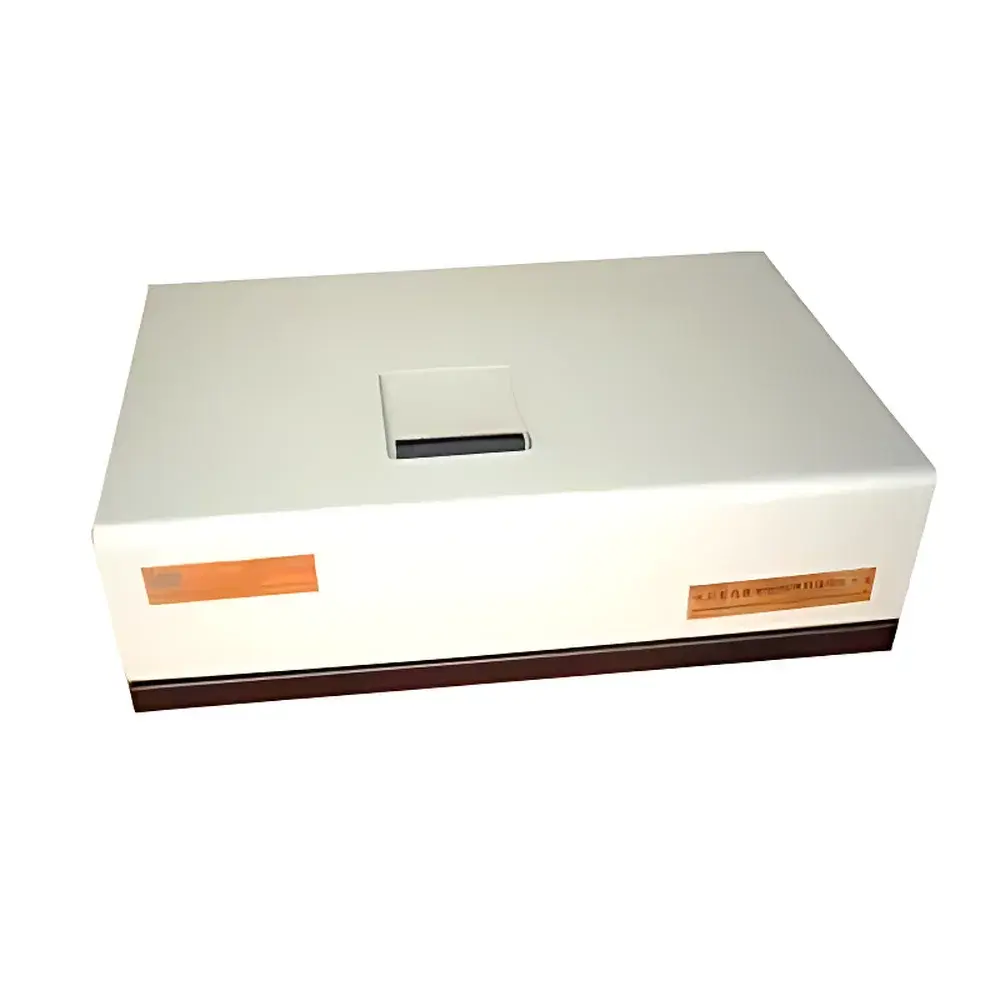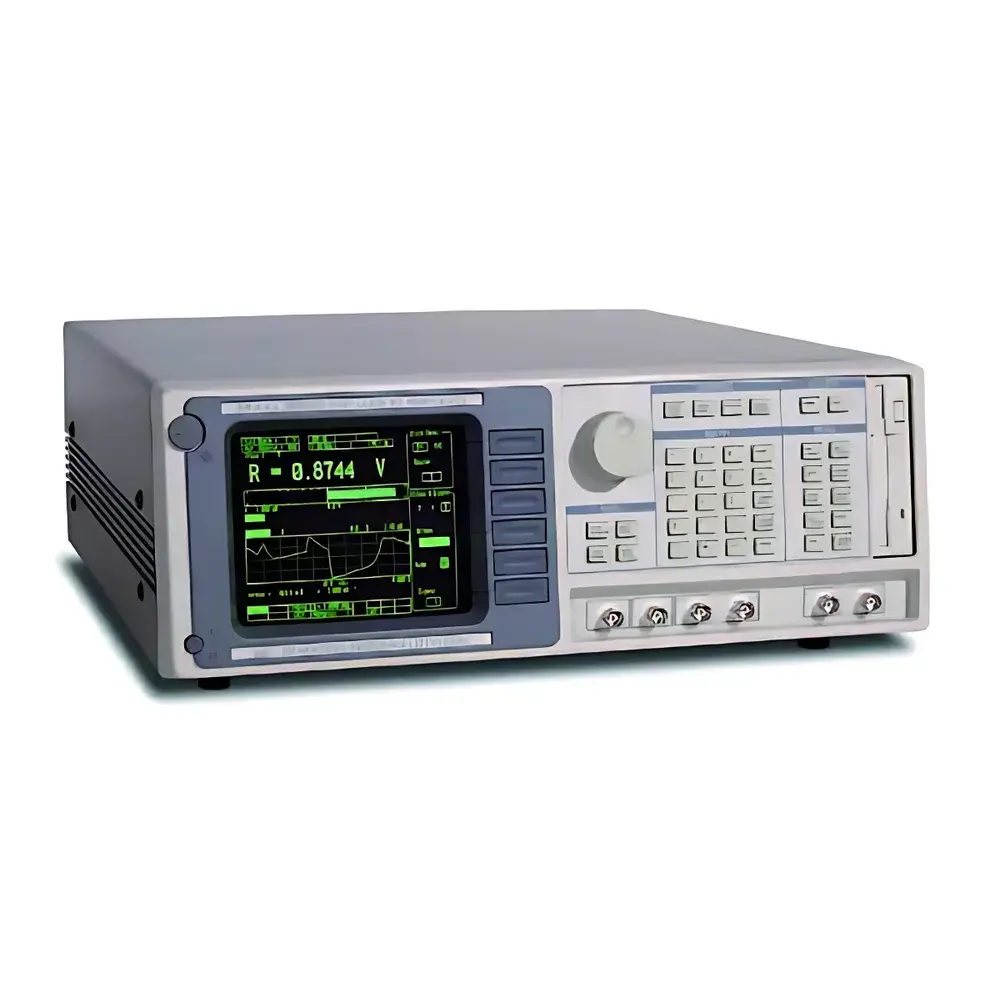
Stanford Research Systems SR850 Dual-Channel Digital Lock-in Amplifier
| Brand | SRS/Stanford Research Systems |
|---|---|
| Origin | USA |
| Model | SR850 |
| Frequency Range | 1 mHz to 102.4 kHz |
| Phase Resolution | 0.001° |
| Architecture | Dual-channel DSP-based |
| Display | Integrated graphical LCR-style interface |
| Optional Accessories | SR540 Optical Chopper, SR550/SR552/SR554 Low-noise Preamplifiers |
Overview
The Stanford Research Systems SR850 is a high-precision, dual-channel digital lock-in amplifier engineered for demanding low-level signal detection in physics, materials science, quantum optics, and nanoscale metrology applications. Unlike analog predecessors (e.g., SR510/SR530) or specialized RF variants (e.g., SR844), the SR850 employs a fully digital signal processing architecture with 24-bit ADCs, adaptive filtering, and real-time FFT-based spectral monitoring. Its core measurement principle relies on synchronous demodulation: an input signal is multiplied by a reference waveform (internal or external), followed by low-pass filtering to extract DC components proportional to the signal’s in-phase (X) and quadrature (Y) amplitudes, magnitude (R), and phase (θ). With a phase resolution of 0.001° and frequency stability governed by a temperature-compensated crystal oscillator (TCXO), the SR850 delivers exceptional angular fidelity across its full 1 mHz–102.4 kHz operating bandwidth—critical for interferometric alignment, impedance spectroscopy, and pump-probe timing analysis.
Key Features
- Dual independent measurement channels with simultaneous X, Y, R, and θ outputs per channel
- Graphical LCR-style display supporting real-time vector plots, time-domain waveforms, and spectrum views
- Internal reference generator with frequency resolution down to 1 µHz and harmonic synthesis up to 99th order
- Auto-gain, auto-phase, and auto-offset functions with programmable convergence thresholds and dwell times
- 24-bit dynamic range and <10 nV/√Hz input noise floor (with optional preamplifier)
- IEEE-488 (GPIB), RS-232, and USB 2.0 interfaces for remote control and data streaming
- Front-panel USB port for firmware updates and configuration backup
Sample Compatibility & Compliance
The SR850 accepts single-ended or differential voltage inputs (±10 V full scale) with configurable AC/DC coupling, 0.03–10 Hz line-frequency notch filters, and 6-pole Bessel or Butterworth low-pass filtering options. It supports both TTL and sine-wave reference inputs, enabling seamless integration with optical choppers (e.g., SR540), function generators, or laser modulation sources. For ultra-low-noise measurements, optional low-noise preamplifiers—including the SR550 (100 fA/√Hz current noise), SR552 (high-voltage, ±200 V input), and SR554 (differential, >120 dB CMRR)—extend sensitivity without compromising common-mode rejection. The instrument complies with CE, FCC Class A, and RoHS directives. Its firmware architecture supports audit-ready operation under GLP and GMP environments via timestamped parameter logging and user-accessible configuration history.
Software & Data Management
SRS provides the proprietary “Lock-in Analyzer” PC software (Windows/macOS/Linux compatible) for instrument configuration, real-time data visualization, and batch acquisition scripting. All measurements support CSV and HDF5 export formats, enabling direct ingestion into Python (NumPy/Pandas), MATLAB, or LabVIEW environments. The SR850 implements IEEE 488.2 SCPI command compliance, allowing full automation within custom test sequences. Internal memory buffers store up to 65,536 points per trace, with trigger synchronization across channels and external TTL events. For regulated laboratories, optional firmware enables 21 CFR Part 11–compliant electronic signatures, audit trails, and role-based access control when used with networked authentication servers.
Applications
- Scanning probe microscopy (SPM) and atomic force microscopy (AFM) signal recovery
- Optical homodyne/heterodyne detection in cavity ring-down and photothermal spectroscopy
- AC susceptibility and dielectric spectroscopy of ferroelectric and superconducting materials
- Low-frequency impedance characterization of electrochemical cells and biosensors
- Phase-sensitive detection in magneto-optic Kerr effect (MOKE) and Faraday rotation experiments
- Calibration-grade reference generation for metrology labs requiring sub-millidegree phase stability
FAQ
What is the minimum measurable phase difference supported by the SR850?
The SR850 achieves a phase resolution of 0.001°, limited primarily by internal clock jitter and ADC quantization noise—not algorithmic interpolation.
Can the SR850 operate as two independent lock-ins simultaneously?
Yes—each channel has dedicated reference oscillators, demodulators, and filter sections, enabling fully asynchronous dual-frequency operation (e.g., harmonic mixing or multi-tone excitation).
Is external reference triggering supported for pulsed-laser experiments?
Yes—the SR850 accepts TTL or CMOS-compatible external reference signals with adjustable delay (0–100 ms, 10 ns resolution) and phase offset calibration relative to the input signal path.
Does the SR850 support harmonic detection beyond the fundamental frequency?
Yes—it offers harmonic analysis up to the 99th harmonic with independent gain, phase, and filter settings per harmonic order.
How is traceability maintained for calibration-critical deployments?
The SR850 includes factory-calibrated NIST-traceable gain and phase coefficients stored in non-volatile memory; users may perform in-situ verification using the built-in precision reference output and dual-channel self-test mode.