
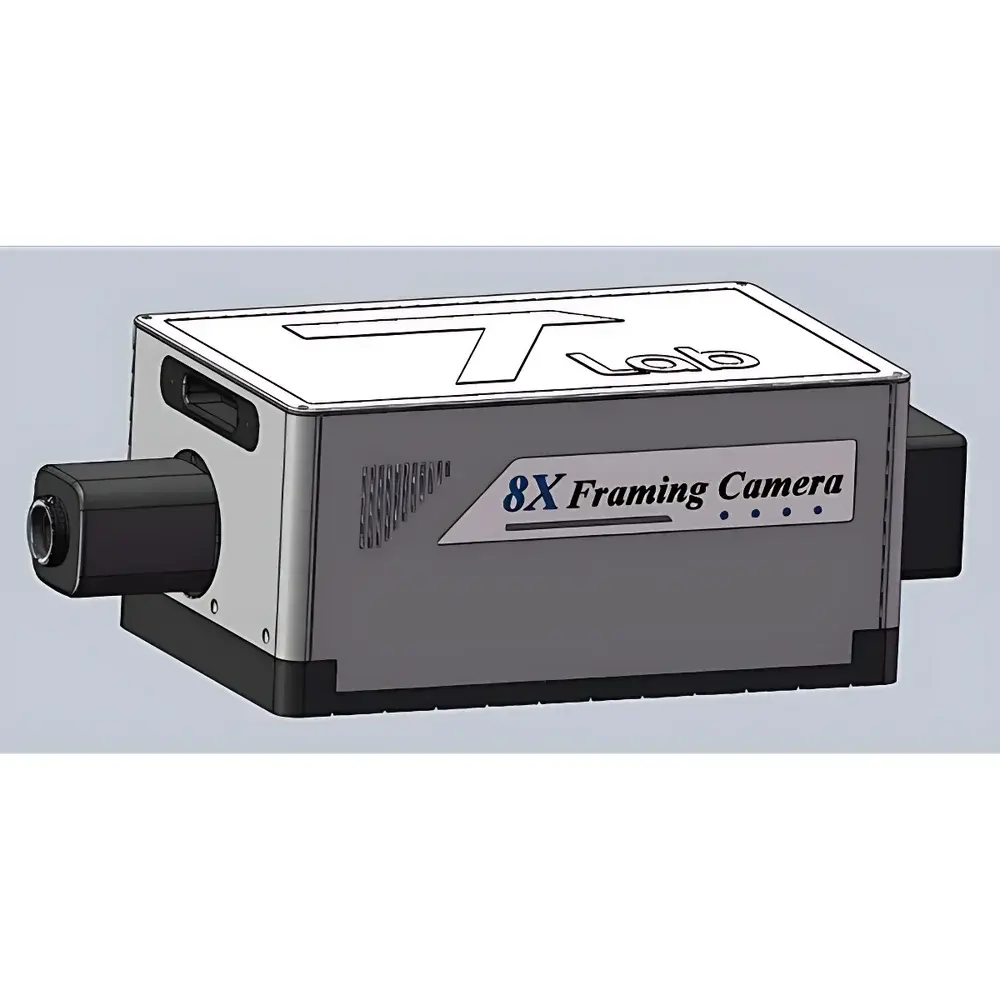
TEO FC Dual-Exposure Visible-Light Framing Camera
| Brand | TEO |
|---|---|
| Origin | Beijing, China |
| Model | FC |
| Channel Count | 4 |
| Frame Count Options | 4-frame & 8-frame modes |
| Spatial Resolution | >25 lp/mm |
| Spectral Response Range | 350–850 nm |
| Gating Width | 3 ns to DC |
| Gating & Delay Adjustment Resolution | 1 ns |
| Delay Adjustment Range | 0–1 s |
| Image Intensifier Cathode Diameter | 18 mm |
| Max Intensifier Gain | 1×10⁴ |
| Sensor Format | 1932 × 1452 (4× binned), 4.5 µm × 4.5 µm pixels |
| A/D Depth | 12-bit |
| Operating Modes | Single-shot 4-frame or 8-frame acquisition with dual-exposure capability |
| inter-frame intervals | ≤1 ns (frames 1–4 and 5–8), 250 ns (between frames 4 and 5 in 8-frame dual-exposure mode) |
| Optical Coupling | Fiber-optic faceplate |
| Phosphor Screen | P47 |
| Inherent Latency | <36.5 µs + 4 µs |
| Timing Jitter (trigger input to gate output) | typical <100 ps, max <200 ps |
Overview
The TEO FC Dual-Exposure Visible-Light Framing Camera is a high-speed, gated intensified imaging system engineered for ultrafast transient phenomena analysis in the visible spectrum (350–850 nm). It operates on the principle of optical framing—using precisely timed, nanosecond-scale gating of an image intensifier coupled to a high-resolution CCD sensor—to capture multiple discrete snapshots from a single event. Unlike conventional streak or scanning cameras, this system delivers true two-dimensional spatial information per frame without motion-induced distortion. Its dual-exposure architecture enables flexible configuration between 4-frame and 8-frame acquisition modes within a single optical train, leveraging time-multiplexed intensifier gating and synchronized sensor readout. This design maintains full spatial fidelity across all frames while enabling sub-nanosecond temporal registration critical for combustion diagnostics, plasma evolution studies, laser-induced breakdown spectroscopy (LIBS), and shockwave propagation analysis.
Key Features
- Dual-mode operation: configurable as either a 4-frame or 8-frame camera via software-selectable gate sequencing—no hardware reconfiguration required.
- Nanosecond-level timing precision: 1 ns resolution for both delay and gate width adjustment; jitter <100 ps (typical) ensures repeatable synchronization with external lasers, spark triggers, or pulsed light sources.
- High spatial fidelity: >25 lp/mm system resolution supported by an 18 mm cathode image intensifier with P47 phosphor and fiber-optic coupling to a 1932 × 1452 CCD sensor (4.5 µm pixels, 12-bit digitization).
- Ultrafast gating: minimum gate width of 3 ns, extendable to DC for long-integration applications; intrinsic latency <36.5 µs + 4 µs enables tight alignment with microsecond-scale events such as flashlamp discharge or capacitor bank firing.
- Optimized inter-frame timing: 1 ns minimum interval between consecutive frames in groups 1–4 and 5–8; programmable 250 ns gap between frames 4 and 5 in 8-frame dual-exposure mode—ideal for capturing pre- and post-ignition states or pump-probe dynamics.
- Robust mechanical and thermal architecture: designed for integration into vacuum chambers, laser labs, and industrial test benches with stable gain calibration over extended operation cycles.
Sample Compatibility & Compliance
The FC camera is compatible with standard C-mount and F-mount optical interfaces and integrates seamlessly with collimated or focused visible-light illumination paths. It supports direct coupling via fiber-optic faceplate or lens-based configurations, accommodating both low-light fluorescence imaging and high-flux plasma emission capture. The system meets electromagnetic compatibility requirements per IEC 61326-1 for laboratory instrumentation. While not certified for medical or aerospace use out-of-the-box, its timing architecture and deterministic trigger response support traceable calibration protocols aligned with ISO/IEC 17025-accredited laboratories. All firmware and control logic are designed to support audit-ready timestamp logging essential for GLP-compliant transient documentation.
Software & Data Management
The FC is operated through a dedicated Windows-based acquisition suite supporting real-time preview, frame-level exposure control, and multi-parameter sequence scripting. The software provides full access to gate delay maps, exposure duration profiles, and inter-frame timing matrices. Acquired datasets are saved in HDF5 format with embedded metadata—including absolute UTC timestamps, hardware configuration state, and environmental sensor readings (optional). Export modules support TIFF, PNG, and MATLAB .mat formats. For regulated environments, optional FDA 21 CFR Part 11-compliant add-ons provide electronic signatures, role-based access control, and immutable audit trails for all acquisition parameters and raw frame data.
Applications
- Combustion science: simultaneous capture of flame kernel development, soot formation, and OH* chemiluminescence across multiple ignition phases.
- Pulsed power diagnostics: time-resolved imaging of flashlamp discharge evolution, electrode erosion, and arc channel formation with 250 ns inter-frame discrimination.
- Laser-material interaction: monitoring ablation plume expansion, plasma shielding onset, and melt pool dynamics during ultrashort-pulse irradiation.
- Ballistics and shock physics: visualization of projectile impact, air shock front propagation, and target deformation sequences at nanosecond-scale intervals.
- Plasma physics: spatially resolved observation of streamer initiation, filament branching, and afterglow decay kinetics in dielectric barrier discharges and corona systems.
FAQ
What is the difference between “4-frame” and “8-frame dual-exposure” modes?
In 4-frame mode, four temporally distinct images are acquired with ≤1 ns spacing. In 8-frame dual-exposure mode, two sequential 4-frame bursts are triggered—separated by a user-defined delay (minimum 250 ns)—yielding eight frames total with precise temporal bracketing around a dynamic transition point.
Can the FC camera be synchronized with external lasers or Q-switches?
Yes—the system accepts TTL or LVDS trigger inputs with sub-100 ps jitter; it supports master-slave synchronization, external clock locking, and programmable trigger delay offsets relative to any system event.
Is the 12-bit ADC sufficient for quantitative intensity analysis?
Yes—combined with calibrated gain linearity across the 1×10⁴ intensifier range and factory-measured pixel response uniformity (PRNU <2.5%), the 12-bit depth supports photon-limited SNR optimization and ratiometric processing in low-light regimes.
Does the camera support remote operation over Ethernet or USB3?
Control and configuration are handled via Gigabit Ethernet; image data transfer uses dedicated PCIe Gen3 x4 interface for sustained 8-frame burst rates up to 10 Hz (full resolution) or higher at reduced ROI sizes.
How is spatial resolution verified and maintained across frames?
Resolution is characterized using USAF 1951 test targets under standardized illumination; maintenance relies on fixed optical path geometry, thermally stabilized intensifier housing, and pixel mapping correction applied during post-processing.





