
InSb Photovoltaic Detector
| Origin | Beijing |
|---|---|
| Manufacturer Type | Distributor |
| Origin Category | Domestic |
| Model | InSb |
| Pricing | Upon Request |
Overview
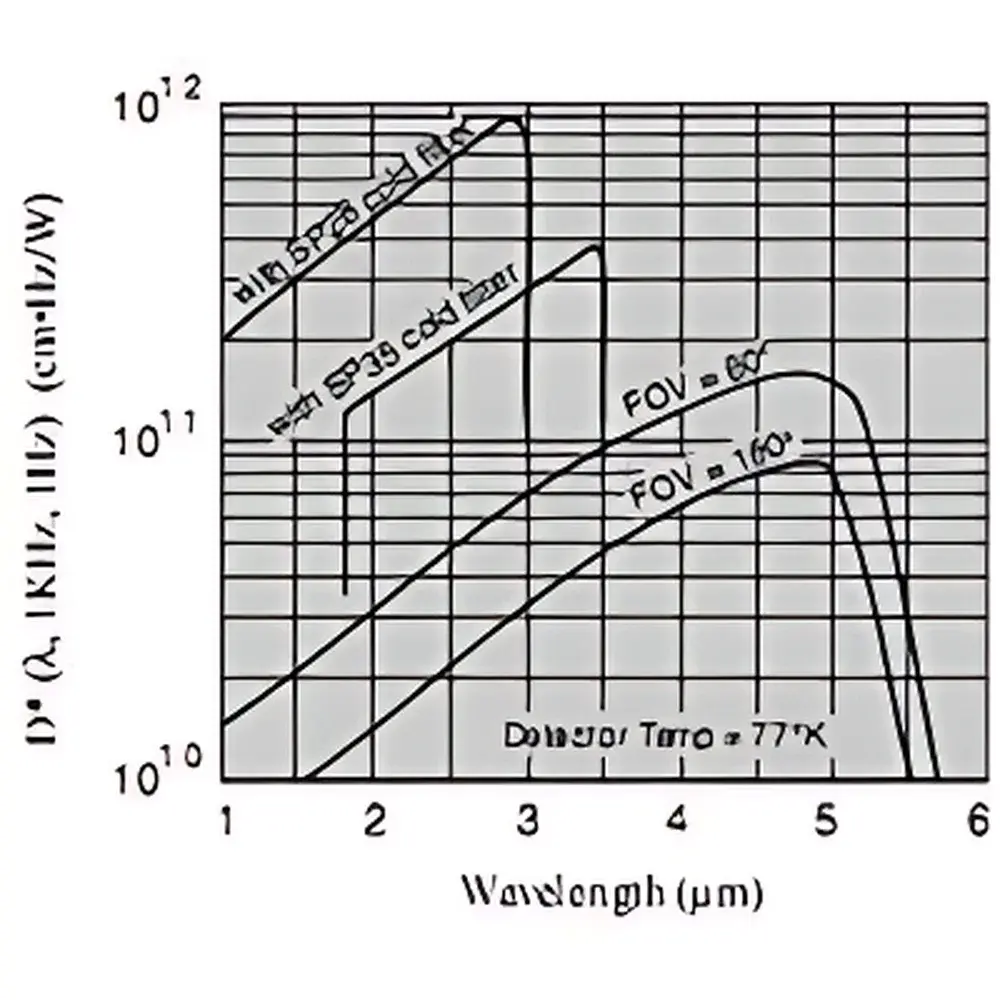
The InSb Photovoltaic Detector is a high-performance mid-infrared (MIR) photodetector engineered for precision spectral measurement and radiometric applications in laboratory, industrial, and defense-related environments. Based on the photovoltaic principle—where incident photons generate electron-hole pairs across the p-n junction of an indium antimonide (InSb) semiconductor crystal—the detector delivers intrinsic zero-bias operation, low noise, and excellent signal-to-noise ratio (SNR) in the 1.0–5.5 µm spectral range. This wavelength coverage aligns critically with fundamental molecular vibrational absorption bands (e.g., C–H, N–H, O–H, and C=O stretching modes), making it indispensable for Fourier Transform Infrared (FTIR) spectroscopy, gas analysis, thermal emission studies, and non-contact temperature sensing. Unlike photoconductive detectors such as PbSe, the InSb device operates without external bias, eliminating Johnson noise contributions and enabling stable DC-coupled output for long-integration measurements under controlled cryogenic conditions.
Key Features
- Photovoltaic detection mechanism ensures inherent low-noise performance and absence of bias-induced drift
- Spectral response range: 1.0–5.5 µm, optimized for mid-IR molecular fingerprint region
- Cryogenically cooled operation using liquid nitrogen (LN₂) Dewar assemblies to maintain detector junction temperature at ~77 K, suppressing thermal dark current and maximizing detectivity (D*)
- Standard packaging includes hermetically sealed, vacuum-compatible Dewar housings with AR-coated ZnSe or Ge windows for optimal transmission in the operational band
- High quantum efficiency (>70% typical across 3–5 µm) and fast temporal response (rise time < 100 ns)
- Compatible with standard BNC or SMA electrical interfaces; designed for integration into OEM spectrometers, FTIR systems, and custom optical benches
Sample Compatibility & Compliance
The InSb detector is intended for use with solid, liquid, and gaseous samples where mid-IR absorption or emission signatures are analyzed. It supports transmission, reflection, and attenuated total reflectance (ATR) configurations when integrated into appropriate spectrometer optics. The device complies with mechanical and electrical interface standards common to spectroscopic accessories (e.g., IEEE 1394, RS-232 control lines for optional temperature monitoring). While not certified to ISO/IEC 17025 as a standalone instrument, its performance characteristics meet the functional requirements outlined in ASTM E1421 (Standard Practice for Describing and Measuring Performance of Fourier Transform Mid-Infrared (FT-MIR) Spectrometers) and support GLP-compliant data acquisition when used within validated system architectures. No hazardous material declarations apply per RoHS Directive 2011/65/EU; InSb is exempted under Annex III due to its essential function in scientific instrumentation.
Software & Data Management
The detector functions as an analog signal source and does not embed firmware or onboard processing. It integrates transparently with third-party spectroscopy platforms—including Thermo Fisher OMNIC, Bruker OPUS, and LabVIEW-based DAQ systems—via standard voltage-output interfaces. When deployed in regulated environments (e.g., pharmaceutical QC labs), users implement audit-trail-capable acquisition software compliant with FDA 21 CFR Part 11 requirements. Raw voltage outputs are linearly proportional to incident radiant flux (in W/cm²), enabling traceable calibration against NIST-traceable blackbody sources. Optional thermistor feedback channels allow real-time Dewar temperature logging, supporting metadata enrichment for spectral datasets in accordance with FAIR (Findable, Accessible, Interoperable, Reusable) data principles.
Applications
- Fourier Transform Infrared (FTIR) spectrometry for polymer identification, pharmaceutical excipient analysis, and contaminant screening
- Gas-phase quantitative analysis of hydrocarbons, CO, NOₓ, and refrigerants in environmental monitoring and combustion diagnostics
- Non-destructive evaluation (NDE) of composite materials via thermal emission mapping
- Calibration reference in radiometry laboratories performing spectral responsivity validation
- Target acquisition and tracking subsystems in infrared countermeasure (IRCM) test benches
- Research in astrophysical IR detector characterization and atmospheric transmission modeling
FAQ
What cooling method is required for optimal InSb detector performance?
Liquid nitrogen (LN₂) cooling to 77 K is mandatory for standard InSb photovoltaic detectors to achieve specified D* values and dark current suppression.
Can this detector be operated without a Dewar assembly?
No. Continuous cryogenic cooling is essential; uncooled operation results in complete loss of sensitivity and excessive thermal noise.
Is the detector compatible with vacuum or purged optical paths?
Yes—standard models feature vacuum-rated stainless steel Dewar housings and optional purge ports for dry nitrogen or argon backfilling to prevent condensation on cold windows.
Does the detector require bias voltage or external amplification?
No bias voltage is needed; however, a low-noise transimpedance or voltage amplifier is typically employed downstream to condition the microvolt-level output signal.
How is spectral calibration performed for systems using this detector?
Calibration relies on reference blackbody sources traceable to NIST SRM 2252 or equivalent; wavelength accuracy is governed by the interferometer’s He–Ne laser reference, not the detector itself.







