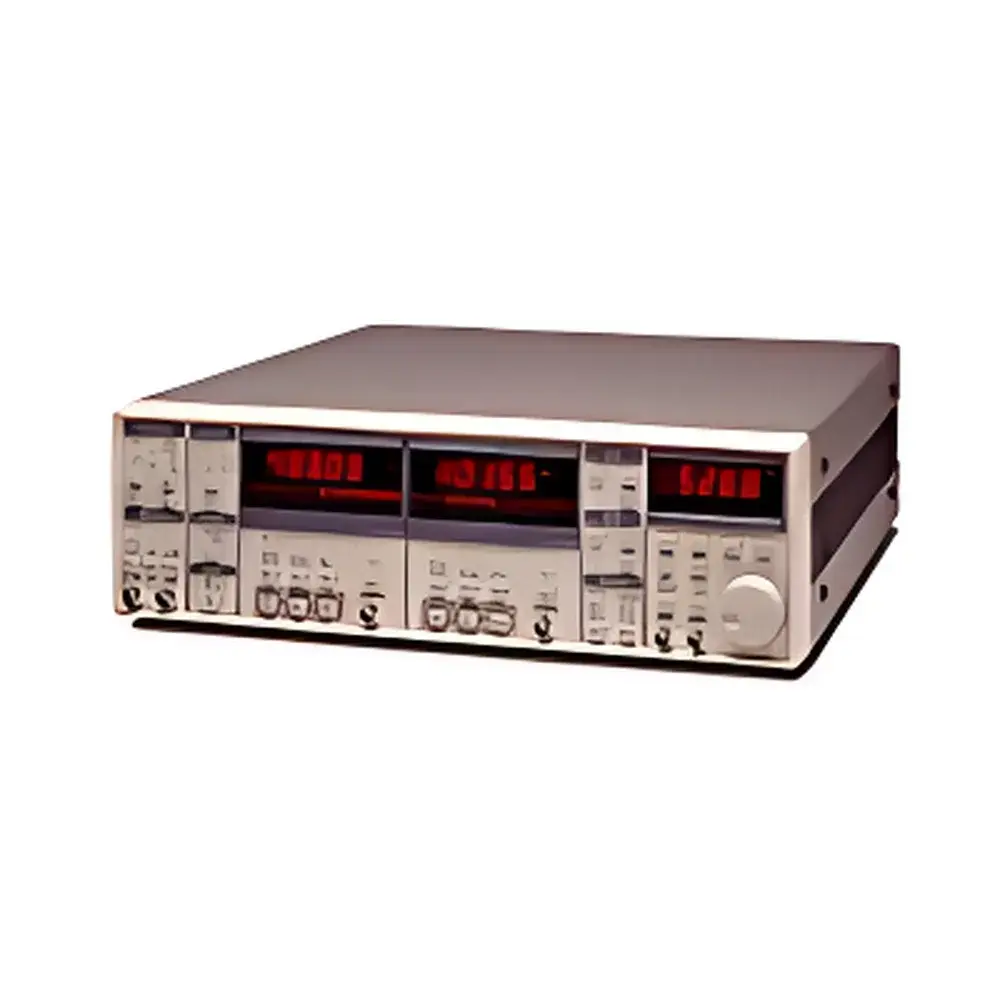
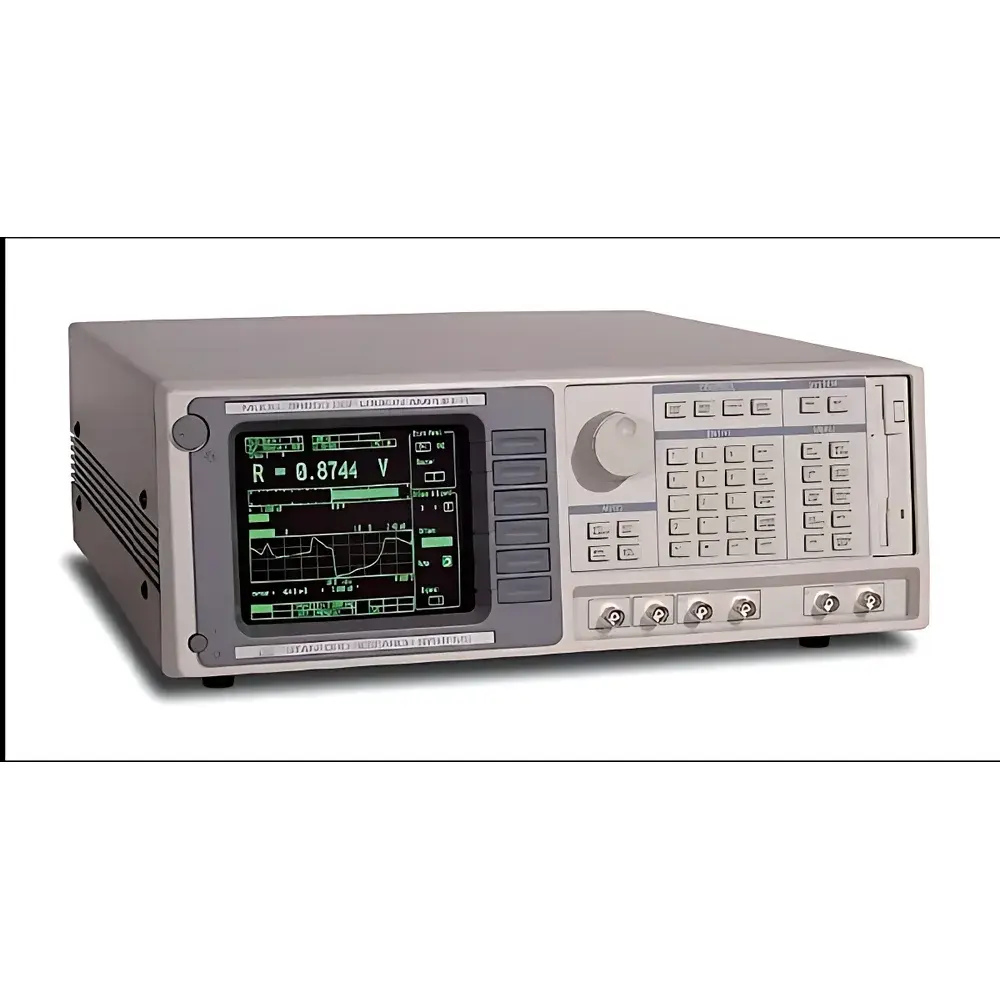
Stanford Research Systems SR830 Dual-Phase Lock-in Amplifier
| Brand | SRS/Stanford Research Systems |
|---|---|
| Origin | USA |
| Model | SR830 |
| Frequency Range | 1 mHz to 102.4 kHz |
| Dynamic Reserve | >100 dB |
| Phase Resolution | 0.01° |
| Temperature Stability | 5 ppm/°C |
| Time Constant Range | 10 µs to 30 ks (up to 24 dB/oct rolloff) |
| Built-in Reference Oscillator | Yes |
| Interfaces | GPIB (IEEE-488), RS-232 |
| Internal Signal Source Spectral Purity | 80 dBc |
Overview
The Stanford Research Systems SR830 Dual-Phase Lock-in Amplifier is a precision analog-digital hybrid instrument engineered for high-sensitivity measurement of small AC signals buried in noise—common in low-temperature physics, optical spectroscopy, scanning probe microscopy, and impedance characterization. Operating on the principle of synchronous demodulation, the SR830 multiplies the input signal with a phase-locked reference waveform (internally generated or externally supplied), followed by low-pass filtering to extract DC components proportional to the in-phase (X) and quadrature (Y) amplitudes of the signal at the reference frequency. This architecture enables detection of signals as low as nanovolt-level amplitudes with exceptional rejection of out-of-band noise, harmonics, and 1/f drift—critical for experiments requiring long integration times and stable baseline conditions.
Key Features
- Dual-phase detection with simultaneous X (R·cosθ), Y (R·sinθ), R (magnitude), and θ (phase) outputs—enabling full vector analysis without external computation
- Dynamic reserve exceeding 100 dB, allowing accurate measurement even when interfering noise exceeds the signal amplitude by two orders of magnitude
- Thermal stability of ±5 ppm/°C ensures minimal drift during extended temperature-varying experiments, supporting reproducible measurements across multi-hour acquisition sessions
- Phase resolution of 0.01° and absolute phase accuracy better than 0.1° over the full 1 mHz–102.4 kHz operating bandwidth
- Configurable time constants from 10 µs to 30 ks (with selectable filter slopes of 6, 12, 18, or 24 dB/octave), optimized for trade-offs between noise bandwidth and response speed
- Integrated reference oscillator with spectral purity of –80 dBc at 1 kHz offset, eliminating need for external signal sources in most applications
- Automated functions including auto-gain, auto-phase, auto-offset, and auto-range—reducing operator dependency and improving measurement repeatability
- Standard GPIB (IEEE-488.2) and RS-232 interfaces compliant with SCPI command syntax, enabling seamless integration into LabVIEW, MATLAB, Python (PyVISA), and custom automation frameworks
Sample Compatibility & Compliance
The SR830 accepts differential or single-ended voltage inputs (±1 V or ±10 V full scale) with programmable AC/DC coupling, 10 MΩ input impedance, and <10 nV/√Hz input noise density at 1 kHz. It is compatible with transducers requiring low-noise preamplification—including cryogenic sensors, photodiodes, piezoresistive cantilevers, and Hall-effect probes. Optional external preamplifiers (e.g., SR550, SR552, SR554) extend effective sensitivity to sub-nanovolt levels. The instrument conforms to CE marking requirements and meets IEC 61000-4 electromagnetic compatibility standards. While not certified for medical or safety-critical environments, its design adheres to general-purpose laboratory instrumentation best practices aligned with ISO/IEC 17025 calibration traceability frameworks when used with NIST-traceable reference standards.
Software & Data Management
Data acquisition and instrument control are supported via native GPIB drivers and ASCII-based SCPI commands. The SR830 does not include embedded graphical display or onboard data storage; instead, it relies on host-based software for visualization and post-processing—a design choice that enhances long-term maintainability and avoids firmware obsolescence. Users routinely interface the unit with National Instruments LabVIEW (via NI-488.2), MATLAB Instrument Control Toolbox, or open-source tools such as PyVISA and QCoDeS. All measurement parameters—including time constant, sensitivity, phase, harmonic order, and filter type—are fully scriptable and support timestamped logging. Audit trails and configuration snapshots can be archived manually or via automated scripts, satisfying basic GLP documentation needs where electronic records are maintained under institutional SOPs.
Applications
- Scanning tunneling microscopy (STM) and atomic force microscopy (AFM) lock-in detection for topographic and spectroscopic mapping
- Optical heterodyne detection in pump-probe spectroscopy, ellipsometry, and photothermal deflection measurements
- Low-frequency impedance spectroscopy of batteries, fuel cells, and electrochemical interfaces
- Cryogenic transport measurements (e.g., Hall effect, magnetoresistance) requiring ultra-low-noise signal recovery
- Modulated laser absorption spectroscopy (LAS) and cavity ring-down spectroscopy (CRDS) signal extraction
- Characterization of MEMS resonators and piezoelectric actuators under dynamic excitation
- Calibration of ultra-low-noise amplifiers and sensor front-ends using known reference stimuli
FAQ
What is the maximum harmonic rejection capability of the SR830?
The SR830 supports harmonic detection up to the 9999th harmonic of the reference frequency, with built-in notch filtering and adjustable harmonic order selection for precise suppression of fundamental and harmonic interference.
Can the SR830 operate without an external reference signal?
Yes—the internal reference oscillator provides stable, low-distortion sine waves from 1 mHz to 102.4 kHz, eliminating dependence on external sources unless phase-coherent multi-instrument synchronization is required.
Is the SR830 compatible with modern 64-bit Windows or Linux operating systems?
While the hardware interface remains fully functional, official SRS drivers were historically developed for legacy Windows versions. However, GPIB and RS-232 communication is reliably achieved on current OS platforms using standard VISA libraries (NI-VISA, linux-gpib) and open-source SCPI wrappers.
How does the SR830 compare to newer DSP-based lock-in amplifiers like the SR850?
The SR830 employs a hybrid analog front-end with digital phase-sensitive detection, offering superior analog noise performance and proven long-term reliability. The SR850 introduces real-time graphical display and enhanced phase resolution (0.001°), but the SR830 remains preferred in applications prioritizing analog integrity, deterministic latency, and field-deployed robustness.