
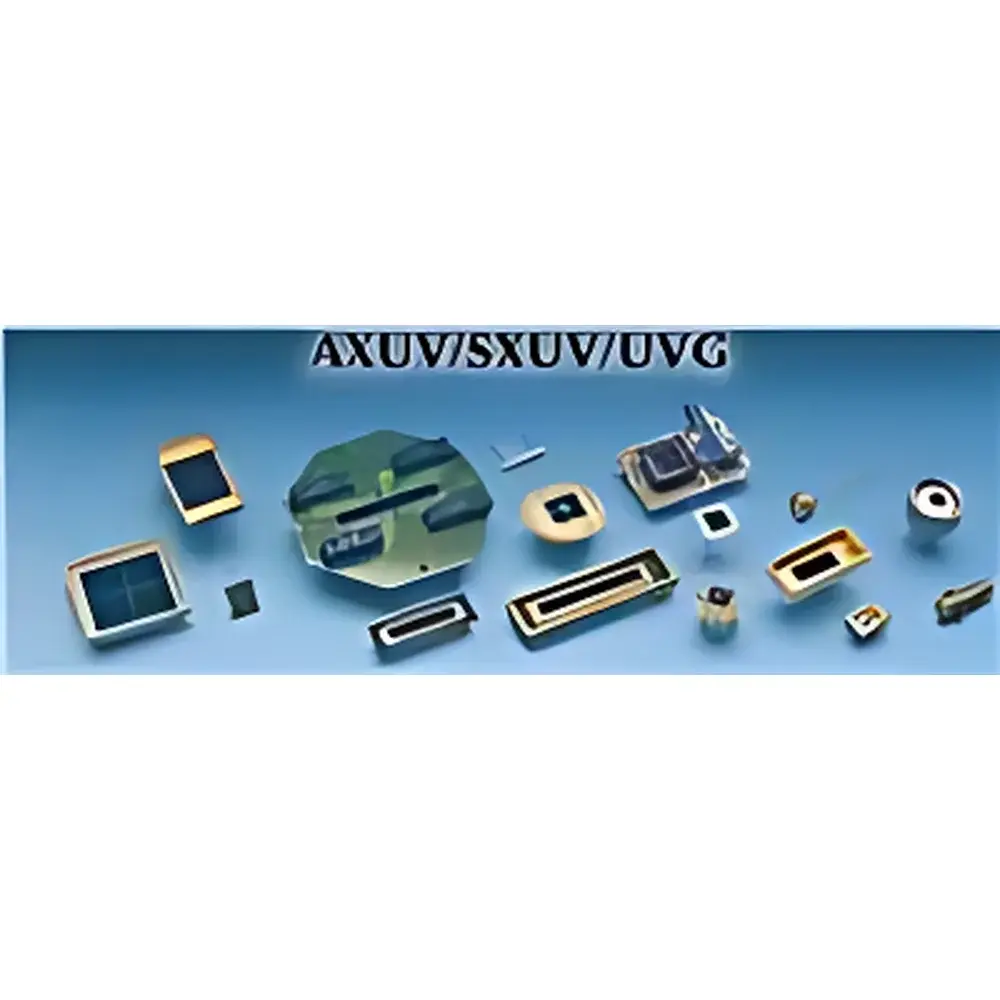
IRD AXUV/SXUV/UVG Series Soft X-ray Detectors
| Brand | IRD |
|---|---|
| Origin | USA |
| Manufacturer Type | Authorized Distributor |
| Import Status | Imported |
| Models | AXUV Series / SXUV Series / UVG Series |
| Pricing | Available Upon Request |
Overview
The IRD AXUV, SXUV, and UVG series soft X-ray detectors are silicon-based photodiodes engineered for direct, absolute detection of photons in the extreme ultraviolet (EUV), vacuum ultraviolet (VUV), and soft X-ray spectral regions (0.04 nm to 160 nm, corresponding to photon energies from ~31 eV up to 31 keV). Unlike scintillator-coupled or gas-based detectors, these devices operate via direct photoelectric absorption in high-purity silicon, eliminating conversion losses and enabling traceable, quantum-efficiency-limited responsivity. The absence of a doped dead layer and implementation of zero-surface-recombination passivation yield near-theoretical internal quantum efficiency (IQE) approaching 100% across their operational bands—critical for radiometric calibration, synchrotron beamline diagnostics, laser-plasma source characterization, and EUV lithography metrology.
Key Features
- Direct-detection architecture: No scintillator or gas amplification required—enables absolute photon flux measurement with minimal uncertainty propagation
- Three optimized product families: AXUV (broadband VUV–soft X-ray, 0.04–160 nm), SXUV (high-flux EUV/X-ray, 4 eV–12 keV, with PtSi entrance window), and UVG (VUV–NUV, 160–600 nm, optimized for high collection efficiency)
- Sub-picosecond intrinsic response time: Enables time-resolved measurements of ultrafast plasma emissions, free-electron laser pulses, and pulsed discharge sources
- Customizable spectral selectivity: Integrated thin-film filters (Cr, W, Au, Fe, Al, Zr, Si₃N₄, SiC, Mo) enable narrow-band operation compliant with ISO 15739 and ASTM E1782 standards for spectral responsivity characterization
- High-dynamic-range configurations: Attenuator-integrated variants available for pulsed sources exceeding 20 mJ per pulse—preserving linearity and preventing surface damage under intense EUV irradiation
- Monolithic array and quadrant PSD options: Supports spatially resolved beam profiling, centroid tracking, and real-time alignment feedback in optical and X-ray beamlines
Sample Compatibility & Compliance
These detectors are designed for integration into UHV (≤10⁻⁹ Torr) and XHV environments typical of synchrotron endstations, laser-plasma laboratories, and space-borne instrumentation. All diodes meet MIL-STD-883H mechanical shock and thermal cycling requirements. Filtered variants comply with ISO/IEC 17025 calibration traceability protocols when used with NIST-traceable reference sources. Detector housings support standard CF-40, CF-63, and KF-40 flanges. For regulated environments—including FDA-regulated analytical workflows or GLP-compliant plasma diagnostics—the detector’s passive analog output and absence of embedded firmware ensure full compatibility with 21 CFR Part 11 audit trail requirements when paired with validated data acquisition systems.
Software & Data Management
IRD provides comprehensive calibration documentation—including spectral responsivity curves (A/W vs. wavelength), linearity coefficients, and temperature-dependent dark current profiles—for each delivered unit. Raw voltage outputs interface seamlessly with industry-standard digitizers (e.g., Keysight, National Instruments, or Zurich Instruments lock-in amplifiers). While the detectors themselves are analog-only, IRD supports integration with LabVIEW, Python (via PyVISA), and MATLAB environments for automated acquisition, pulse-height analysis, and multi-channel synchronization. Optional firmware-agnostic signal conditioning modules (gain-stabilized transimpedance amplifiers with 10⁶–10¹¹ V/A range selection) facilitate quantitative photon counting and dose-rate reporting without proprietary software dependencies.
Applications
- Synchrotron radiation beamline monitoring (3rd/4th generation facilities: APS-U, ESRF-EBS, SPring-8, PETRA IV)
- EUV lithography source power and stability metrology (13.5 nm at ≤0.1% bandwidth)
- Laser-produced plasma (LPP) and discharge-produced plasma (DPP) diagnostics
- Space-based solar physics instrumentation (e.g., EVE/SDO, Solar Orbiter SPICE)
- Time-resolved spectroscopy of attosecond XUV pulses using pump-probe geometries
- Calibration transfer standards for secondary detectors in national metrology institutes (NMI)
FAQ
What is the difference between AXUV, SXUV, and UVG series detectors?
AXUV diodes feature uncoated silicon with ultra-low surface recombination for broadband VUV-to-soft-X-ray sensitivity; SXUV incorporates a PtSi entrance window for enhanced quantum efficiency above 1 keV and higher damage threshold; UVG uses optimized shallow-junction design for peak responsivity in 160–600 nm, achieving >95% external quantum efficiency.
Can these detectors be used in air or only under vacuum?
All three series require operation under vacuum (typically ≤10⁻⁵ Torr for VUV/EUV use) due to atmospheric absorption below 190 nm; however, UVG-series devices may operate in nitrogen-purged enclosures for NUV applications.
Do IRD detectors provide NIST-traceable calibration certificates?
Yes—each detector is supplied with a factory calibration report referencing NIST SRM 2065 (deuterium lamp) and SRM 2066 (synchrotron radiation), including uncertainty budgets per GUM guidelines.
Is custom array geometry or filter deposition available?
Yes—IRD offers bespoke linear and 2D arrays (up to 64-element monolithic configurations), quadrant PSDs with sub-5 µm position resolution, and evaporation-deposited filter stacks meeting ISO 11439 spectral purity specifications.
What is the typical rise time for single-pulse detection?
Measured electrical rise times are <100 ps for bare diodes (50 Ω termination); system-level timing resolution depends on amplifier bandwidth and cabling—sub-500 ps is routinely achieved in optimized setups.





