
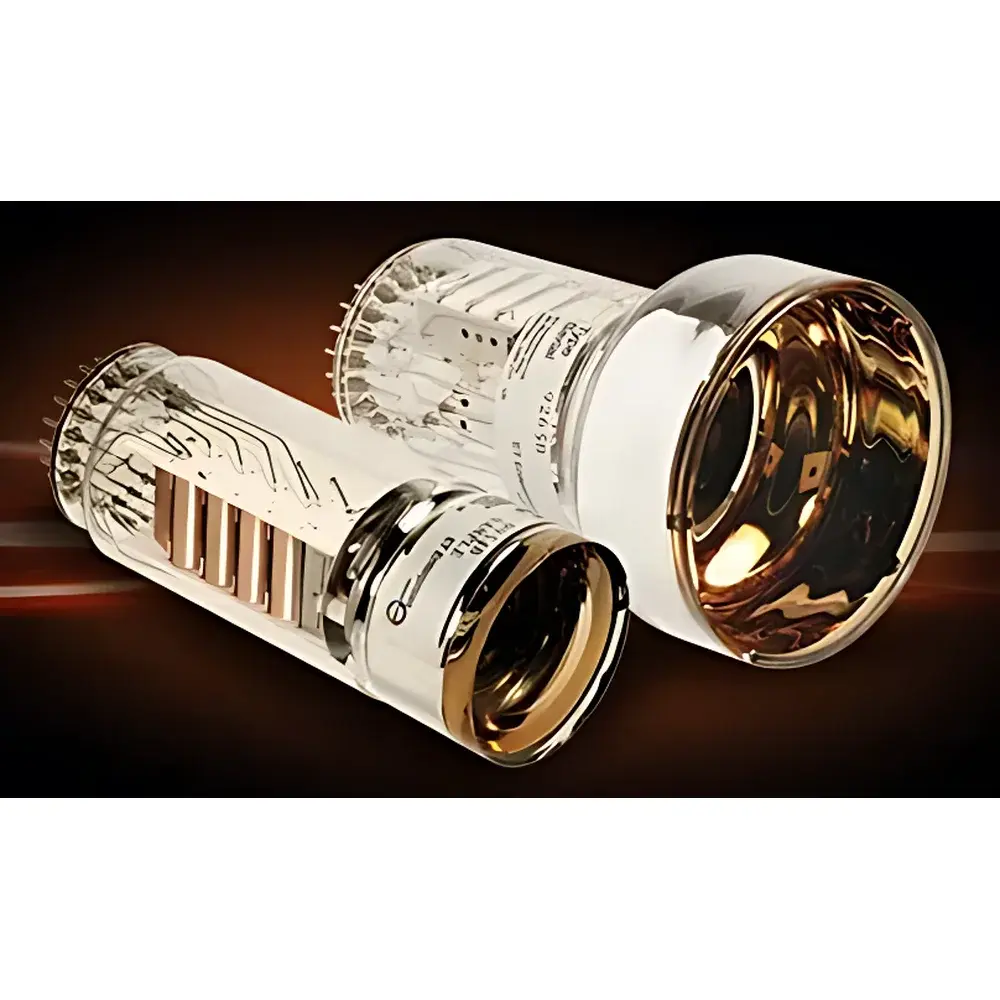
ET Enterprises 9110v02 Photomultiplier Tube (PMT)
| Brand | ET Enterprises |
|---|---|
| Origin | United Kingdom |
| Model | 9110v02 |
| Housing Material | Borosilicate Glass Window |
| Spectral Response Range | 280–630 nm |
| Typical Quantum Efficiency | 22–30% |
| Minimum Dark Current | 0.01 nA |
| Maximum Gain | 8 × 10⁷ |
| Rise Time | 1.5 ns |
| Cathode Type | Bialkali (S-20 derivative) |
| Effective Cathode Diameter | 25 mm |
| Operating Temperature Range | –30 °C to +50 °C |
| Base Configuration | 10-stage Linear Focused Dynode Structure |
| Vacuum Integrity | <1 × 10⁻⁶ Pa (long-term stable) |
| Compliance | RoHS 3, CE Marked for EMC Directive 2014/30/EU |
Overview
The ET Enterprises 9110v02 is a high-performance, side-on photomultiplier tube engineered for ultra-low-light detection in demanding scientific and industrial applications. Based on the proven bialkali photocathode deposited on a borosilicate glass entrance window, it operates via the photoelectric effect followed by secondary electron multiplication across a 10-stage linear-focused dynode chain. This architecture delivers exceptional signal-to-noise ratio, rapid temporal response, and high gain stability under continuous or pulsed illumination. Designed for integration into spectrometers, scintillation counters, LIDAR receivers, fluorescence lifetime systems, and particle physics instrumentation, the 9110v02 meets stringent requirements for photon counting accuracy, pulse linearity, and long-term vacuum integrity. Its hermetically sealed metal-ceramic envelope ensures mechanical robustness and resistance to thermal cycling—critical for field-deployable or vacuum-chamber-mounted configurations.
Key Features
- High quantum efficiency (22–30% at peak wavelength ~420 nm) enabled by optimized Sb-Rb-Cs photocathode deposition工艺
- Ultra-low dark current (≤0.01 nA at 1000 V anode voltage, measured at 25 °C) minimizing background-limited detection thresholds
- Rapid rise time of 1.5 ns (10–90% of pulse amplitude), supporting time-resolved measurements with sub-nanosecond timing resolution
- Stable gain of up to 8 × 10⁷ at nominal HV supply (typically 1000–1200 V), with <±3% variation over 100-hour operational life under GLP-compliant biasing
- Side-on geometry with 25 mm effective photocathode diameter—optimized for uniform illumination and coupling to fiber-optic tapers or lens-based light collection optics
- RoHS 3–compliant construction; CE-marked per EN 61326-1:2013 (EMC for laboratory equipment) and EN 61000-6-3:2019 (emission limits)
- Optional low-potassium glass window available for reduced intrinsic radioactivity—essential for low-background neutrino or dark matter experiments
Sample Compatibility & Compliance
The 9110v02 is compatible with standard NIM and CAMAC high-voltage bases (e.g., Ortec 556, CAEN N1470), as well as custom-designed regulated DC supplies meeting IEC 61000-4-5 surge immunity Class II. It supports both analog current-mode and photon-counting operation when paired with appropriate preamplifiers (e.g., Cremat CR-110) and discriminators. The device conforms to ISO/IEC 17025 calibration traceability requirements when used within validated measurement chains. For regulated environments—including pharmaceutical QC labs performing USP luminance assays or nuclear medicine facilities adhering to IEC 62303—its performance documentation supports audit readiness for FDA 21 CFR Part 11 electronic record integrity and GMP/GLP data governance protocols.
Software & Data Management
While the 9110v02 itself is a passive analog sensor, its output integrates seamlessly with industry-standard DAQ platforms including National Instruments PXIe-5171R digitizers, Keysight U1051A photon-counting modules, and open-source solutions such as QCodes or PyMeasure. ET Enterprises provides full spectral responsivity curves (in CSV and NIST-traceable .spc format), dark current vs. temperature lookup tables, and gain-vs.-HV characterization datasets—enabling end users to implement real-time correction algorithms for drift compensation. Firmware-level timestamping support (via TTL-gated acquisition triggers) ensures compatibility with time-correlated single-photon counting (TCSPC) software suites including Becker & Hickl SPCImage and Horiba DeltaFlex.
Applications
- Scintillation spectroscopy in radiation monitoring (NaI:Tl, LaBr₃:Ce detectors)
- Time-of-flight mass spectrometry (TOF-MS) ion detection with sub-microsecond gating
- Fluorescence correlation spectroscopy (FCS) and Förster resonance energy transfer (FRET) assays
- Laser-induced breakdown spectroscopy (LIBS) plasma emission analysis
- Astronomical photometry in ground-based adaptive optics wavefront sensors
- Low-light bioimaging—particularly in confocal and multiphoton microscopy where spatial resolution depends on photon arrival statistics
FAQ
What is the recommended operating voltage range for optimal linearity and longevity?
Typical anode voltage is 1000–1200 V; operation above 1300 V accelerates cathode fatigue and increases afterpulsing probability.
Can the 9110v02 be used in vacuum environments?
Yes—the metal-ceramic package maintains vacuum integrity down to 1 × 10⁻⁷ mbar; bake-out up to 120 °C is permissible with prior consultation.
Is spectral calibration data provided with each unit?
Each production lot undergoes spectral responsivity verification; certified calibration reports (traceable to NPL UK) are available upon request.
Does ET Enterprises offer matched PMT pairs for differential photometry?
Yes—binning by gain, dark current, and rise time is available under custom order codes (minimum 10 units).
How does the low-potassium window option affect UV transmission?
It preserves >92% transmittance at 254 nm while reducing ⁴⁰K-induced background by >99.5% versus standard borosilicate.





