
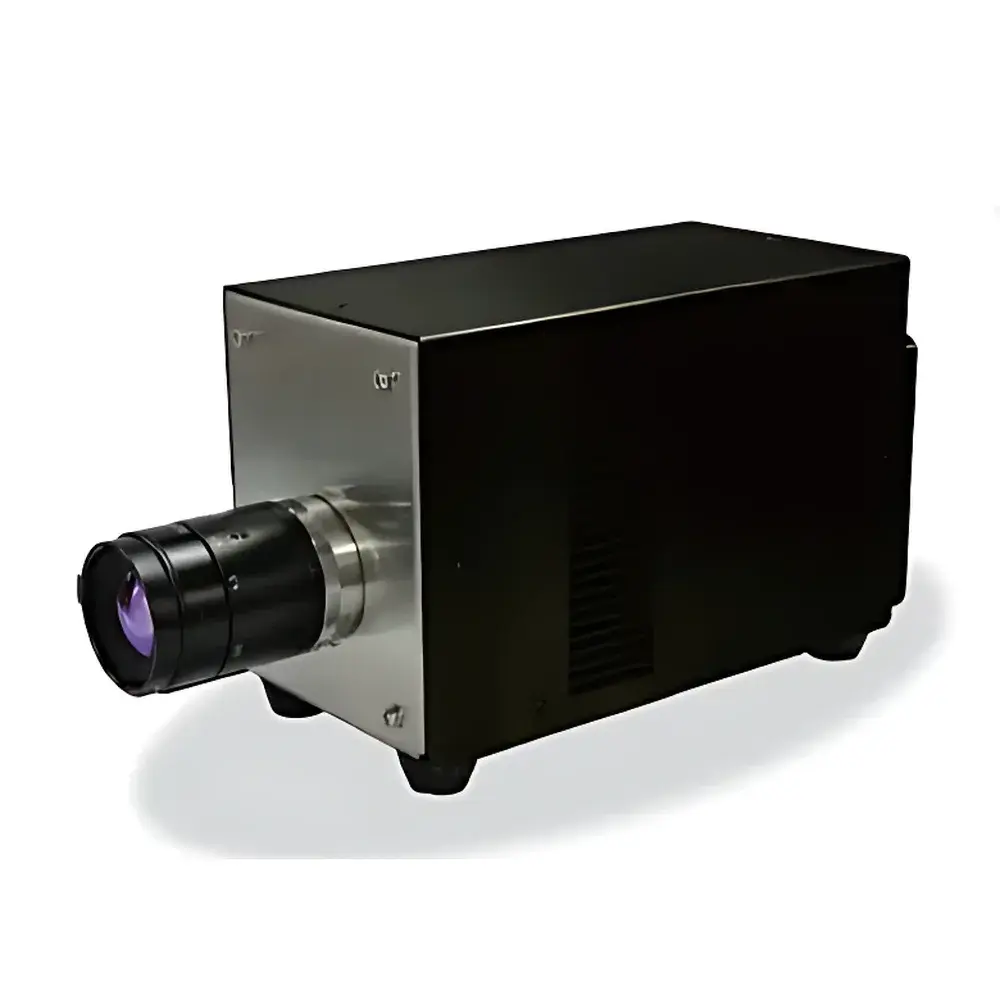
Artray ARTCAM-2350SWIR Deep-Cooled Short-Wave Infrared (SWIR) Camera
| Brand | Artray |
|---|---|
| Origin | Japan |
| Model | ARTCAM-2350SWIR |
| Spectral Range | 1000–2350 nm |
| Resolution | 320 × 256 pixels |
| Pixel Pitch | 30 µm × 30 µm |
| Interface | Camera Link |
| Max Frame Rate | 320 fps |
| Cooling Temperature | −75 °C (thermoelectric) |
| A/D Resolution | 16-bit |
Overview
The Artray ARTCAM-2350SWIR is a high-performance, deep-cooled short-wave infrared (SWIR) imaging camera engineered for scientific, industrial, and defense applications requiring high sensitivity and low-noise operation in the 1000–2350 nm spectral band. Based on an InGaAs/GaAsSb focal plane array (FPA), the camera employs thermoelectric (Peltier) cooling to stabilize detector temperature at −75 °C—significantly suppressing dark current and enabling long integration times without saturation. Its QVGA-format sensor (320 × 256 pixels) features uniform 30 µm pixel pitch and 16-bit analog-to-digital conversion, delivering high dynamic range and quantitative radiometric fidelity. Unlike uncooled or lightly cooled SWIR sensors, the ARTCAM-2350SWIR’s deep-cooling architecture ensures stable baseline performance across ambient temperature fluctuations, making it suitable for time-lapse spectroscopic imaging, laser beam profiling, and low-photon-flux inspection tasks where signal integrity and reproducibility are critical.
Key Features
- Deep thermoelectric cooling to −75 °C for ultra-low dark current and enhanced signal-to-noise ratio (SNR)
- High quantum efficiency InGaAs/GaAsSb detector optimized for 1000–2350 nm spectral response
- 16-bit digitization with full-well capacity calibrated for linear response across exposure durations
- Camera Link interface (Base configuration) supporting deterministic frame timing and real-time data streaming up to 320 fps at full resolution
- Hermetically sealed, vacuum-compatible housing with integrated thermal management for long-term operational stability
- Factory-calibrated non-uniformity correction (NUC) tables stored onboard for rapid startup and consistent radiometric accuracy
Sample Compatibility & Compliance
The ARTCAM-2350SWIR is designed for integration into optical bench systems, automated inspection platforms, and laboratory-grade spectroscopy setups. It supports standard C-mount and F-mount lens adapters (with optional flange distance compensation), enabling compatibility with off-the-shelf SWIR lenses, objective assemblies, and custom collimators. The camera complies with CE marking requirements for electromagnetic compatibility (EMC Directive 2014/30/EU) and low-voltage safety (LVD Directive 2014/35/EU). While not certified for medical or aerospace use out-of-the-box, its hardware design meets baseline requirements for GLP-aligned instrumentation validation—particularly when deployed with traceable NIST-calibrated light sources and documented calibration protocols. Firmware supports user-defined ROI readout and trigger-synchronized acquisition, facilitating compliance with ISO/IEC 17025 method validation workflows in accredited testing laboratories.
Software & Data Management
Artray provides the ARTView SDK—a cross-platform (Windows/Linux) software development kit supporting C/C++, Python, and MATLAB APIs. The SDK enables full control over exposure time, gain, region-of-interest (ROI), frame rate, and internal NUC table selection. Acquired images are output in standard 16-bit TIFF or raw binary formats, preserving bit-depth integrity for downstream analysis in tools such as ENVI, MATLAB Image Processing Toolbox, or custom Python pipelines using NumPy and OpenCV. Audit-trail functionality—including timestamped metadata (exposure, temperature, gain settings) embedded in image headers—is available via optional firmware upgrade, aligning with FDA 21 CFR Part 11 requirements for electronic records in regulated environments. Data logging and batch acquisition scripts can be implemented without proprietary runtime dependencies.
Applications
- Non-destructive evaluation (NDE) of polymer composites, silicon wafers, and solar cell coatings via SWIR transmission and reflectance contrast
- Real-time monitoring of combustion processes, flame structure, and hot-gas dynamics in research burners and turbine test rigs
- Quantitative laser-induced breakdown spectroscopy (LIBS) and cavity ring-down spectroscopy (CRDS) detection in the 2–2.5 µm molecular fingerprint region
- Biomedical tissue imaging through scattering media (e.g., skin, plant leaves) leveraging reduced Mie scattering at SWIR wavelengths
- Defense and security applications including covert illumination imaging, counter-UAS surveillance, and spectral signature identification
- Process analytical technology (PAT) for pharmaceutical granulation and drying endpoint determination using moisture-sensitive SWIR absorption bands
FAQ
What is the difference between ARTCAM-2350SWIR and ARTCAM-2500SWIR?
The primary distinction lies in spectral cutoff: ARTCAM-2350SWIR is optimized for 1000–2350 nm, while ARTCAM-2500SWIR extends responsivity to 2500 nm using a GaAsSb-based detector. The latter exhibits higher dark current and requires more stringent thermal stabilization.
Does the camera support external triggering and synchronization?
Yes—hardware TTL trigger input/output is provided for master-slave synchronization with lasers, shutters, or motion stages. Trigger latency is <1 µs, with jitter <50 ns.
Is radiometric calibration included with the system?
A factory-applied relative responsivity map is supplied; absolute radiometric calibration (W/cm²/sr/nm) is available as an optional service using NIST-traceable blackbody sources.
Can the camera operate continuously for extended periods?
Yes—the thermoelectric cooler and heat dissipation system are rated for continuous 24/7 operation at ambient temperatures ≤30 °C with adequate airflow or liquid cooling interface.
What lens mounts are supported?
Standard C-mount is native; F-mount and M42 adapters are available as accessories. Back focal length adjustments are required for optimal focus across the SWIR band due to chromatic shift.






