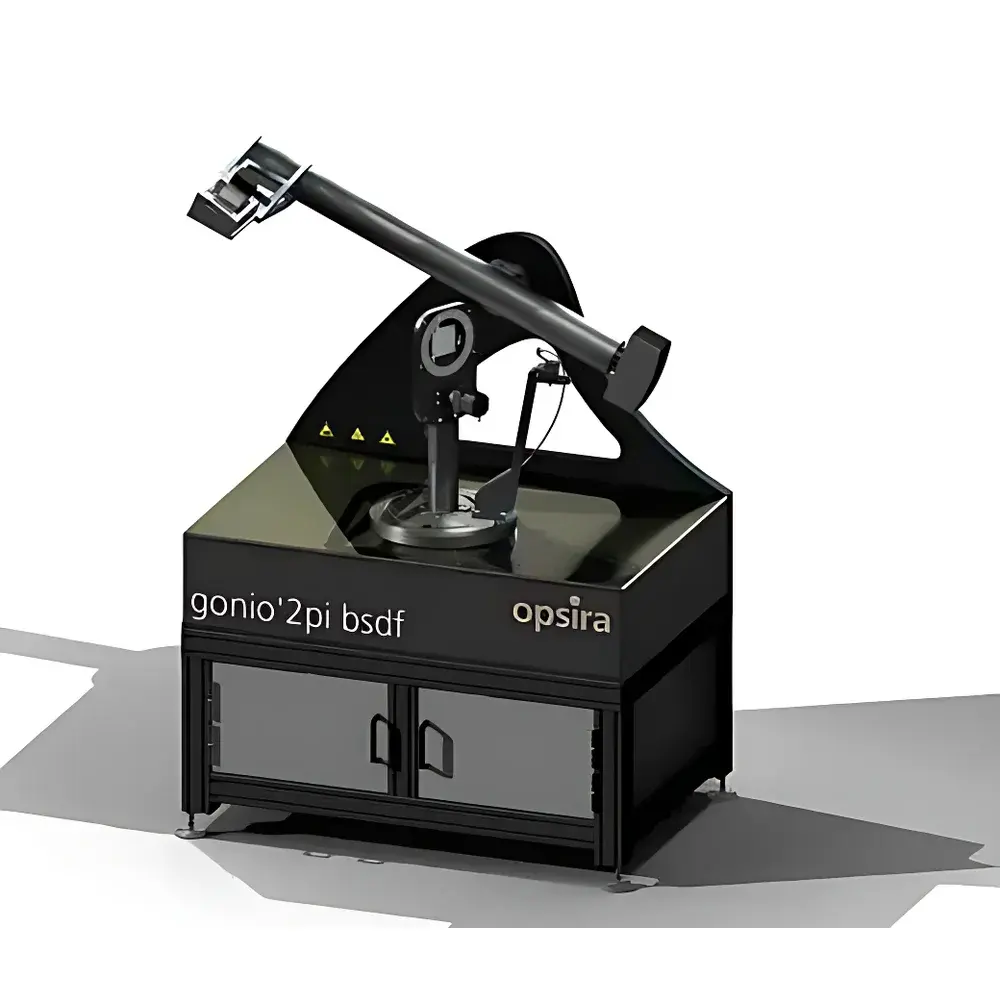
Gonio-2Pi Near-Field Source Measurement System
| Origin | Germany |
|---|---|
| Manufacturer Type | Distributor |
| Origin Category | Imported |
| Model | Gonio-2Pi |
| Price | Upon Request |
Overview
The Gonio-2Pi Near-Field Source Measurement System is a high-precision goniophotometric platform engineered for comprehensive spatial, spectral, and angular characterization of light sources. Operating on the principle of rotating-arm goniometry with synchronized detector positioning, the system captures luminance, radiance, intensity, and spectral power distribution (SPD) across both near-field and far-field regions. Its dual-domain capability—enabled by interchangeable optical modules and calibrated probe heads—supports full 2π solid-angle acquisition, making it uniquely suited for LED packages, multi-chip arrays, automotive headlamps, medical lighting systems, and other complex emissive devices where chip-level spectral heterogeneity and optical crosstalk critically influence downstream optical design fidelity.
Key Features
- Modular architecture supporting near-field (NF), far-field (FF), BSDF (Bidirectional Scattering Distribution Function), and multi-spectral Ray Data acquisition within a single platform
- Two configurable versions: Si (standard) for high-resolution near-field imaging and XL (extended) for enhanced angular resolution (10−4° internal, 10−2° external)
- Integrated detector suite including Hamamatsu PMT-based photometers, Luca imaging luminance cameras, Spec’3 spectroradiometers, Spr’3 spectral radiometers, and frc’3 broadband radiometers/photometers
- Adjustable working distance (700 mm or 850 mm) with motorized precision positioning to accommodate varying source geometries and thermal management requirements
- Optical spatial resolution < 0.03 mm at the source plane, enabling chip-level radiant mapping of multi-wavelength LED dies (e.g., 488 nm and 630 nm emitters)
- Full spectral compatibility with V(λ)-weighted photometry, RGB-tristimulus, and custom multi-band radiometric channels
Sample Compatibility & Compliance
The Gonio-2Pi accommodates a broad range of light-emitting components—from bare-die LEDs and COB (Chip-on-Board) modules to fully assembled automotive headlamp assemblies and surgical lighting fixtures. It supports thermal stabilization during measurement via optional temperature-controlled stages (e.g., up to 83.5°C surface monitoring). All optical calibration protocols adhere to ISO/CIE traceable standards, and measurement data workflows comply with GLP/GMP documentation requirements. The system’s spectral radiometric modules are validated per CIE S 025/E:2015 and NIST-traceable calibration certificates are provided with each detector head. Export configurations meet CE, RoHS, and IEC 61000-6-3 electromagnetic compatibility directives.
Software & Data Management
Control and analysis are performed using the vendor’s proprietary RayData Suite, a Windows-based application supporting real-time acquisition, multi-layer data fusion (intensity + spectrum + angle + temperature), and automated ray set generation. All measurements export in standardized ORF (Optical Ray Format), fully compatible with industry-leading optical simulation environments—including LightTools, TracePro, ASAP, Zemax OpticStudio, and Ansys Speos. The software implements audit-trail logging compliant with FDA 21 CFR Part 11 for regulated R&D and quality assurance environments. Data integrity is reinforced through checksummed binary storage, versioned project archives, and user-role–based access control.
Applications
- LED package development: Quantifying chip-to-chip spectral non-uniformity, phosphor conversion efficiency, and near-field angular emission asymmetry
- Automotive lighting: Validating ECE R149 and SAE J1383 beam pattern compliance through reconstructed far-field intensity distributions derived from near-field measurements
- Medical illumination: Characterizing correlated color temperature (CCT) stability, spectral radiant flux uniformity, and flicker metrics across operating temperatures
- AR/VR microdisplay calibration: Extracting directional SPDs for eyebox modeling and chromatic aberration compensation
- BSDF characterization of diffusers, reflectors, and lens arrays used in secondary optics integration
FAQ
What distinguishes near-field measurement from far-field measurement in this system?
Near-field acquisition captures spatially resolved radiance/luminance at distances comparable to the source dimension (e.g., 700–850 mm), preserving chip-level emission structure; far-field data is mathematically derived via Fourier transformation or direct goniometric scanning at distances satisfying Fraunhofer criteria.
Can the Gonio-2Pi measure pulsed or modulated light sources?
Yes—the PMT and imaging detectors support gated acquisition synchronized to external TTL triggers, enabling time-resolved radiant flux and spectral transient analysis.
Is thermal drift compensated during long-duration measurements?
The system integrates real-time ambient and stage temperature monitoring; optional active thermal stabilization modules maintain sample temperature within ±0.5°C during extended acquisitions.
Does the ORF output include polarization information?
Standard ORF exports contain intensity, wavelength, and direction vectors; polarization-resolved ray sets require optional Stokes-parameter–capable detector add-ons and are supported in v3.2+ of RayData Suite.
How is calibration traceability maintained across detector types?
Each detector head ships with individual NIST-traceable calibration reports; inter-sensor consistency is verified quarterly using reference lamps traceable to PTB (Physikalisch-Technische Bundesanstalt) standards.