
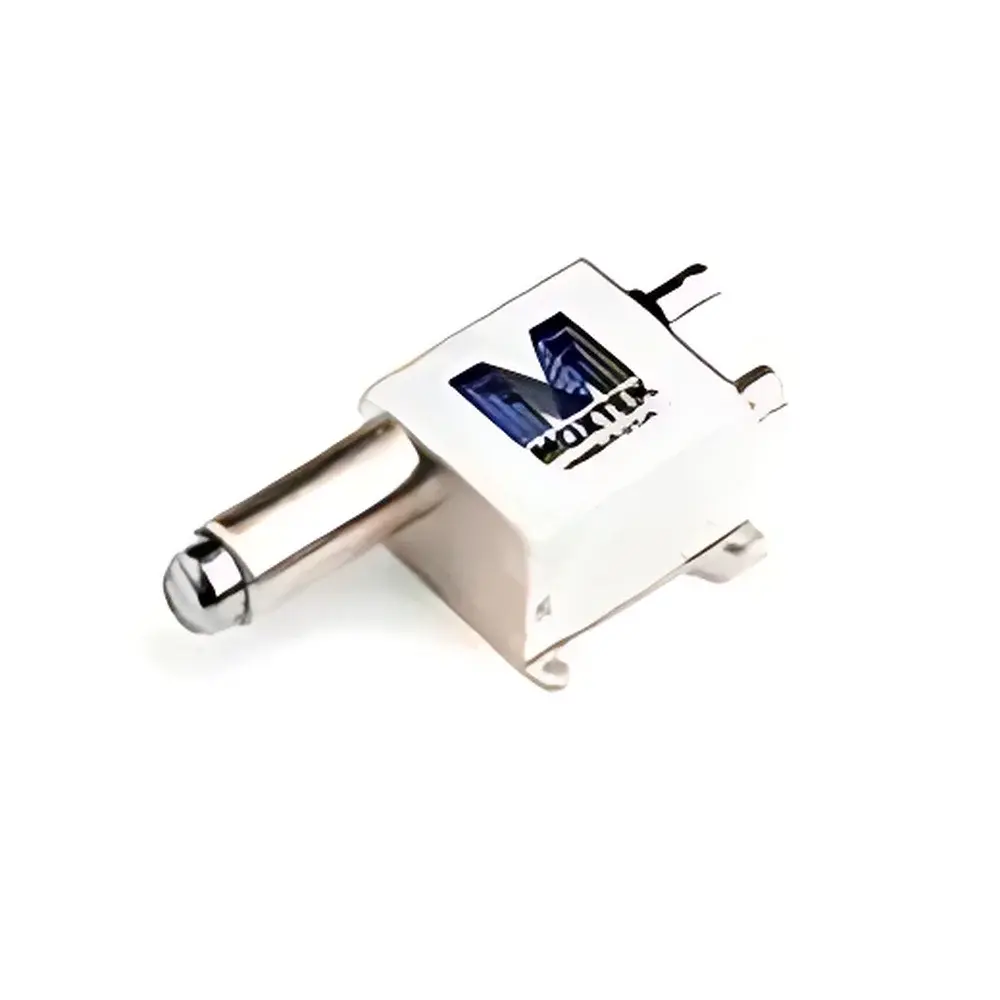
Si-PIN Detector XPIN-BT by Moxtek
| Brand | Moxtek |
|---|---|
| Origin | USA |
| Model | XPIN-BT |
| Active Area | 6 mm² or 13 mm² |
| Silicon Thickness | 450 µm or 625 µm |
| Beryllium Window Thickness | 8 µm or 25 µm |
| Collimator Materials | Tungsten / Cobalt / Titanium / Aluminum |
| Energy Resolution (FWHM @ Mn Kα) | ≤170 eV (6 mm²), ≤230 eV (13 mm²) |
| Peak-to-Background Ratio @ 1 keV | 3600:1 (6 mm², typical), 3000:1 (13 mm², typical) |
Overview
The XPIN-BT is a high-performance silicon p-i-n (Si-PIN) X-ray detector engineered by Moxtek—a U.S.-based technology leader in X-ray and optical components since 1986. Designed for integration into benchtop and portable X-ray fluorescence (XRF) spectrometers, the XPIN-BT operates on the principle of direct X-ray photon absorption in high-purity silicon, generating charge carriers proportional to incident photon energy. Its intrinsic layer (i-layer) provides optimized depletion depth for efficient detection across the soft to mid-energy X-ray range (typically 0.1–30 keV). The detector leverages Moxtek’s proprietary ultra-low-noise JFET preamplifier architecture and precision-machined beryllium entrance windows to maximize quantum efficiency—particularly critical for low-energy elements such as Na, Mg, Al, Si, P, and S. Unlike scintillation-based detectors, the Si-PIN design delivers inherent energy resolution without spectral distortion from light yield nonlinearity, enabling reliable qualitative and semi-quantitative elemental analysis in field-deployable and laboratory-grade instruments.
Key Features
- Two standard active area options: 6 mm² and 13 mm²—optimized for signal-to-noise balance in compact or higher-throughput configurations
- Thick silicon substrates (450 µm or 625 µm) enhance detection efficiency above 5 keV while maintaining excellent charge collection uniformity
- Ultra-thin beryllium windows (8 µm or 25 µm) minimize low-energy absorption—enabling high transmission down to ~100 eV for light element analysis
- Integrated JFET preamplifier with sub-electron noise performance ensures minimal electronic contribution to overall energy resolution
- Modular collimator compatibility with tungsten, cobalt, titanium, and aluminum materials supports tailored beam definition for specific sample geometries and excitation conditions
- Hermetically sealed ceramic package with controlled internal atmosphere ensures long-term stability and resistance to humidity-induced degradation
Sample Compatibility & Compliance
The XPIN-BT is compatible with solid, powdered, and thin-film samples commonly analyzed in ED-XRF applications—including alloys, geological specimens, environmental filters, polymers, and coated substrates. Its low-energy response enables compliance with ASTM E1621 (Standard Guide for XRF Analysis of Waste Materials) and ISO 22073 (X-ray spectroscopy — Vocabulary and symbols). When integrated into systems validated under GLP or GMP frameworks, the detector supports traceable calibration protocols and meets requirements for audit-ready data integrity per FDA 21 CFR Part 11 when paired with compliant acquisition software. No regulatory certification is held by the detector alone; final system-level compliance rests with the OEM instrument manufacturer.
Software & Data Management
The XPIN-BT interfaces via standard analog pulse output (shaped Gaussian or trapezoidal) compatible with industry-standard multichannel analyzers (MCAs) and digital pulse processors (e.g., Amptek DP5, XIA Pixie-4). It does not include embedded firmware or onboard digitization. Raw spectral data are processed externally using peak deconvolution algorithms (e.g., least-squares fitting, iterative least squares), background subtraction (SNIP, TopHat), and matrix correction models (Fundamental Parameters or empirical calibration). Moxtek provides comprehensive technical documentation—including spectral response curves, window transmission data, and temperature-dependent leakage current specifications—to support OEM integration, uncertainty budgeting, and metrological traceability.
Applications
- Routine elemental screening in handheld and benchtop XRF analyzers for scrap metal sorting, RoHS/WEEE compliance testing, and mining exploration
- Light-element quantification in thin-film solar cell manufacturing (e.g., CdTe, CIGS layer thickness and composition)
- Environmental monitoring of airborne particulate matter collected on polycarbonate or quartz filters
- Forensic analysis of paint chips, glass fragments, and gunshot residue where low-Z element discrimination is essential
- Academic research in synchrotron beamlines requiring stable, low-noise detectors for time-resolved XRF mapping
FAQ
What cooling method is required for optimal XPIN-BT performance?
The XPIN-BT operates effectively at thermoelectrically cooled temperatures (−10 °C to −20 °C), typically achieved using a single-stage Peltier cooler. Liquid nitrogen is not required, but stabilization below ambient significantly reduces leakage current and improves energy resolution.
Can the XPIN-BT be used in vacuum or helium-purged environments?
Yes—the detector’s hermetic ceramic package permits operation in dry nitrogen, helium, or high-vacuum (<10⁻³ mbar) environments, provided thermal management and electrical feedthroughs are properly engineered.
How does window thickness affect detection limits for sodium and magnesium?
An 8 µm Be window increases transmission below 1.5 keV by ~40% compared to 25 µm, directly improving minimum detection limits (MDLs) for Na (1.04 keV) and Mg (1.25 keV) by up to a factor of 2.5 under identical counting conditions.
Is the XPIN-BT suitable for high-flux synchrotron applications?
While robust for laboratory X-ray tubes (up to 50 W), it is not rated for direct insertion into high-brilliance undulator beams; users should implement attenuators or defocusing optics to maintain count rates below 50 kcps to avoid pulse pile-up and resolution degradation.






