
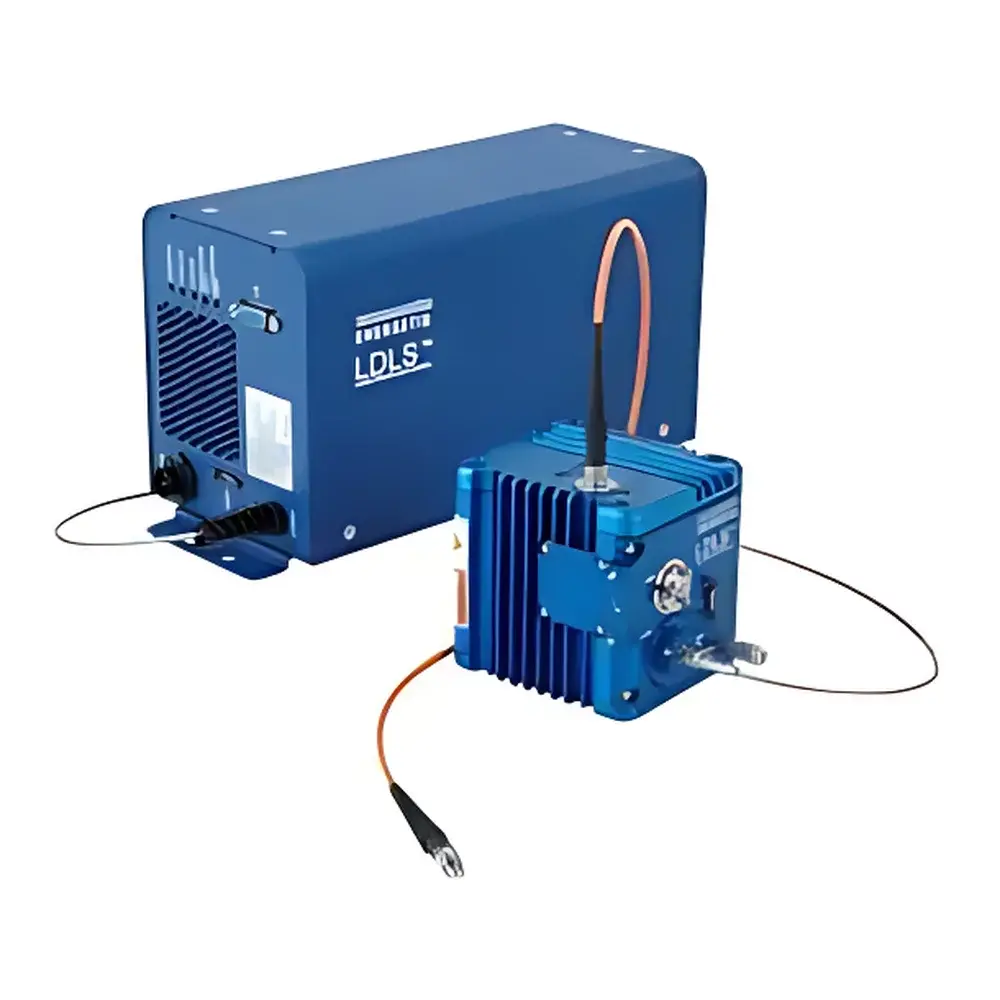
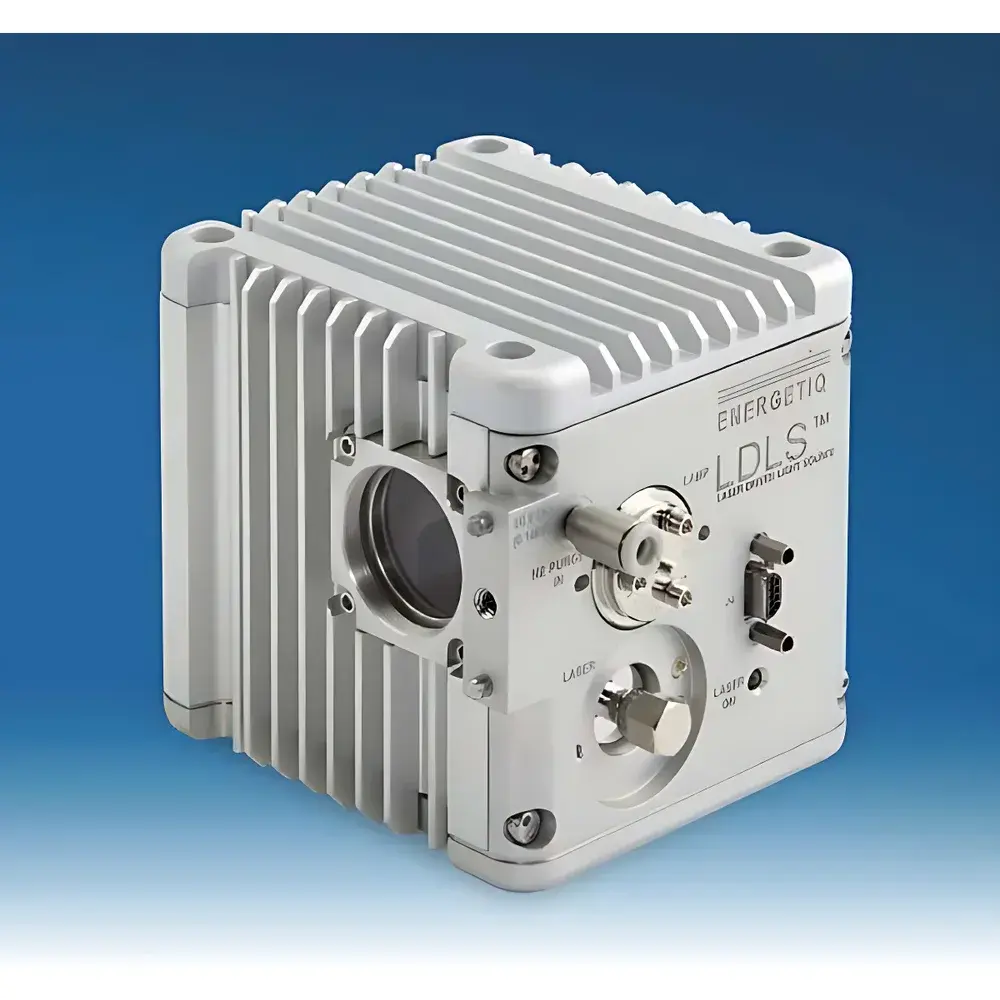
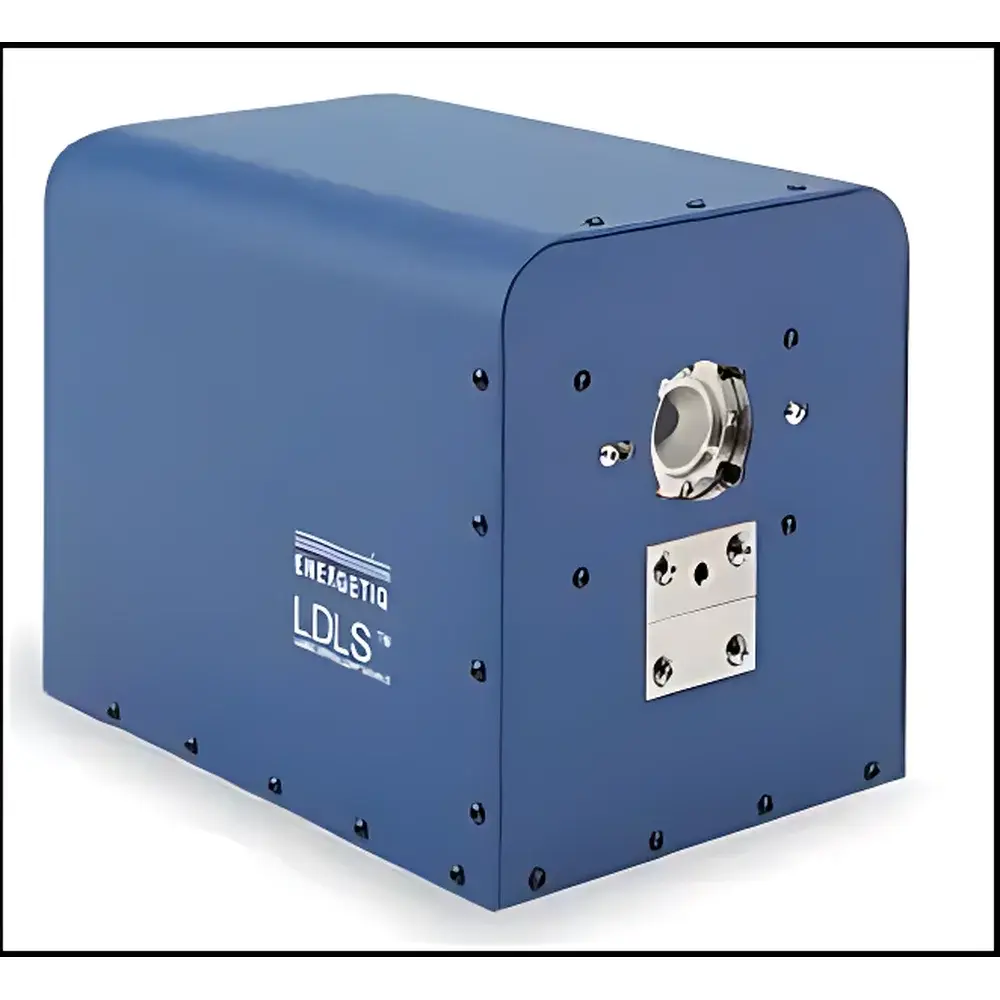
Energetiq EQ-99 LDLS Laser-Driven Light Source
| Brand | Energetiq |
|---|---|
| Origin | USA |
| Model | EQ-99 |
| Spectral Range | 170 nm – 2100 nm |
| Output Options | Free-Space and Fiber-Coupled |
| Numerical Aperture (NA) | up to 0.47 |
| Typical Bulb Lifetime | > 9,000 hours |
| Dimensions (Lamp Head) | 82.3 × 85.7 × 76.2 mm |
| Weight (Lamp Head) | 0.7 kg |
| Power Supply Dimensions | 107 × 111 × 254 mm (excl. feet) |
| Weight (Power Supply) | 1.4 kg |
| Illumination Mode | External Illumination |
| Light Source Type | Electrodeless Laser-Driven Plasma Source |
Overview
The Energetiq EQ-99 LDLS (Laser-Driven Light Source) is a high-performance, electrodeless broadband white-light source engineered for demanding optical laboratory applications requiring spectral continuity, spatial stability, and long-term radiometric reproducibility. Unlike conventional arc lamps—such as deuterium, tungsten-halogen, or xenon—whose output degrades due to electrode erosion, thermal drift, and spectral discontinuities, the EQ-99 employs a pulsed laser to sustain a stable, high-temperature plasma in a fused-silica cavity. This laser-driven plasma mechanism eliminates physical electrodes entirely, enabling continuous spectral emission from the deep ultraviolet (170 nm) through the visible and into the near-infrared (2100 nm). The result is a single, compact source capable of replacing multi-lamp configurations in UV-VIS-NIR spectrophotometry, monochromator calibration, optical component characterization, and hyperspectral imaging systems—without spectral gaps or intensity rolloff at short wavelengths.
Key Features
- Laser-driven plasma architecture ensures electrode-free operation, eliminating cathode sputtering, filament aging, and spectral instability associated with traditional discharge lamps.
- Exceptional brightness: radiance exceeds that of a 75 W xenon arc lamp by a factor of 10 and outperforms a 30 W deuterium lamp by over 100× in the UV region (190–220 nm).
- High spatial stability (<100 µm effective source size) and low pointing drift support precision alignment in micro-optical setups and fiber-coupled spectroscopy.
- Short-term and long-term power stability < ±0.5% (RMS, 8-hour measurement), meeting requirements for quantitative absorbance and reflectance measurements under GLP-compliant workflows.
- Flexible output interface: free-space collimated beam (NA ≤ 0.47) or SMA-905/FC-PC fiber coupling (core diameters 50–400 µm); optional integrated shutter and intensity modulation via analog/digital input.
- Compact form factor (lamp head: < 83 × 86 × 76 mm; weight: 0.7 kg) enables integration into space-constrained platforms including automated optical benches and OEM instrumentation.
Sample Compatibility & Compliance
The EQ-99 LDLS is compatible with standard optical components rated for UV transmission (e.g., fused silica lenses, MgF₂ windows, broadband dielectric mirrors) and supports both air- and purged-path configurations for optimal EUV/DUV throughput. Its spectral continuity and low temporal noise make it suitable for applications governed by ASTM E308 (computing colorimetric coordinates), ISO 13406-2 (display illumination uniformity), and USP (UV spectrophotometer qualification). While not intrinsically certified for IEC 61000-4 EMC immunity, the system meets FCC Part 15 Class B emissions limits when operated with its dedicated power supply. Full traceable calibration reports (NIST-traceable irradiance per nm) are available upon request for audit-ready documentation in regulated environments (e.g., pharmaceutical QC labs operating under FDA 21 CFR Part 11).
Software & Data Management
The EQ-99 operates via RS-232 or USB virtual COM port using ASCII command protocol (e.g., “LASER ON”, “INTENSITY 75”, “QUERY TEMP”). Third-party integration is supported through LabVIEW VIs, Python (pySerial), MATLAB Instrument Control Toolbox, and EPICS IOC drivers. Optional Energetiq LightControl™ software provides real-time monitoring of plasma temperature, lamp head temperature, laser diode current, and cumulative operational hours—with automatic logging to CSV or SQLite databases. Audit trail functionality records all parameter changes with timestamp and user ID, satisfying ALCOA+ principles for data integrity in GxP-regulated settings.
Applications
- UV-VIS-NIR absorption, reflectance, and fluorescence spectroscopy across material science, chemistry, and life sciences laboratories.
- Calibration and validation of monochromators, array spectrometers, and FTIR interferometers requiring broadband, low-noise reference sources.
- Optical component testing—including transmittance of filters, coatings, and waveguides—especially where deep-UV performance verification is critical.
- Microscopy illumination for widefield and confocal systems requiring uniform, flicker-free excitation across multiple fluorophores.
- Environmental and gas-phase analysis (e.g., DOAS, CRDS) where long lamp lifetime (>9,000 h) reduces instrument downtime and recalibration frequency.
- OEM integration into analytical instruments such as atomic absorption spectrometers (AAS), ellipsometers, and semiconductor wafer inspection tools.
FAQ
What distinguishes the LDLS technology from conventional xenon or deuterium lamps?
The LDLS uses a focused laser to ignite and sustain a plasma without electrodes—eliminating spectral lines, flicker, and rapid intensity decay inherent to electrode-based lamps.
Can the EQ-99 be used in vacuum or purged environments?
Yes; the lamp head is sealed and rated for operation under N₂ or Ar purge (minimum flow: 0.5 L/min) to enhance DUV transmission below 190 nm.
Is fiber coupling included as standard?
Free-space output is standard; fiber coupling requires selection of an appropriate adapter (e.g., FC/PC or SMA-905) and compatible fiber—custom NA-matched bundles are available.
Does the system support remote triggering and synchronization?
Yes; TTL-compatible external trigger input allows precise timing control for pump-probe experiments or gated detection schemes.
How is lamp lifetime defined and validated?
Lifetime is defined as time until radiant flux drops to 80% of initial value at 254 nm under nominal operating conditions; validated per IEC 62471 photobiological safety testing protocols.



