
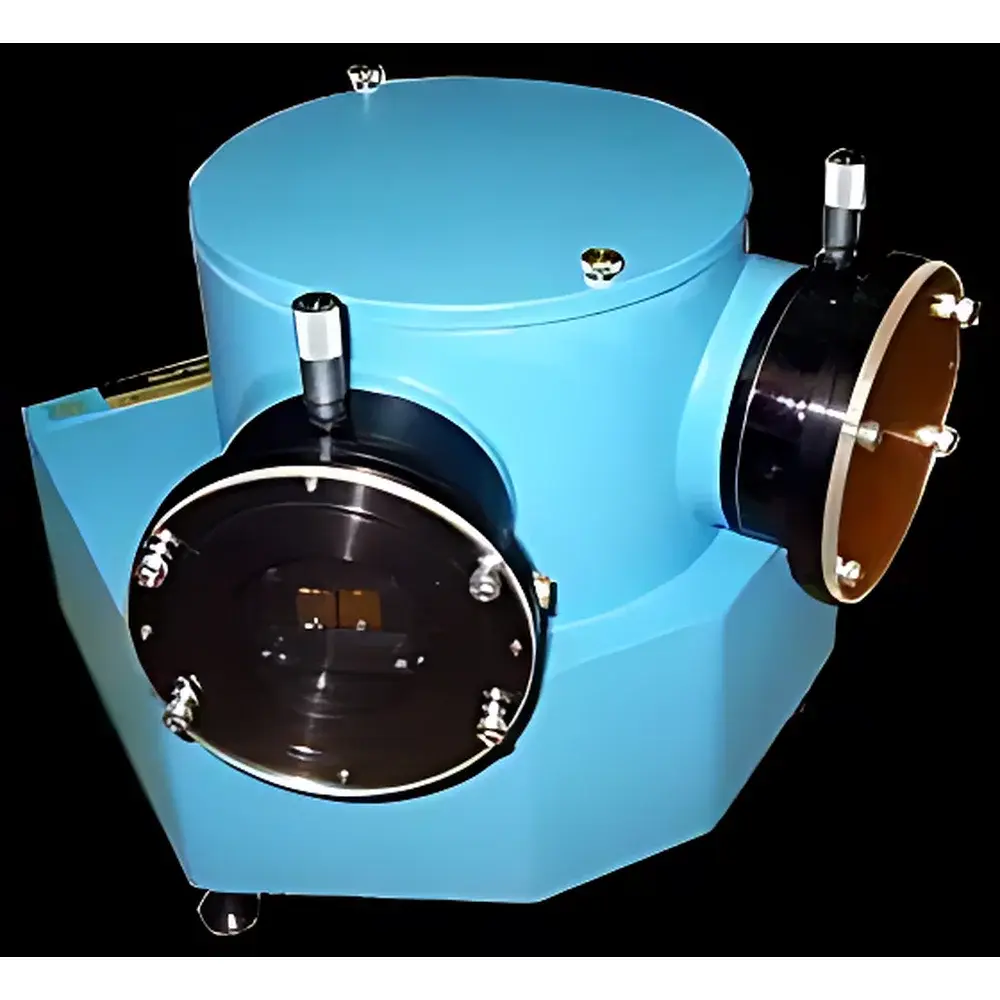
McPherson Model 234/302 Vacuum Ultraviolet Monochromator
| Brand | McPherson |
|---|---|
| Origin | USA |
| Manufacturer Type | Authorized Distributor |
| Origin Category | Imported |
| Model | Model 234/302 |
| Pricing | Upon Request |
| Focal Length | 200 mm |
| Optical Design | Modified Seya-Namioka |
| f/# | 4.5 |
| Grating Size | 40 × 45 mm |
| Wavelength Accuracy | ±0.10 nm (with 1200 g/mm grating) |
| Wavelength Repeatability | ±0.05 nm (with 1200 g/mm grating) |
| Slit-to-Slit Working Distance | 229 mm |
| Input/Output Beam Angle | 64° or 180° selectable |
| Focal Plane Width | 25 mm |
| Focal Plane Tilt | ~30° |
| Grating Options | 300–2400 g/mm |
| Resolution @ 313.1 nm | 0.06–0.3 nm (dependent on grating) |
| Reciprocal Linear Dispersion | 2–816 nm/mm |
| Detector Interface | CCD or MCP imaging array |
| Vacuum Compatibility | Standard UHV option (10⁻¹⁰ Torr with all-metal seals) |
| Residual Gas Analysis | Performed pre-shipment |
Overview
The McPherson Model 234/302 is a compact, high-performance vacuum ultraviolet (VUV) monochromator engineered for precision spectral isolation and imaging in the 30–2200 nm range—extending deep into the VUV region where atmospheric absorption necessitates operation under high or ultra-high vacuum (UHV). Its optical architecture is based on a modified Seya-Namioka configuration, optimized to minimize aberrations across the focal plane while maintaining mechanical simplicity and thermal stability. Unlike conventional Czerny-Turner designs, the Model 234/302 employs a single concave, aberration-corrected holographic grating (standard: 1200 g/mm, IV-type) that simultaneously collimates, disperses, and focuses light—eliminating the need for auxiliary mirrors and reducing scattering losses. This monolithic optical path ensures high throughput (f/4.5), excellent stray-light suppression (<10⁻⁶), and intrinsic compatibility with double-monochromator configurations for enhanced spectral purity. The instrument is designed for direct integration onto vacuum chambers—such as plasma sources, synchrotron beamlines, or laser harmonic generation setups—supporting both scanning spectroscopy and static spectral imaging modes.
Key Features
- Aberration-corrected concave grating optics enabling diffraction-limited performance across a 25-mm-wide tilted focal plane (~30° from normal)
- Modular configuration: operates as a scanning monochromator, fixed-wavelength bandpass filter, or imaging spectrometer when coupled to back-illuminated CCDs or microchannel plate (MCP) detectors
- Dual-beam-angle geometry (64° or 180°) accommodates diverse vacuum chamber layouts and optical access constraints
- UHV-ready construction with optional all-metal sealing (CF-63 or CF-100 flanges), achieving base pressures down to 10⁻¹⁰ Torr; residual gas analysis (RGA) certified prior to shipment
- Precision wavelength control via McPherson Model 789A-3 digital stepper motor drive, delivering ±0.05 nm repeatability and ±0.10 nm absolute accuracy (with 1200 g/mm grating)
- Multi-grating compatibility (300–2400 g/mm) enables application-specific resolution and dispersion trade-offs—e.g., 0.06 nm resolution at 313.1 nm with 2400 g/mm, or broad-band coverage to 2.2 µm with 300 g/mm
- Compact footprint (330 × 330 × 254 mm) and low mass (11.3 kg) facilitate mounting on movable stages or integration into multi-instrument end stations
Sample Compatibility & Compliance
The Model 234/302 is intrinsically compatible with samples requiring VUV excitation or emission analysis—including dielectric barrier discharges, laser-produced plasmas, synchrotron-radiation-excited phosphors, and high-harmonic-generation (HHG) sources. Its all-stainless-steel, oxygen-free copper gasketed vacuum housing meets ASTM E595 outgassing requirements for space-qualified instrumentation and complies with ISO 10110-7 surface quality standards for optical components. When configured as a double monochromator (Model 234/302 + 234/302 or paired with Model 234/304), it satisfies stringent stray-light specifications required for fluorescence quantum yield measurements per ISO 17025-accredited laboratories. The system supports GLP/GMP-compliant operation when integrated with validated motion control firmware and audit-trail-enabled software (see Software & Data Management).
Software & Data Management
Instrument control is implemented via McPherson’s SpectraMagic™ software suite (Windows 10/11, 64-bit), which provides deterministic grating positioning, automated slit-width calibration, and real-time wavelength-to-pixel mapping for imaging detectors. The API supports LabVIEW, MATLAB, and Python (PyVISA) integration, enabling custom experiment sequencing—including synchronized plasma triggering, time-resolved spectral acquisition, and multi-channel detector readout. All motor position logs, vacuum pressure timestamps, and detector gain settings are embedded in HDF5-formatted data files, ensuring full traceability for FDA 21 CFR Part 11 compliance when paired with electronic signature modules. Firmware updates preserve backward compatibility with legacy grating encoders and shutter controllers, minimizing revalidation effort in regulated environments.
Applications
- Vacuum ultraviolet spectroscopy of atomic and molecular resonance lines (e.g., He I at 58.4 nm, H Lyman-α at 121.6 nm)
- Plasma diagnostics in fusion research and industrial plasma processing (electron temperature and density profiling via line-ratio analysis)
- Characterization of VUV-transparent optical materials (MgF₂, LiF, CaF₂) and reflective coatings (Ir, Pt, SiC)
- Time-resolved photoluminescence studies of wide-bandgap semiconductors (AlN, BN, diamond) and scintillator materials
- High-order harmonic spectroscopy (HHG) up to the 30th order in gas-phase targets
- Beamline monochromation for synchrotron soft X-ray/VUV end stations requiring <0.1 nm resolution and <10⁻⁷ stray light
FAQ
What vacuum level is required for optimal VUV transmission below 120 nm?
Operation below 120 nm requires pressures ≤10⁻⁶ Torr to minimize O₂ and H₂O absorption; the UHV option (10⁻¹⁰ Torr) is recommended for long-term stability and reduced carbon contamination.
Can the Model 234/302 be used with a standard silicon CCD?
No—silicon CCDs exhibit negligible quantum efficiency below 115 nm. Deep-depletion, back-thinned CCDs with MgF₂ or LiF anti-reflection coatings—or MCP-intensified cameras—are required for VUV sensitivity.
Is double monochromation possible without external optical alignment?
Yes—the Model 234/302 supports mechanically coupled tandem operation using McPherson’s kinematic mounting interface, preserving co-alignment during simultaneous grating scans.
How is wavelength calibration performed and maintained?
Calibration uses NIST-traceable spectral lines (e.g., Ne, Ar, Kr hollow-cathode lamps); drift compensation is enabled via onboard reference photodiode monitoring of grating motor encoder steps.
Does the system support automated slit-width adjustment?
Slit widths are manually set but documented in SpectraMagic™; motorized slits (Model 234/302-SLIT-M) are available as an add-on option with full software integration.




