
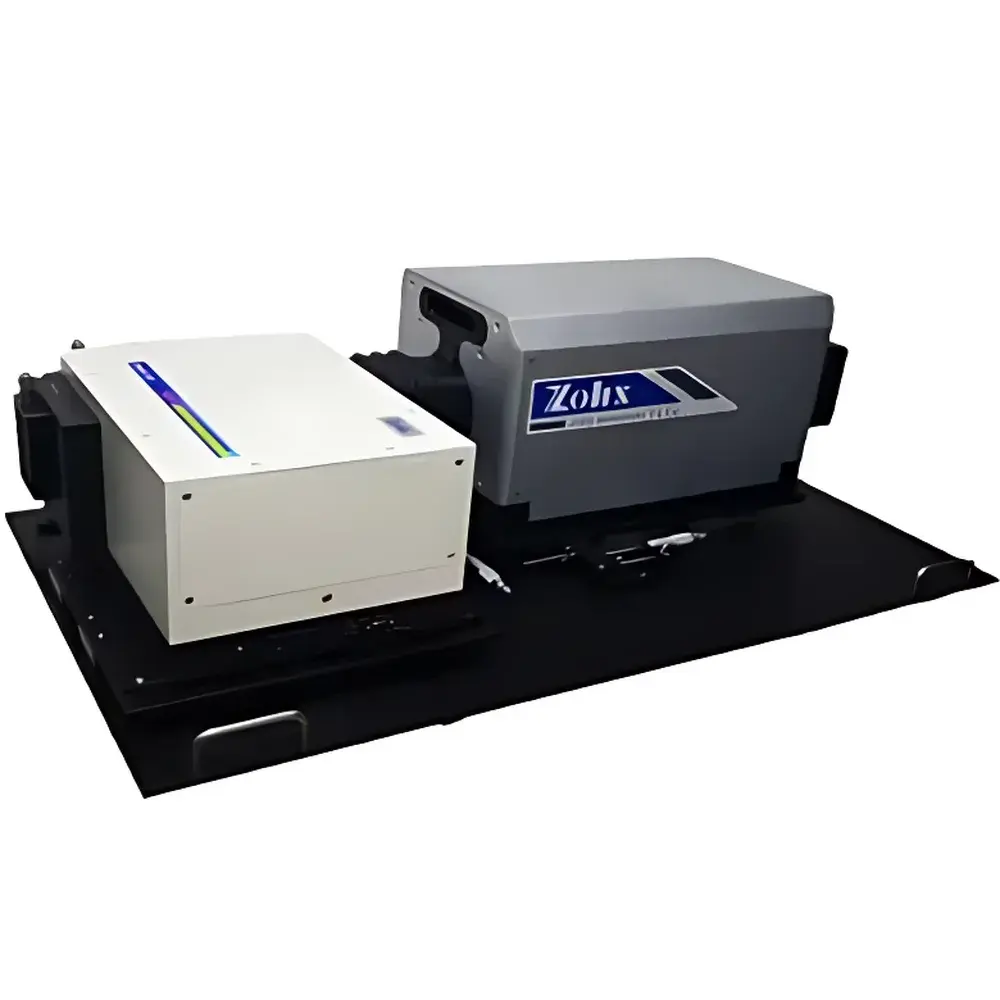
TEO ST10 Universal Streak Camera
| Brand | TEO |
|---|---|
| Origin | Beijing, China |
| Model | ST10 |
| Instrument Type | Synchronized Scanning Streak Camera |
| Photocathode Size | 12 mm |
| Temporal Resolution | ≤2 ps (at 400 fs sweep setting) |
| System Temporal Resolution (with spectrometer coupling) | ≤5 ps (in 500 ps time window) |
| Spectral Range | 200–900 nm |
| Spatial Resolution | >50 lp/mm |
| Scan Modes | Single-shot & High-frequency (up to 200 MHz) |
| Image Intensifier | 25 mm dual-MCP (MCP125), gain ≤1.0×10⁴ |
| Readout Sensor | Cooled scientific CMOS, 2048×2048 pixels, 6.5 µm pitch, 16-bit ADC, >90 dB dynamic range, -15 °C minimum cooling temperature |
| Coupling | Lens-coupled |
| Interface | USB 3.0 |
Overview
The TEO ST10 Universal Streak Camera is a synchronized scanning streak imaging system engineered for high-fidelity, single-shot temporal diagnostics of ultrafast optical transients. Based on the photochronographic principle—where incident photons liberate photoelectrons from a photocathode, which are then accelerated, deflected by a time-varying electric field across a stripline anode, and finally converted into visible light on a phosphor screen—the ST10 delivers simultaneous picosecond-scale temporal resolution and micron-level spatial fidelity. Its core measurement capability lies in capturing intensity-vs.-time-vs.-spatial-position waveforms of transient radiation events with sub-2 ps intrinsic time resolution (measured at 400 fs sweep speed), enabling direct observation of ultrafast photophysical, photochemical, and plasma emission dynamics. Designed explicitly for broad adoption in academic and industrial R&D laboratories—not just specialized ultrafast facilities—the ST10 integrates mature, commercially qualified components (including the Photochron-5 high-frequency streak tube) while maintaining rigorous metrological traceability and operational robustness.
Key Features
- Ultra-broad spectral response: Configurable photocathodes (S20, BK, S25) cover 200–900 nm (UV-VIS-NIR), supporting diverse excitation sources and emission targets.
- High temporal fidelity: ≤2 ps intrinsic streak tube resolution (at 400 fs sweep); system-level resolution ≤5 ps when integrated with calibrated spectrograph optics and timing electronics.
- Dual-scan architecture: Seamless switching between single-shot triggering (for stochastic or low-repetition-rate events) and high-frequency repetitive scanning (up to 200 MHz), eliminating trade-offs between event capture probability and time-base density.
- Enhanced signal detection: Dual-stage microchannel plate (MCP125) intensifier provides up to 10⁴ gain with P20 phosphor, optimized for low-light quantum efficiency (>90% at peak cathode response) and minimal spatial distortion.
- Cooled scientific readout: 2048×2048-pixel CMOS sensor with 6.5 µm pixel pitch, thermoelectric cooling to −15 °C, 16-bit digitization, and >90 dB dynamic range ensures high SNR across weak transient signals and bright background conditions.
- Modular optical interface: Standard lens-coupled input with manual slit adjustment (0–3 mm width, 10 µm precision), facilitating rapid alignment with microscopes, fiber outputs, or spectrometer entrance slits.
Sample Compatibility & Compliance
The ST10 interfaces natively with standard C-mount and F-mount optical trains, enabling direct integration into time-resolved fluorescence lifetime setups, transient absorption spectrometers, and ultrafast plasma diagnostics platforms. Its 12 mm effective photocathode length supports both narrow-line and broadband input geometries. The system complies with IEC 61000-6-3 (EMC emission limits) and IEC 61010-1 (safety requirements for laboratory equipment). While not certified for GMP/GLP environments out-of-the-box, its deterministic trigger latency (<1 ns jitter), hardware timestamping capability, and audit-ready software logging support validation under ISO/IEC 17025 and FDA 21 CFR Part 11 when deployed within controlled instrument qualification protocols.
Software & Data Management
The ST10 is operated via TEO StreakView—a native Windows application supporting full hardware control (scan voltage ramp, trigger delay, MCP gain, sensor exposure), real-time preview, and post-acquisition analysis. Key capabilities include: 3D spatiotemporal data visualization; arbitrary slice extraction along time, space, or wavelength axes; automated fluorescence decay curve fitting (mono-/bi-exponential models); spectral deconvolution using reference calibration files; and batch processing of multi-frame acquisitions. All raw frames retain embedded metadata (timestamp, sweep speed, gain setting, slit width), ensuring reproducibility and traceability. Export formats include HDF5 (for MATLAB/Python interoperability), TIFF (16-bit linear), and CSV (intensity vs. pixel index). Software updates follow a documented version-control policy compliant with NIST SP 800-53 Rev. 5 configuration management guidelines.
Applications
- Time-resolved photoluminescence (TRPL) of perovskite, quantum dot, and 2D semiconductor materials
- Ultrafast chemiluminescence and bioluminescence kinetics in catalytic and enzymatic reactions
- Plasma emission dynamics in laser-induced breakdown spectroscopy (LIBS) and pulsed discharge systems
- Transient absorption and time-resolved Raman spectroscopy with pump-probe synchronization
- Fluorescence lifetime imaging (FLIM) when coupled to confocal or widefield microscopes
- Characterization of ultrafast optoelectronic devices, including photodetectors, modulators, and single-photon emitters
- Thomson scattering diagnostics in laser-plasma interaction experiments
- Time-of-flight measurements in free-electron laser (FEL) beamlines and ultrafast X-ray pump–optical probe configurations
FAQ
What is the minimum measurable pulse duration supported by the ST10?
The ST10 achieves ≤2 ps intrinsic temporal resolution at its fastest sweep setting (400 fs), limited primarily by streak tube electron transit time spread and deflection circuit bandwidth. System-level resolution degrades to ≤5 ps when used with typical Czerny–Turner spectrographs due to optical dispersion and slit diffraction effects.
Can the ST10 be synchronized with external lasers operating at 1 kHz or 10 MHz repetition rates?
Yes—via TTL-compatible trigger input with <1 ns jitter tolerance. The internal scan generator supports programmable delay (0–10 ms, 1 ps resolution) and phase-locking to external clock signals up to 200 MHz.
Is vacuum maintenance required by the end user?
No—the ST10 incorporates a sealed, factory-evacuated streak tube with >10-year operational lifetime under normal lab conditions. No user-accessible vacuum ports or pumps are present.
Does the system support spectral calibration with NIST-traceable standards?
Yes—StreakView includes a dedicated spectral calibration module compatible with Hg/Ar lamp spectra and custom polynomial mapping. Calibration files are stored with each dataset to ensure spectral axis reproducibility across sessions.
What computing resources are required for real-time acquisition at full frame rate?
A host PC with Intel Core i7 (10th gen or newer), ≥32 GB RAM, and USB 3.2 Gen 2 (10 Gbps) interface is recommended. Full-resolution streaming (2048×2048 @ 40 fps) requires sustained write throughput >500 MB/s to NVMe storage.



