
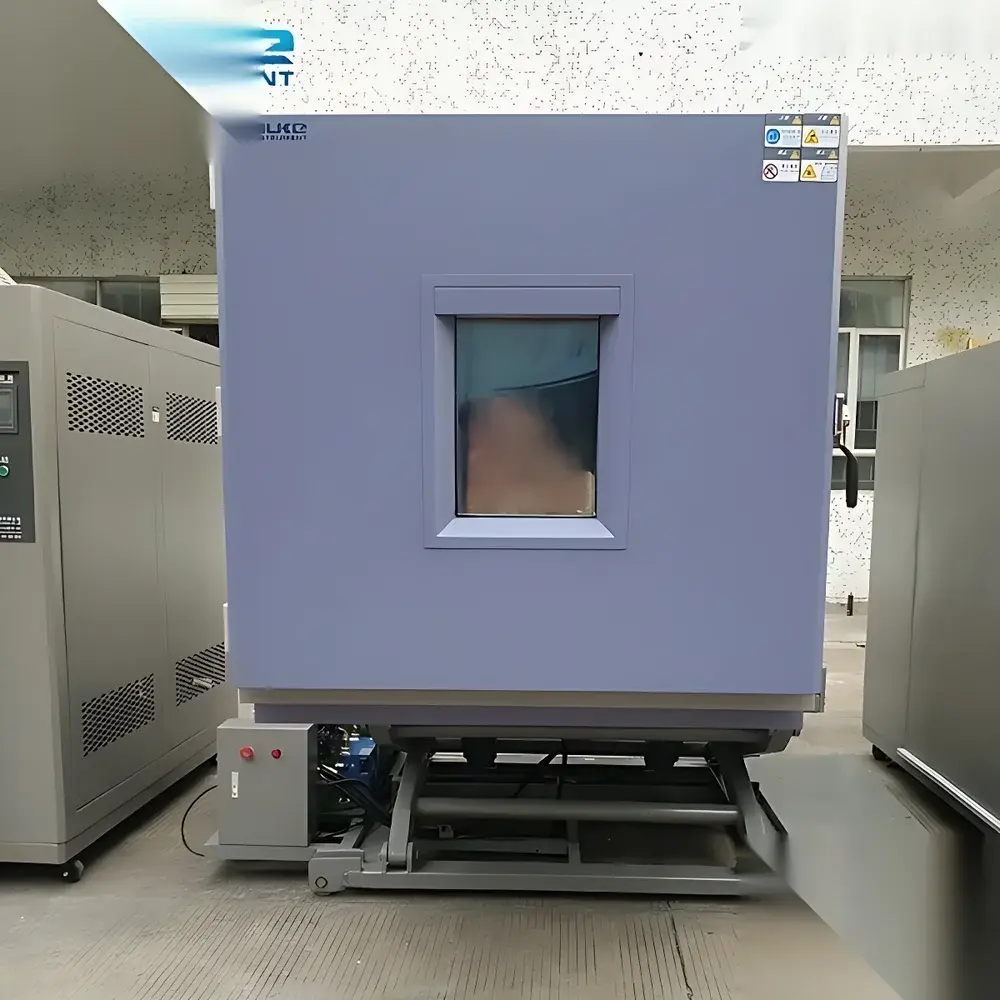
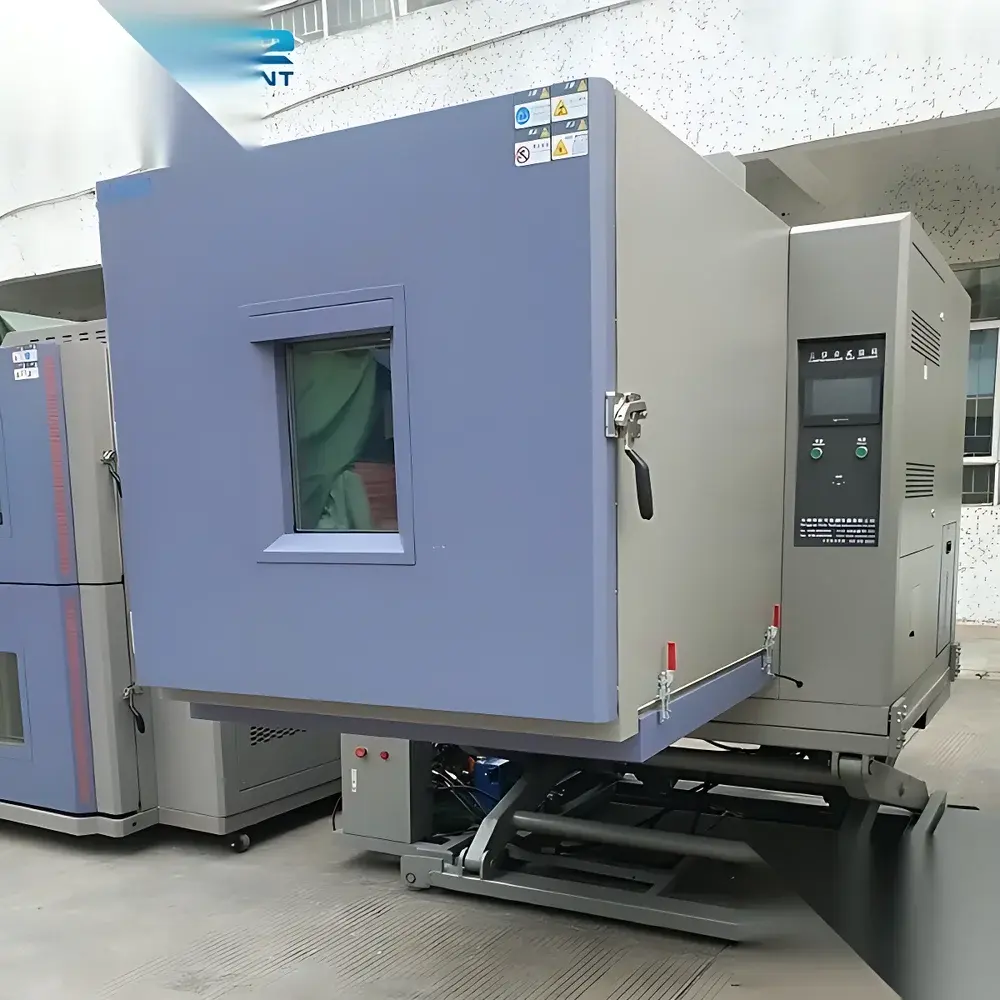
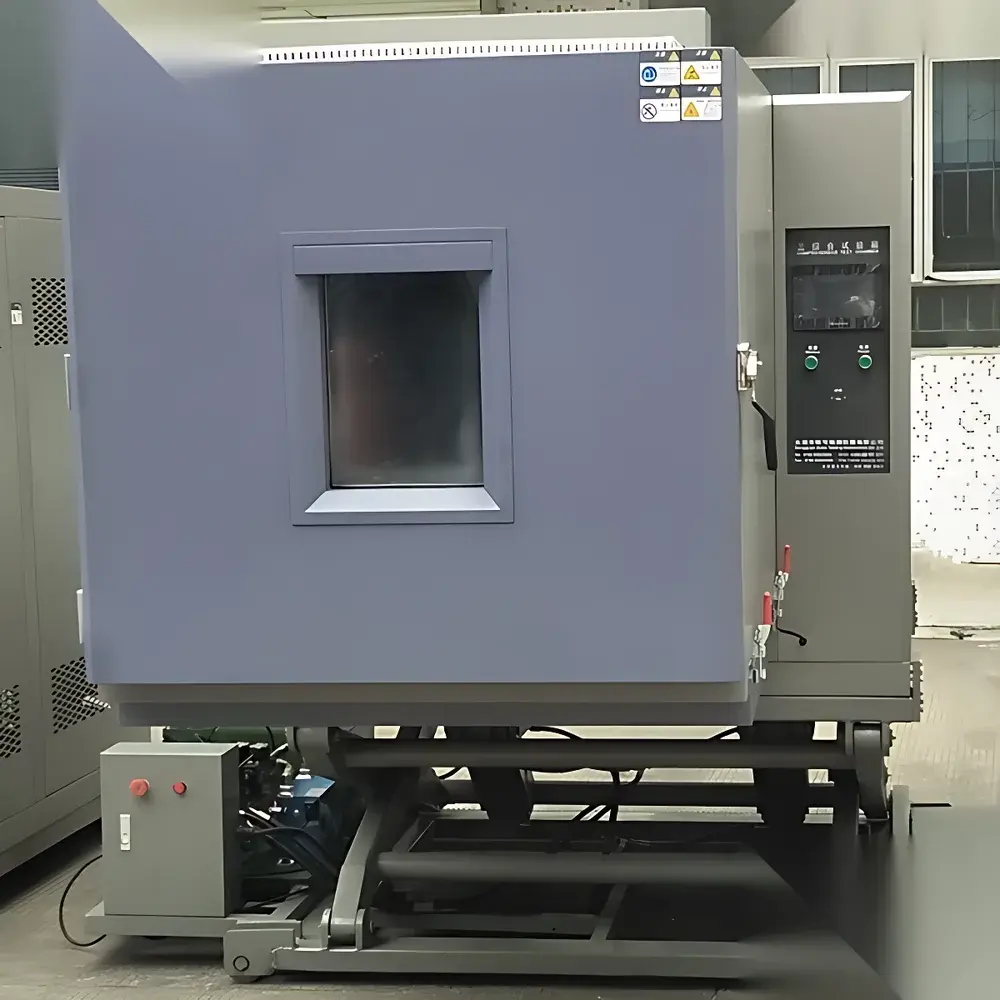
Combined Temperature-Humidity-Vibration Environmental Test Chamber – OEM/ODM Manufacturer
| Key | Table Size: 350 × 350 mm (customizable) |
|---|---|
| Max Load Capacity | 25 / 50 / 75 / 100 kg |
| Vibration Axis | Vertical, Horizontal, or Dual-Axis (selectable) |
| Frequency Range | 1–600 Hz / 1–3000 Hz / 1–5000 Hz |
| Peak-to-Peak Displacement | 0–5 mm (5 mm p-p) |
| Max Acceleration | <20 g |
| Frequency Resolution | 0.01 Hz, Accuracy: ±0.1 Hz |
| Power Supply | AC 220 V / 50 Hz or AC 380 V / 50 Hz |
| Compliance | GB/T 2423.10 |
| Operating Ambient | 15–35 °C, ≤85% RH, Non-corrosive, Low-EMI Environment |
Overview
The Combined Temperature-Humidity-Vibration Environmental Test Chamber is an integrated reliability validation platform engineered for accelerated life testing and structural integrity assessment of electro-mechanical systems under simultaneous thermal, hygroscopic, and dynamic mechanical stress conditions. Unlike sequential single-stress testing, this triaxial environmental chamber applies temperature cycling (typically −70 °C to +180 °C), controlled humidity (10–98% RH), and programmable sinusoidal vibration—either vertically, horizontally, or in dual-axis mode—within a single test cycle. Its design adheres to the physical principles of coupled stress interaction modeling, enabling realistic replication of field service environments encountered during transportation, installation, and operational use. The system is widely deployed in automotive Tier-1 supplier validation labs, aerospace component qualification facilities, and consumer electronics R&D centers where compliance with IEC 60068-2 series and GB/T 2423.10 (equivalent to IEC 60068-2-6 for vibration) is mandatory.
Key Features
- Modular vibration exciter assembly with electromagnetic shaker and closed-loop force feedback control, supporting frequency ranges up to 5 kHz and acceleration outputs up to 20 gpeak.
- Stainless-steel insulated chamber with double-wall construction, refrigeration via cascade compressor system, and steam-based humidification with PID-controlled saturation chamber.
- Programmable test profiles combining temperature ramp rates (0.5–10 °C/min), humidity dwell/sweep cycles, and synchronized vibration sequences—including sweep (logarithmic or linear), fixed-frequency dwell, and multi-step composite waveforms.
- Dual-axis vibration capability with independent motion control, ensuring orthogonal excitation alignment per ISO 10816-3 and ASTM D4728 requirements for transport simulation.
- Integrated safety architecture featuring real-time monitoring of overtemperature, overpressure, motor overload, grounding fault, short-circuit, and vibration amplitude deviation—with automatic power cutoff and audible alarm on threshold violation.
- Robust mechanical interface: standard 350 × 350 mm horizontal shaker table (customizable up to 600 × 600 mm), rated for static loads from 25 kg to 100 kg depending on configuration.
Sample Compatibility & Compliance
This chamber accommodates a broad spectrum of physical samples—from PCB assemblies and MEMS sensors to automotive ECUs, infotainment modules, and medical device enclosures—without requiring sample-specific fixtures beyond standard mounting adapters. All configurations meet essential national and international standards including GB/T 2423.10 (vibration), GB/T 2423.3 (humidity), GB/T 2423.2 (high/low temperature), and are compatible with test plan documentation required for ISO/IEC 17025-accredited laboratories. While not inherently FDA 21 CFR Part 11-compliant out-of-the-box, optional audit-trail-enabled controllers support GLP/GMP traceability when integrated with validated software platforms.
Software & Data Management
The system operates via a Windows-based HMI with embedded real-time controller running deterministic RTOS firmware. Test programs are authored using hierarchical script syntax supporting nested loops, conditional triggers, and time-synchronized parameter transitions. Raw vibration data (acceleration, displacement, velocity) is sampled at ≥20 kHz and logged alongside thermohygrometric readings at user-defined intervals (100 ms–10 s). Export formats include CSV, MATLAB (.mat), and UFF58—enabling post-processing in MATLAB, LabVIEW, or commercial FEA pre-processors. Optional Ethernet/IP or Modbus TCP interfaces allow integration into centralized MES or PLM environments for automated report generation and nonconformance tracking.
Applications
- Automotive: ECU solder joint fatigue validation, connector mating durability under thermal cycling + road-spectrum vibration.
- Aerospace: Avionics box shock response spectrum (SRS) verification per DO-160 Section 8.
- Consumer Electronics: Drop-test correlation studies using combined low-temperature storage followed by high-g impact simulation.
- Industrial IoT: Long-term reliability screening of battery-powered edge sensors exposed to warehouse-grade humidity swings and conveyor-induced vibration.
- Medical Devices: Verification of sterilization-resistant housing integrity after repeated autoclave cycles plus simulated ambulance transport vibration.
FAQ
What ambient conditions are required for safe and accurate operation?
The chamber must be installed in a climate-controlled room maintained between 15–35 °C with relative humidity ≤85% RH, free from strong electromagnetic fields, corrosive vapors, direct solar radiation, and unshielded airflow across the cabinet surface.
Can the system perform random vibration testing?
No—this model supports only sinusoidal waveform generation, including swept-sine, stepped-sine, and fixed-frequency modes. Random vibration capability requires a separate controller and shaker upgrade path.
Is remote monitoring supported?
Yes—via optional Ethernet connectivity and secure HTTPS web interface, enabling real-time status viewing, alarm notification via SMTP/SNMP, and limited parameter adjustment without local HMI access.
What maintenance intervals are recommended?
Compressor oil and refrigerant levels should be verified annually; vibration shaker armature alignment and suspension compliance checks are advised every 2,000 operating hours or per manufacturer’s calibration schedule.
Does the system include calibration certification?
A factory-as-built calibration report (covering temperature uniformity, humidity accuracy, and vibration amplitude linearity) is supplied with each unit; ISO/IEC 17025-accredited third-party calibration is available as a value-added service.



